Skip to main content Skip to footer
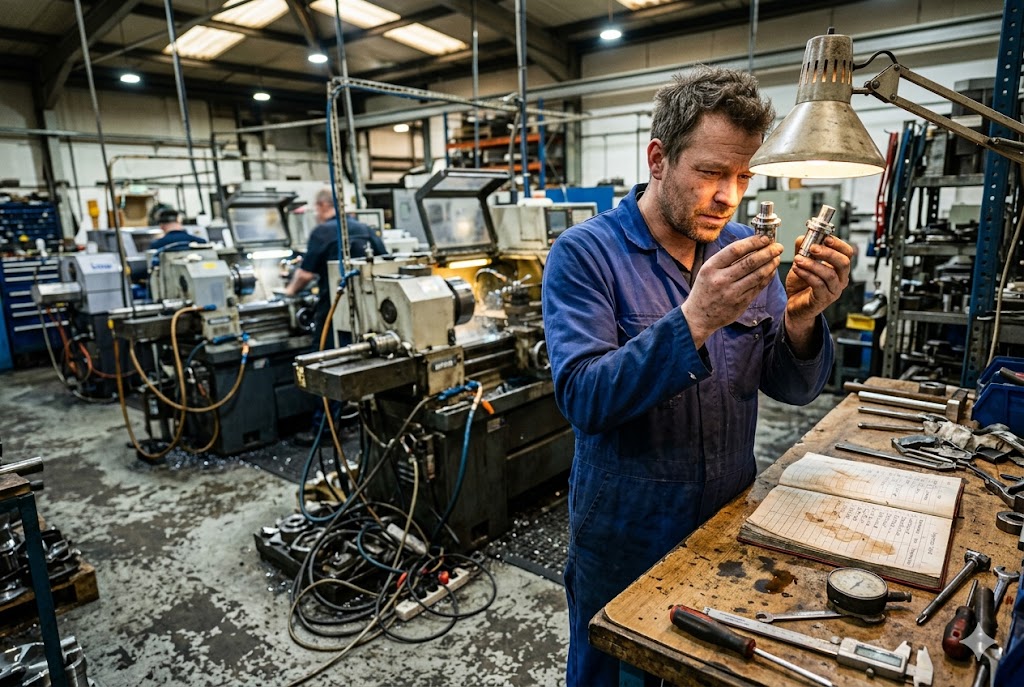
Buyers often request "stainless steel" without specifying a grade — and that single omission can lead to parts that corrode in weeks or cost twice as much to machine.
303 and 316L stainless steel serve different purposes. 303 contains sulfur for faster, cheaper machining but corrodes more easily. 316L contains molybdenum for superior resistance to chlorides and pitting, making it essential in marine, medical, and chemical environments despite its higher machining cost.
Choosing the wrong grade wastes money. The sections below explain exactly when each material fits — and when it does not.
When Should I Choose 316L Over 303 Stainless Steel for Swiss-Turned Parts in Corrosive Environments?
Parts that look identical on a drawing can fail completely differently in the field, depending on the environment they live in.
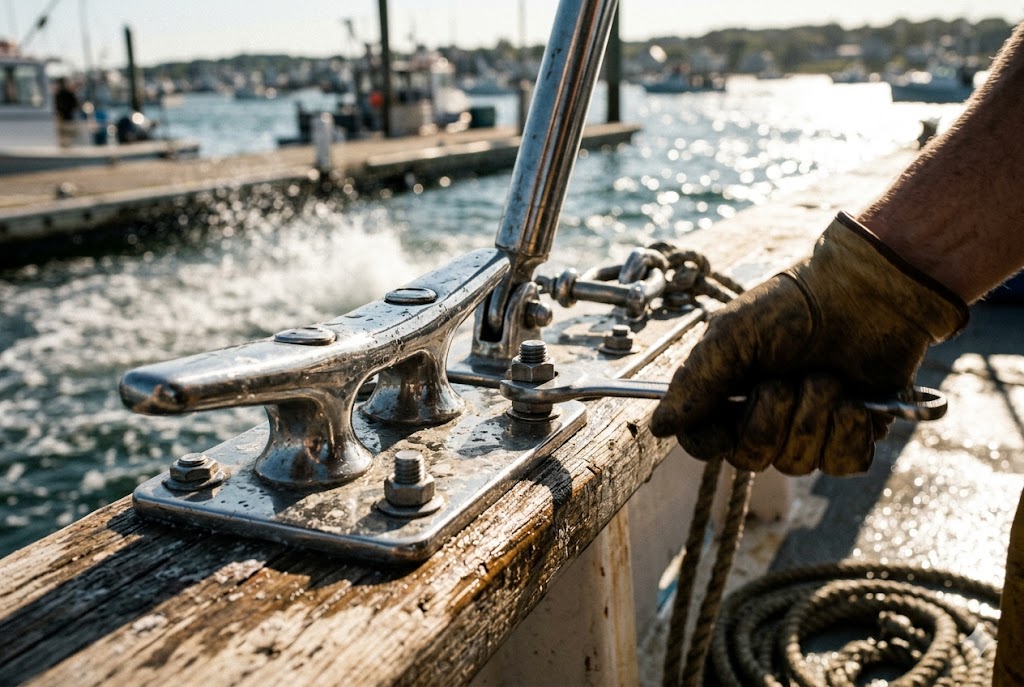
Choose 316L when parts contact saltwater, chlorides, acids, or body fluids. Its 2–3% molybdenum content blocks pitting and crevice corrosion that 303 cannot resist. For marine hardware, medical implants, food-contact fittings, and chemical processing components, 316L is the only safe choice 1 in the 300-series austenitic family.
Why Molybdenum Changes Everything
316L's defining element is molybdenum, present at 2–3% by weight. This element is completely absent in 303. Molybdenum strengthens the passive oxide film on the steel surface, creating a barrier that resists chloride ions — the primary cause of pitting corrosion in stainless steel.
Pitting resistance is quantified by the Pitting Resistance Equivalent Number (PREN) 2:
PREN = %Cr + 3.3 × %Mo + 16 × %N
| Grade | Typical Cr (%) | Typical Mo (%) | Typical N (%) | PREN |
|---|---|---|---|---|
| 303 | 17–19 | 0 | ≤0.11 | ~17–19 |
| 316L | 16–18 | 2–3 | ≤0.10 | ~24–26 |
A PREN below 20 is generally considered unsuitable for chloride-bearing environments. 303 rarely clears that threshold. 316L comfortably exceeds it.
We always specify a minimum PREN of 24 on drawings for 316L parts intended for saltwater or chemical service. Mill test reports must confirm this value. This is a contractually enforceable way to prevent suppliers from quietly substituting 304 or even 303 and claiming equivalency.
Environments Where 303 Will Fail Prematurely
303 is not suitable for:
- Seawater or brackish water immersion
- Regular contact with chloride-based cleaning agents
- Food processing lines using saline or acidic wash cycles
- Medical devices exposed to body fluids or repeated autoclaving with chloride solutions
- Chemical processing equipment handling acids or halogens
In these environments, the sulfide inclusions in 303 — the same inclusions that make it so easy to machine — create micro-galvanic sites on the surface. Chloride ions attack these sites first. Pits initiate, grow, and eventually undercut the part structure.
Regulatory Contexts That Mandate 316L
For medical devices, FDA 21 CFR and EU 1935/2004 (food contact materials) effectively exclude 303. Sulfide inclusions can leach under sterilization protocols such as repeated autoclaving with chloride solutions. This creates contamination risk that regulators will not accept. If a drawing calls for parts that touch food or go inside a human body, 316L is the mandatory grade. Specifying anything else creates liability.
The Low-Carbon Advantage of 316L
316L differs from standard 316 in one critical way: carbon content. Standard 316 allows up to 0.08% carbon. 316L caps it at 0.03%. This matters for welding. At elevated temperatures, carbon combines with chromium to form chromium carbides at grain boundaries — a process called sensitization. Sensitized zones lose corrosion resistance and become vulnerable to intergranular attack 3.
316L eliminates this risk. Verifying that a bar is truly 316L — not standard 316 or 304 — requires combustion analysis per ASTM E1019 4 to measure carbon content directly; XRF alone cannot make this distinction. 303, by contrast, is categorically not weldable. Its sulfur content causes hot cracking in the weld zone. If downstream fabrication includes any welding, 316L is the only viable choice.
How Does 303 Stainless Steel's Sulfur Content Improve Machinability on Swiss-Type Lathes?
Our machinists notice the difference between 303 and 316L within the first few parts of a new run — tool life, chip behavior, and cycle time all shift.
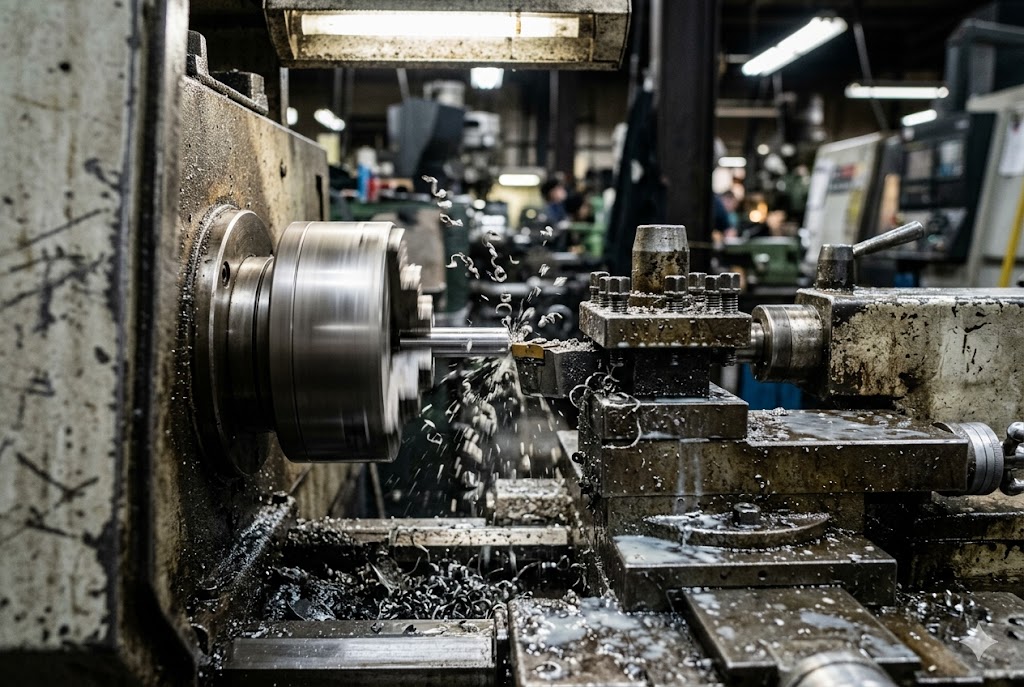
303 stainless steel contains a minimum of 0.15% sulfur by design. Sulfur forms manganese sulfide inclusions 5 that act as built-in chip-breakers during cutting. These inclusions reduce cutting forces, lower tool wear, and allow higher speeds and feeds — making 303 the most machinable grade in the entire 300-series austenitic family.
How Sulfide Inclusions Work at the Cutting Zone
When a carbide or ceramic cutting tool contacts 303 bar stock, it encounters a matrix of fine manganese sulfide (MnS) particles distributed throughout the metal. These particles have two important properties: they are softer than the surrounding steel matrix, and they act as stress concentrators.
Under cutting loads, chips initiate and break at the MnS particles rather than forming long, stringy ribbons. Short chips clear the cutting zone cleanly. This prevents chip packing in the tool gullets and reduces the risk of surface scratches on finished parts — both critical concerns on Swiss-type lathes running at tight positional tolerances.
| Property | 303 SS | 316L SS |
|---|---|---|
| Min. sulfur content | 0.15% | ≤0.03% |
| Machinability rating (free-machining baseline = 100%) | ~78% | ~45–50% |
| Recommended cutting speed (carbide insert, external turning) | 180–250 SFM | 100–150 SFM |
| Chip form | Short, curled | Long, stringy |
| Tool life (relative) | High | Moderate to low |
Swiss-Type Lathes and the Case for 303
Swiss-type CNC lathes 6 — Star, Citizen, Tsugami — are engineered for high-volume production of small-diameter, close-tolerance parts. Bar stock feeds through a guide bushing and is supported very close to the cutting tool. This setup minimizes deflection. The machine delivers precision. But it relies on predictable chip behavior.
303 delivers that predictability. Chips break cleanly, clear the guide bushing zone, and do not wrap around small-diameter tools or workpieces. Cycle times drop. Tool changes happen less often. In high-volume production of fasteners, bushings, pins, shafts, and fittings — where corrosion exposure is limited — 303 is the economically correct default.
The Cost Difference Is Real
The per-part cost difference between 303 and 316L is not trivial, especially at volume. Consider the combined effect:
- Raw material cost: 316L bar stock typically costs 20–35% more than 303 per kilogram due to its molybdenum content.
- Cycle time: 303 allows speeds and feeds up to 40–60% faster than 316L. That translates directly to machine hours saved.
- Tooling: 316L work-hardens more aggressively, consuming inserts faster. Tooling cost per part increases significantly.
For a part running at 10,000 units per year, choosing 303 where corrosion resistance is not critical is a meaningful cost decision — not just a material specification preference.
A Risk to Watch: Inclusion Banding in Chinese Bar Stock
The sulfide inclusions in 303 are not always uniformly distributed. In large-diameter bar or heavily cold-drawn material, inclusions can align into bands along the rolling direction. This creates anisotropy — the material behaves differently in transverse versus longitudinal directions, affecting both corrosion initiation sites and mechanical properties.
This risk increases when bar stock comes from suppliers of uncertain provenance. We require incoming PMI/OES verification of sulfur content on every new heat of 303 bar stock. If sulfur content is below spec, machinability drops and the reason for choosing 303 disappears.
Can 316L Stainless Steel Hold the Same Tight Tolerances as 303 on a Swiss-Type Lathe?
When a client sends a drawing with ±0.005 mm tolerances and specifies 316L, the first question from our process team is always about tool strategy and work-hardening management.
316L can achieve the same tight tolerances as 303 on a Swiss-type lathe, but only with the correct process setup. Because 316L work-hardens more aggressively, toolpath strategy must maintain consistent chip load, use sharp carbide tooling, and avoid rubbing passes that trigger surface hardening ahead of the cutting edge.
Understanding Work-Hardening in 316L
316L is an austenitic stainless steel. Like all austenitic grades, it work-hardens through a mechanism called strain-induced martensitic transformation 7. When the material deforms plastically under cutting loads, the austenite structure partially transforms into a harder phase. This hardened zone forms directly in front of the advancing cutting edge.
If the tool dwells, rubs, or takes an insufficient chip load — even briefly — it encounters a surface that is harder than the bulk material. The tool wears faster. Dimensional deviation increases. On a Swiss-type lathe making parts to ±0.005 mm, this deviation can push a feature out of tolerance before the operator sees it.
Tooling and Process Parameters That Matter
| Parameter | 303 SS Setup | 316L SS Setup |
|---|---|---|
| Insert geometry | Standard positive rake | High positive rake, sharp edge |
| Coating | TiN or uncoated acceptable | TiAlN or PVD preferred |
| Cutting speed | 180–250 SFM | 100–150 SFM |
| Chip load (feed per rev) | Standard | Maintain consistent; never reduce below min threshold |
| Coolant | Soluble oil, moderate pressure | High-pressure coolant preferred |
| Dwell passes | Acceptable | Avoid entirely |
Sharp tooling is non-negotiable with 316L. A worn insert that would still hold tolerance on 303 will cause work-hardening runaway on 316L. We schedule insert changes at fixed intervals during 316L production runs rather than running to failure — a practice that increases tooling cost but protects dimensional consistency.
Tolerances Achievable With Proper Setup
With a properly maintained Swiss-type lathe (Star SV-20, Citizen L20, or equivalent), rigid fixturing, and the tooling strategy above, 316L can hold:
- Outer diameter: ±0.005 mm
- Inner diameter (bored feature): ±0.008 mm
- Length: ±0.01 mm
- Concentricity/runout: ≤0.005 mm TIR
These numbers match what 303 can achieve under similar conditions. The difference is not the achievable tolerance — it is the process discipline required to get there consistently across a production batch.
In-Process Monitoring for 316L Runs
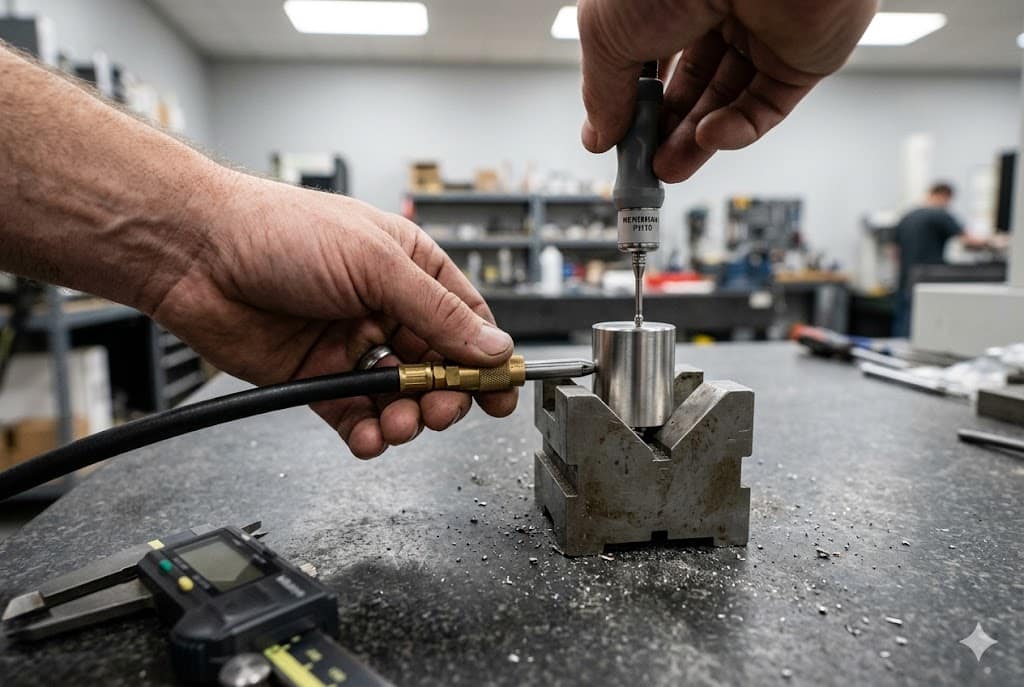
Because 316L is less forgiving, we run more frequent in-process checks on 316L batches than on 303. Dimensional verification on critical features happens every 20–30 pieces on 316L runs versus every 50–100 on 303. We use air gauging for bore diameters and a contact CMM probe for critical shaft diameters.
If drift exceeds 30% of the tolerance band during a run, we stop, inspect tooling, and reset before continuing. This is a process discipline issue, not a material capability issue. 316L can hold tight tolerances — but it will not forgive a lazy process.
What Surface Treatment Enhances Corrosion Resistance of 303 Stainless Steel Swiss CNC Parts?
Even when 303 is the right grade for a part, clients sometimes ask whether a surface treatment can close the gap with 316L in mild corrosive environments.
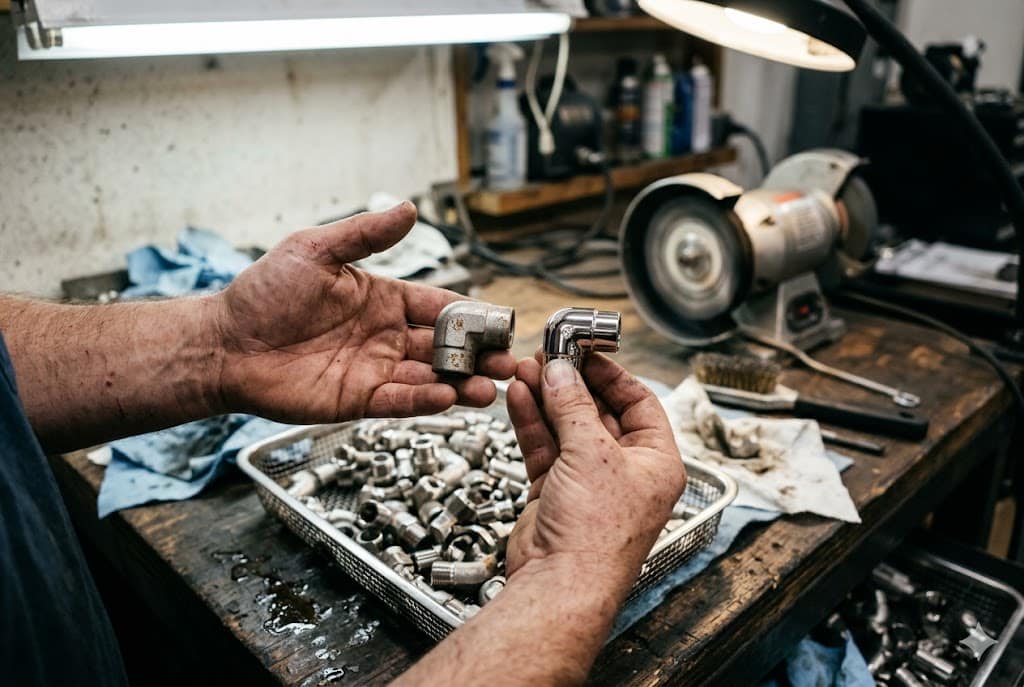
Passivation is the primary surface treatment for 303 stainless steel CNC parts. It removes free iron and sulfide residues using nitric or citric acid, thickening the native chromium oxide film. Passivation improves 303 performance in mild environments but does not replicate 316L's molybdenum-driven resistance to chlorides.
What Passivation Does — and What It Does Not Do
Machining exposes free iron from cutting tool contact, smeared surface layers, and partially exposed MnS inclusions. Free iron corrodes rapidly and creates rust staining even on stainless steel — a common complaint with 303 parts that were not passivated after machining.
Passivation removes this contaminated surface layer. The process involves immersing parts in a dilute acid bath — typically 20–25% nitric acid per ASTM A967 8 / AMS 2700, or citric acid per ASTM A967 Method C2. After immersion and rinse, the chromium in the steel surface spontaneously forms a denser, more uniform chromium oxide film.
| Passivation Standard | Acid Type | Concentration | Temperature | Immersion Time |
|---|---|---|---|---|
| ASTM A967 Method N1 | Nitric acid | 20–45% | 20–30°C | 20–30 min |
| ASTM A967 Method C2 | Citric acid | 4–10% | 21–49°C | 4–10 min |
| AMS 2700 Method 1 | Nitric acid | 20–25% | 25°C | 20 min min |
Citric acid passivation is increasingly preferred in export production because it is safer to handle, generates less hazardous waste, and produces equivalent salt spray performance on 300-series austenitic grades.
Other Surface Treatments for 303 Parts
Beyond passivation, several other coatings and treatments are applied to 303 Swiss-turned parts, depending on the application.
Electropolishing 9 smooths the surface at a microscopic level by removing peaks and valleys through electrochemical dissolution. It removes MnS inclusions from the immediate surface layer more aggressively than acid passivation. The result is a cleaner, shinier surface with improved corrosion resistance. Electropolishing is common for 303 parts going into food equipment or cleanroom environments, though it still does not make 303 equivalent to 316L in heavy chloride service.
PVD Coatings (TiN, TiCN, CrN) add a hard, chemically inert ceramic layer to the surface. These are typically applied for wear resistance rather than corrosion resistance — common on precision pins, shafts, and fittings subject to sliding contact. PVD coatings do not meaningfully improve corrosion resistance on 303 in wet chloride environments.
Electroless Nickel Plating (ENP) deposits a uniform nickel-phosphorus layer that provides good corrosion resistance and a hard surface. ENP is useful where both corrosion protection and dimensional precision matter, as the coating deposits uniformly on complex geometries including bores and threads. However, ENP adds cost and introduces a process step that must be controlled for thickness and adhesion.
When Surface Treatment Is Not Enough
No surface treatment makes 303 suitable for marine immersion 10, chemical processing with chlorides, or medical device sterilization. If parts will see these environments regularly, the correct answer is to change the base material to 316L — not to add a coating to 303.
We tell clients directly: passivation on 303 is a quality finishing step, not a corrosion resistance upgrade strategy. If the application requires genuine chloride resistance, specify 316L from the start.
Conclusion
303 and 316L are not interchangeable. 303 machines faster and costs less — the right choice where corrosion exposure is mild. 316L costs more to machine but holds in environments where 303 fails. Match the grade to the environment, verify the material, and finish correctly.
Footnotes
1. Overview of SAE 316L stainless steel composition, corrosion resistance, and typical applications. ↩︎
2. Explains the PREN formula used to rank stainless steel grades by resistance to pitting in chloride environments. ↩︎
3. Describes intergranular corrosion and the sensitization mechanism caused by chromium carbide precipitation at grain boundaries. ↩︎
4. ASTM E1019 standard test methods for carbon determination in steel by combustion analysis. ↩︎
5. Explains how manganese sulfide inclusions in free-machining steels act as chip-breakers to improve machinability. ↩︎
6. Describes Swiss-style lathe mechanics, guide bushing support, and suitability for small-diameter close-tolerance parts. ↩︎
7. Covers martensite formation and strain-induced martensitic transformation in austenitic steels during deformation. ↩︎
8. Comprehensive overview of ASTM A967 chemical passivation methods for stainless steel using nitric and citric acid. ↩︎
9. Describes the electropolishing process, how it smooths and passivates stainless steel surfaces for improved corrosion resistance. ↩︎
10. Covers marine grade stainless steel requirements, chloride resistance thresholds, and why 316L is the minimum coastal grade. ↩︎