Skip to main content Skip to footer
Every time we onboard a new client in North America, they ask us the same question: how many parts can your factory actually make? It sounds simple. But after years of sourcing Swiss CNC work 1 across Guangdong and Zhejiang, we know the answer is never a single number — and suppliers who give you one without asking about your part are guessing.
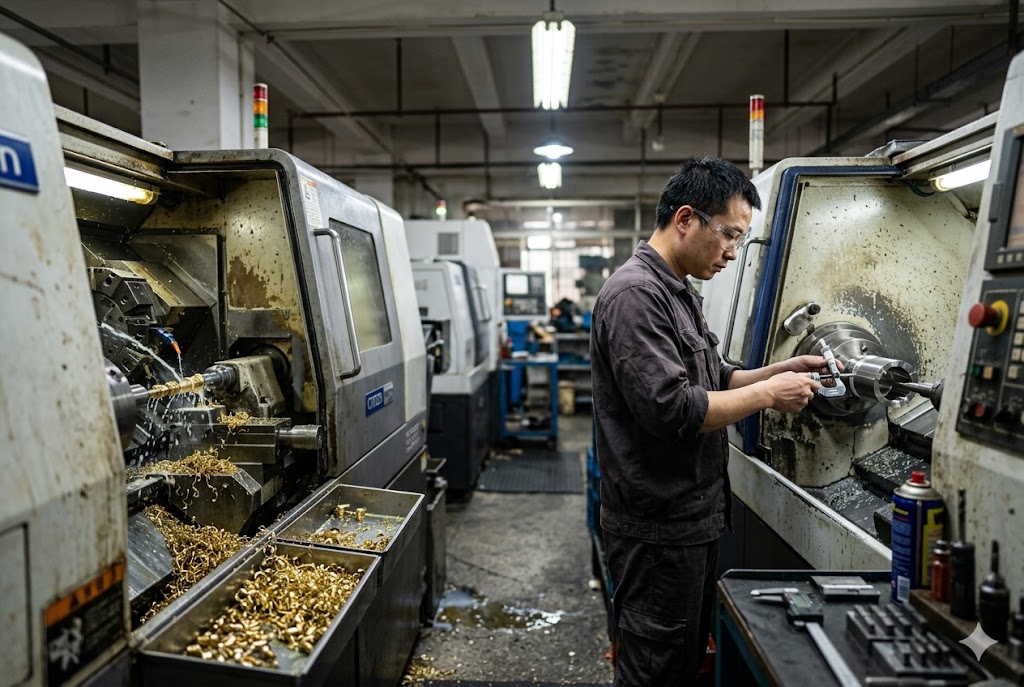
There is no single maximum monthly output figure for Swiss CNC machined parts at a Chinese factory. Capacity depends on four variables: machine count, cycle time per part, shift pattern, and uptime rate. A factory running 10 Swiss lathes on 15-second cycles 24/7 produces a fundamentally different monthly volume than one running identical machines on 3-minute cycles across two shifts.
So before you request a capacity statement from any supplier, you need to understand how those four variables interact — and what questions to ask.
How Do I Calculate Whether a Factory's Capacity Is Sufficient for My Annual Purchase Volume?
When we help clients evaluate a factory's Swiss machining capacity, the first thing we do is request two numbers: the machine count and the cycle time for our specific part.
To calculate whether a factory can handle your annual volume, divide your annual requirement by 12 to get monthly demand, then compare it to the factory's realistic monthly output per machine — which is cycle time converted to an hourly rate, multiplied by shift hours and uptime percentage. A factory with 10 Swiss lathes running 45-second cycles at 85% uptime on two shifts produces roughly 204,000 parts per month.
The Capacity Formula, Step by Step
The math is straightforward once you have the right inputs. Here is the structure:
- Parts per hour per machine = 3,600 seconds ÷ cycle time (seconds)
- Hours per month per machine = daily shift hours × operating days × uptime %
- Monthly output per machine = Parts per hour × Hours per month
- Total factory monthly output = Monthly output per machine × machine count
Let's run a realistic example. Your part is a stainless steel sensor housing at 20mm diameter with a 60-second cycle time 2. The factory operates two 8-hour shifts, 26 working days per month, at 80% uptime.
- Parts per hour: 3,600 ÷ 60 = 60 parts/hour
- Shift hours per month: 16 hours × 26 days = 416 hours
- Adjusted for uptime: 416 × 0.80 = 332.8 hours
- Monthly output per machine: 60 × 332.8 = 19,968 parts
- With 15 machines: 15 × 19,968 = ~299,520 parts/month
That is a very different number from what a factory might quote you off the top of their head.
Uptime Rates Vary by Material and Part Complexity
This is where the numbers diverge across factory tiers. Real-world utilization on Chinese Swiss lathe lines is not uniform. Uptime rate is best understood through the lens of overall equipment effectiveness 3, which combines availability, performance, and quality into a single productivity measure.
| Material / Part Type | Typical Uptime Rate | Key Reason for Variance |
|---|---|---|
| Brass connector pins, simple geometry | 85–92% | Free-machining material, long uninterrupted runs |
| Aluminum structural parts | 83–90% | Good chip evacuation, moderate tool life |
| Stainless steel sensor housings | 75–82% | Higher tool change frequency, in-process checks |
| Titanium medical implant components | 70–78% | Frequent inspection, slower feed rates |
Cycle Time Range Across Common Part Types
Cycle time is the single most powerful variable in this calculation. It swings by a factor of more than 25:1 across the range of parts that Chinese Swiss shops produce.
| Part Description | Diameter | Material | Typical Cycle Time | Parts/Hour/Machine |
|---|---|---|---|---|
| Simple screw or connector pin | ≤8mm | Brass | 8–15 sec | 240–450 |
| Automotive sensor housing | ~20mm | Stainless | 45–90 sec | 40–80 |
| Multi-feature industrial shaft | ~25mm | Alloy steel | 90–180 sec | 20–40 |
| Medical implant with B-axis milling | ~32mm | Titanium 4 | 3–8 min | 7–20 |
The gap between the fastest and slowest production scenarios is approximately 25:1. This is why asking "what is your monthly capacity" without specifying your part returns a meaningless number.
What a Realistic Capacity Commitment Looks Like
A credible factory will not give you a blanket monthly volume. They will ask for your drawing, run a sample, measure the actual cycle time, state their machine count allocated to your program, and calculate from there. If a factory quotes you 500,000 parts per month without seeing your drawing, treat that figure with caution.
The most reliable publicly documented monthly output figures from actual Chinese Swiss CNC facilities range from roughly 300,000 pieces per month at mid-sized mixed-fleet shops running 50+ machines, to over 13 million pieces per month at specialist high-volume operations running 75+ Swiss lathes 24 hours a day on simple short-cycle brass parts.
What Happens to My Delivery Schedule If a Factory's Swiss-Type Lathes Are Already Fully Booked?
We've seen this situation cause real production stoppages for our clients' downstream customers. A factory confirms your order. Six weeks in, you follow up on shipment status. The factory tells you machines were running at full capacity for another program and your parts got pushed back.
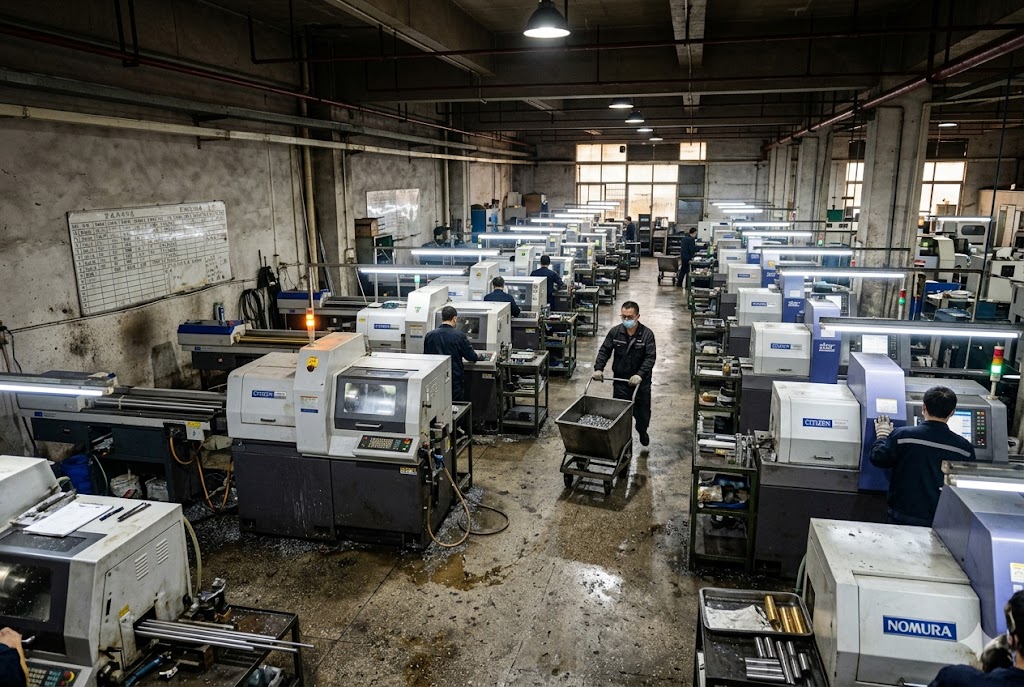
If a factory's Swiss lathes are already fully booked, your delivery schedule will slip unless the factory adds shift hours, temporarily reallocates machines from lower-priority programs, or has a sister facility with available capacity. Without a written capacity allocation clause in your contract, you have no leverage when scheduling conflicts arise.
Why Swiss Lathe Scheduling Conflicts Are Common
Swiss lathes are capital-intensive. A single high-end Citizen or Tsugami machine costs $150,000–$300,000 USD. Factories want every machine running at full utilization, which means they often accept more orders than they have guaranteed slack capacity to absorb.
Chinese Swiss shops concentrated in Guangdong — which accounts for over 60% of Chinese factories offering Swiss machining 5 — typically run the most aggressive shift patterns of any manufacturing region in China. Many facilities operate 24/7/365 with skeleton overnight crews managing bar feeder reloads. At that level of utilization, there is very little buffer.
The problem compounds when you are a foreign importer placing mid-volume orders. A domestic Chinese customer placing the same order in person may get priority treatment simply through the relationship. Your order, managed remotely through a sales rep and a spreadsheet, is easier to push when schedules tighten.
What Booking Conflicts Actually Cost You
| Scenario | Typical Lead Time Impact | Cost Implication for Buyer |
|---|---|---|
| Partial machine reallocation | 1–2 weeks added | Expedited freight cost |
| Full rescheduling to next available window | 3–5 weeks added | Production stoppage for downstream customer |
| Factory subcontracts to unqualified third party | Variable | Quality risk, drawing exposure risk |
| Factory refuses to deliver on original date | Depends on contract | Potential compensation claims, supplier change cost |
Contractual Protections That Actually Work
The most effective protection is a capacity allocation clause in your purchase order or supply agreement. This clause should specify:
- The minimum number of machines dedicated to your program during the contract period
- A weekly output floor — for example, no fewer than X pieces per calendar week
- A written notice requirement if the factory needs to reduce allocated capacity
- A remediation timeline if output falls below the agreed floor
Without this, your delivery schedule is entirely dependent on the factory's goodwill and internal prioritization. Some factories will honor informal commitments. Others will not.
Regular production reports also help. We require all factories in our network to submit weekly output and machine allocation reports 6 during active production runs. This creates visibility before a delay becomes a crisis, rather than after.
Can a Factory Scale Up Capacity for My Peak Season Demand, and How Much Lead Time Is Needed?
Our clients in the US market often have seasonal demand patterns. Orders spike in Q3 and Q4. They need their supplier to scale output by 30–50% for three to four months, then drop back. Most factories say yes to this request during negotiations. Fewer can actually deliver it.
A factory can scale Swiss CNC capacity for peak demand through three mechanisms: adding overtime shifts, purchasing or leasing additional machines, or reallocating machines from lower-priority programs. Adding shifts requires 2–4 weeks of lead time. Acquiring new Swiss lathes requires 3–6 months minimum, including delivery and qualification time.
Three Scaling Mechanisms and Their Real Constraints
Adding shifts is the fastest option. A factory running two shifts can theoretically add a third, increasing daily output by 50%. In practice, this requires trained operators who are not already scheduled on other machines. In Guangdong and Zhejiang, skilled Swiss lathe operators are in short supply. A factory that quotes unlimited shift-adding capability without a concrete operator headcount plan is giving you a theoretical answer, not a practical one.
Machine acquisition takes longer than most buyers expect. Swiss lathes from Citizen, Tsugami, Star, or Hanwha have lead times of 3–6 months from order to delivery. After delivery, the factory needs 4–8 weeks to install, qualify, and run first articles. A factory that does not already have machines on order cannot add new equipment in time for a Q3 demand spike if you confirm in April.
Program reallocation is the most common real-world solution. The factory moves machines from lower-margin or lower-priority domestic programs to your high-volume export order. This creates risk for those other customers, and it is a short-term fix — once domestic programs reassert their requirements, your allocation shrinks again.
Bar Stock Supply Chain: The Constraint Nobody Mentions
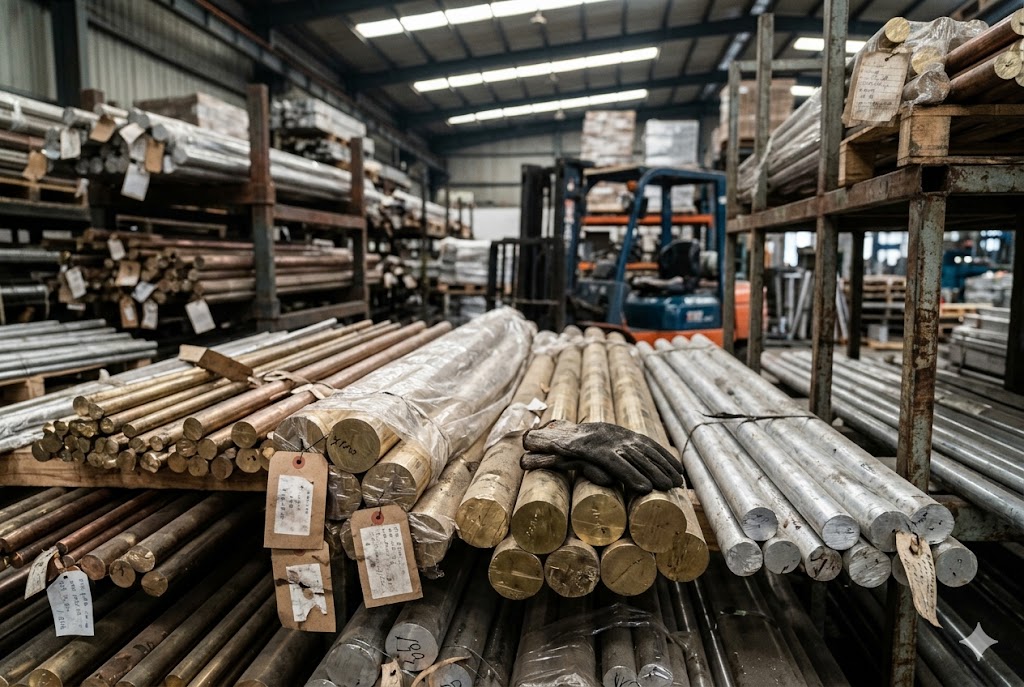
One scaling constraint that monthly output figures consistently obscure is bar stock 7 replenishment. At a 15-second cycle time on 8mm brass bar stock, a single 3-meter bar is consumed in approximately 20–25 parts. A machine running 240 parts per hour consumes roughly 10 bars per hour.
Scale that up: a 20-machine facility running three shifts needs approximately 4,800 bars per day. That is a non-trivial logistics and storage requirement. Smaller Chinese Swiss shops often cannot sustain the raw material throughput needed to run at full theoretical capacity, which is why their practical output ceiling is lower than their machine count implies.
Lead Time Requirements by Scaling Method
| Scaling Method | Realistic Lead Time | Output Increase Potential | Key Risk |
|---|---|---|---|
| Add overtime to existing shifts | 2–4 weeks | 10–20% | Operator fatigue, quality variance |
| Add a full third shift | 4–8 weeks | Up to 50% | Operator availability in tight labor markets |
| Reallocate machines from other programs | 1–3 weeks | 20–40% | Disrupts other customers, temporary fix |
| Purchase new Swiss lathes | 5–9 months | Scalable long-term | Capital expenditure, qualification time |
Should I Split My Swiss CNC Order Across Multiple Factories to Reduce Capacity Risk?
This is a question we hear often, and the answer is more nuanced than most guides will tell you. Splitting orders is not always the right move. But for certain order profiles, it is the most sensible supply chain risk management 8 tool available.
Splitting Swiss CNC orders across two or three factories reduces single-source capacity risk and protects against factory-level disruptions such as machine breakdowns, labor disputes, or fire. However, it increases qualification cost, quality management complexity, and unit price — because smaller per-factory volumes may not meet the threshold for high-volume pricing, which typically begins at 100,000 pieces per month per factory.

When Splitting Makes Sense
The case for splitting is strongest when three conditions are met simultaneously: your total monthly volume is large enough to give each factory a meaningful allocation, your part design is stable enough that running dual qualifications is not wasteful, and your downstream customer's production schedule cannot absorb a 4–6 week supply disruption.
Medical device and aerospace component buyers almost always split sources for regulatory as well as commercial reasons. High-volume connector and fastener buyers running volumes above 500,000 pieces per month routinely dual-source 9 as a matter of policy.
The case against splitting is clearest for low-to-mid volume buyers. If your total monthly requirement is 50,000 pieces, splitting it gives each factory 25,000 pieces — well below the 100,000-piece threshold at which Chinese Swiss shops offer their best pricing. The per-part premium on small allocations can be 15–30% higher than on consolidated orders.
The 100,000-Piece MOQ Threshold Explained
The minimum order quantity 10 threshold cited by Chinese Swiss CNC shops for high-volume pricing — typically 100,000 pieces per month — is not arbitrary. It reflects the actual economic break-even point where setup amortization, tooling cost, bar stock waste, and first-article qualification overhead per part drops to a price-competitive level. Below that threshold, the factory is essentially charging you for the setup burden on every order.
This is why splitting your order requires a careful volume analysis before you commit to a dual-source strategy.
Risk Comparison: Single Source vs. Dual Source
| Factor | Single Factory | Dual Factory |
|---|---|---|
| Unit price | Lower (volume leverage) | Higher (split volumes) |
| Capacity risk | High | Reduced |
| Quality consistency | Higher (one process) | Requires active management |
| First article qualification cost | One-time | Doubles |
| Supplier management workload | Lower | Higher |
| Recommended for monthly volume | Below 200,000 pcs | Above 300,000 pcs |
A Practical Middle Path: Qualified Backup Supplier
Many of our clients choose a middle path: qualify a primary factory and a backup factory, but direct 100% of orders to the primary during normal operations. The backup factory runs a small monthly program — enough to keep their process qualified — and is ready to absorb volume on short notice if the primary runs into trouble.
This approach preserves most of the unit price advantage of single-source consolidation while maintaining a tested fallback option. It costs more than pure single-sourcing, but less than full dual-sourcing.
Conclusion
Swiss CNC capacity is not a factory attribute — it is a calculation. Machine count, cycle time, shift pattern, and uptime rate determine the real number for your specific part. Evaluate these variables before you commit, protect your schedule with contractual capacity clauses, plan scaling lead times early, and align your sourcing structure with your volume before deciding whether to split orders.
Footnotes
1. Wikipedia overview of Swiss lathe technology, guide bushing design, and precision capabilities. ↩︎
2. Fractory's guide to Swiss machining explains cycle times, spindle setups, and throughput considerations. ↩︎
3. LeanProduction's OEE reference explains how uptime, performance, and quality combine into a single utilization metric. ↩︎
4. Wikipedia on titanium covers its machinability challenges that directly affect Swiss CNC cycle time and uptime rates. ↩︎
5. Nomura's industry overview of Swiss machining applications and the role of Guangdong in Chinese precision manufacturing. ↩︎
6. Precipart's Swiss turning primer covers machine allocation, bar feeder operation, and production monitoring practices. ↩︎
7. Wikipedia on bar stock explains material forms, standard dimensions, and consumption rates in automatic lathe production. ↩︎
8. Agrinventory's guide to dual sourcing covers supply disruption scenarios and how splitting sources reduces single-factory risk. ↩︎
9. TechTarget's definition of dual sourcing explains the strategy, when it applies, and trade-offs versus single sourcing. ↩︎
10. GEP's dual-sourcing strategy guide covers MOQ thresholds, volume allocation decisions, and procurement best practices. ↩︎