Skip to main content Skip to footer

Every week, our team fields the same question from US importers who are tired of managing two factories, two freight shipments, and two sets of quality problems. They want one throat to choke — and they want to know if their Chinese molding supplier can be that one source.
Yes, many established Chinese injection molding suppliers offer full assembly services as part of a one-stop manufacturing model. They range from simple snap-fit assembly and hardware installation to fully automated sub-assembly lines integrating molded components, metal stampings, PCBs, and fasteners. The real question is whether that assembly operation is genuinely in-house or quietly subcontracted next door.
The answer matters more than most importers realize. Let us walk through what you actually need to know before you consolidate.
What Types of Assembly Services Do Chinese Injection Molding Factories Typically Offer?
Our team visits dozens of Chinese molding factories every year. The gap between what a supplier says on their website and what we actually find on the shop floor is often significant. Knowing what to look for saves you from a costly mistake.
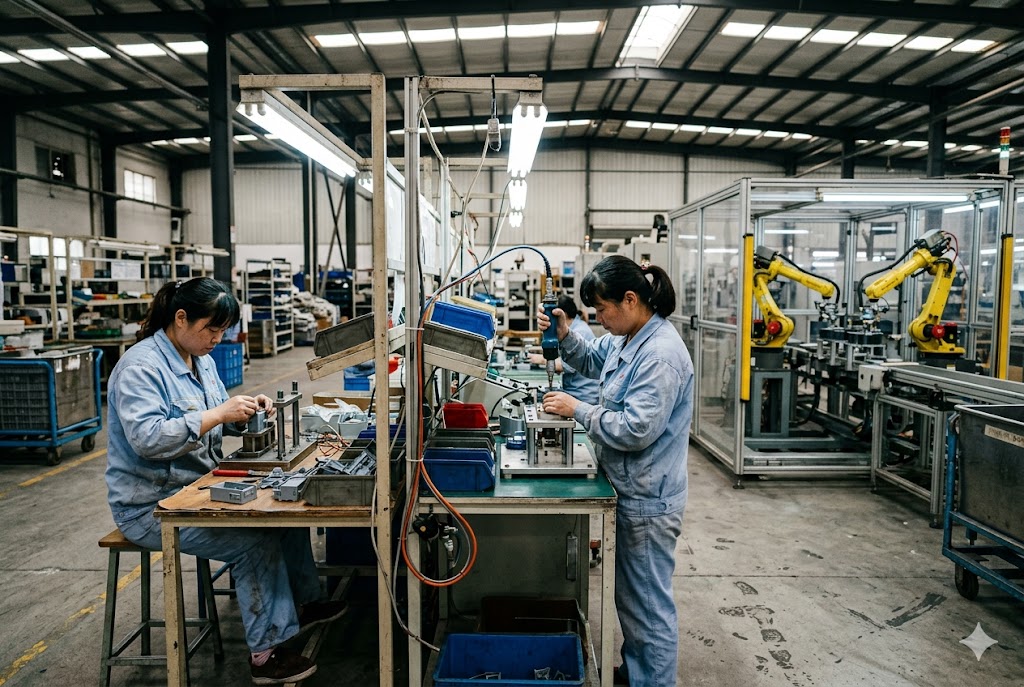
Chinese injection molding suppliers typically offer three tiers of assembly: manual assembly for low-volume or simple products, semi-automated assembly using jigs and press-fit or screwdriving stations for mid-volume programs, and fully automated lines with robotic pick-and-place and vision-system verification for high-volume production. Your required volume and quality level must match the supplier's actual tier.
The Three Assembly Tiers Explained
Not every supplier can handle every assembly type. Here is a plain breakdown of what each tier looks like in practice.
Tier 1 — Manual Assembly
Operators join parts by hand using simple fixtures. This works for low-volume programs or products with straightforward geometry. Labor cost is low. Consistency depends entirely on individual operator skill and supervision quality. As volume increases, defect rates tend to drift upward.
Tier 2 — Semi-Automated Assembly
Operators feed parts into purpose-built jigs. The station performs the joining operation — press-fit, snap-fit, screwdriving, or heat staking. This is the most common setup for mid-volume consumer goods and industrial components exported to the US. Consistency is better than pure manual. Cycle time is faster. This tier suits programs running 10,000 to 500,000 units per year.
Tier 3 — Fully Automated Assembly
Robotic pick-and-place cells 1, vision-system verification, and in-line functional testing. Built for high-volume programs in consumer electronics, automotive, and medical devices. Setup cost is high. Per-unit consistency is the best available. This tier is not common in general-purpose molding factories — it requires significant capital investment and dedicated engineering staff.
Assembly Services Comparison Table
| Assembly Tier | Typical Volume | Common Applications | Key Risk |
|---|---|---|---|
| Manual | < 10,000 units/yr | Simple housings, snap-fit covers | Operator-dependent consistency |
| Semi-automated | 10,000–500,000 units/yr | Consumer goods, industrial parts | Jig wear over long runs |
| Fully automated | > 500,000 units/yr | Electronics, automotive, medical | High setup cost, long lead time |
What "In-House" Actually Means
This is the detail that trips up most importers. A supplier can honestly say they offer assembly services while routing your work to a neighboring workshop they do not own or control. We have seen this firsthand during unannounced factory visits 2. The assembly happens off-site. Quality accountability breaks down completely. When a defect appears, both parties point at each other.
Before you sign a bundled molding-and-assembly contract, ask the supplier to show you the assembly area on-site. If they hesitate or redirect the conversation, treat that as a red flag.
What Components Can Be Integrated During Assembly?
Most capable Chinese molding-plus-assembly suppliers can integrate the following into a finished sub-assembly:
- Molded plastic components (their own production)
- Metal stampings and inserts
- Fasteners (screws, nuts, rivets)
- PCBs and electronic sub-assemblies
- Gaskets and seals
- Labels and packaging inserts
The key variable is whether these components are sourced by the supplier or supplied by you. Clarify this in your RFQ. Ambiguity here leads to cost disputes later.
How Do I Evaluate a Chinese Supplier's Assembly Quality Control Process for Injection-Molded Parts?
When our engineers review a new supplier's quality system, assembly quality control is where most factories fall short. Molding process control is relatively well understood. Assembly quality control is often improvised.
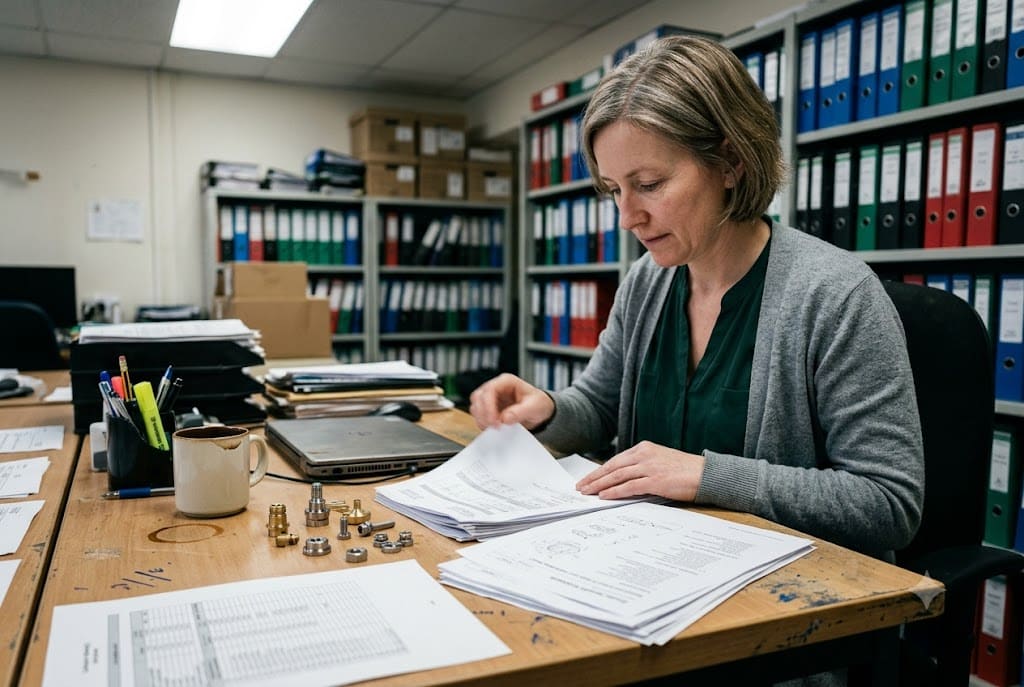
To evaluate a Chinese supplier's assembly quality control process, review their written assembly work instructions, defined inspection checkpoints at each sub-assembly stage, go/no-go acceptance criteria, functional testing methods, and production test coverage rates. A supplier who cannot produce these documents before production approval has no real quality system for assembly.
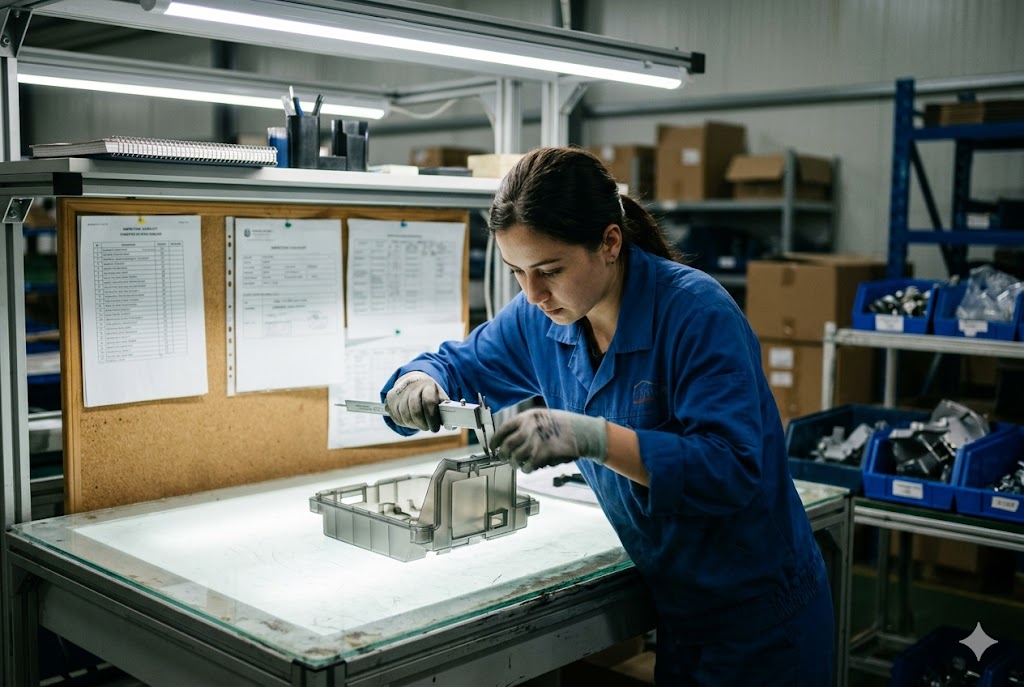
Why Assembly Quality Control Fails More Often Than Molding QC
Molding is a repeatable machine process. Once the process parameters are set and validated, the machine runs consistently. Assembly is different. It involves human decisions, physical handling, and sequential joining operations where each step affects the next. A small variation in step 2 can cause a failure that only shows up in step 7.
Without documented work instructions, each operator develops their own method. When personnel change — which happens often in Chinese factories — the method changes too. Quality drifts. Defect rates rise. You find out when a customer complaint lands on your desk.
What to Look for in an Assembly Quality Plan
Before approving a supplier for assembly production, request the following documents and evaluate each one:
| Document | What to Check |
|---|---|
| Assembly work instructions | Step-by-step sequence with photographs for each operation |
| Torque specifications | Defined values for every fastened joint, not a range |
| In-process inspection checklist | Specific checkpoints with pass/fail criteria, not general "inspect for quality" language |
| Functional test protocol | Test method, equipment, pass/fail criteria, and coverage rate (100% or statistical) |
| Nonconforming material procedure | What happens when a sub-assembly fails inspection |
Functional Testing Is the Most Important Gate
We tell every client the same thing: functional testing embedded in the assembly line 3 is the single most valuable quality control addition you can require. A visual inspection gate catches what looks wrong. A functional test catches what does not work.
Depending on your product, functional testing might include:
- Electrical continuity checks
- Pressure leak tests
- Snap-force or pull-force measurement
- Actuation cycle counts
- Optical or dimensional verification using vision systems
Require the supplier to define the specific test method, the pass/fail criteria, and whether coverage is 100% or statistical sampling. Get this in writing before production is approved — not after the first shipment has already shipped.
Tolerance Stack-Up: The Hidden Assembly Failure Mode
Here is something most importers do not think about until it costs them money. Individual molded parts can be within dimensional specification and still fail to assemble correctly. This happens because of tolerance stack-up 4: the accumulated effect of small dimensional variations across multiple mating components.
When you put five parts together, each at the edge of its allowed tolerance, the combined error can exceed what the assembly fixture or product function will accept. This problem is invisible when you inspect individual components. It only appears when parts come together.
Require the supplier to perform a dimensional stack-up analysis during the DFM phase. They should model the worst-case accumulated tolerance across all mating interfaces. They should validate that the assembly process produces acceptable results across the full tolerance range — not only when all components happen to be at nominal dimensions.
What Are the Cost Benefits of Combining Injection Molding and Assembly at One Factory in China?
When clients ask us to model the cost of consolidating versus splitting operations, the numbers consistently favor consolidation — but only when the supplier is genuinely capable of both. The savings are real. The risks of choosing the wrong supplier are also real.
Combining injection molding and assembly at one Chinese factory eliminates inter-factory freight, repacking operations, incoming inspection at a separate assembly house, and the coordination overhead of managing two suppliers. For high-volume consumer goods programs, this consolidation commonly reduces total landed cost by 8 to 15 percent compared to splitting operations across specialist suppliers.

Where the Cost Savings Come From
The savings from consolidation are not theoretical. They are elimination of specific, measurable cost items.
| Cost Item Eliminated | Typical Impact |
|---|---|
| Inter-factory freight (molding to assembly house) | Removed entirely |
| Repacking at assembly facility | Removed entirely |
| Incoming inspection at assembly house | Removed entirely |
| Dual supplier coordination and communication overhead | Significant reduction in your team's time |
| Split-shipment logistics management | Simplified to single origin point |
For a program running 100,000 units per year, these eliminations add up quickly. We have modeled programs where consolidation savings exceeded $40,000 annually — before accounting for the reduction in management time on the importer's side.
The IP Trade-Off You Must Understand
Consolidation has a cost that does not show up on a landed cost spreadsheet: IP exposure. A supplier who only molds individual components has limited understanding of how those components combine into a final product. A supplier performing full assembly sees the complete product architecture, functional relationships between parts, and performance specifications from functional testing.
For products with novel mechanisms or proprietary features, this is a meaningful risk. Some importers deliberately split molding and assembly between two unrelated suppliers as an IP compartmentalization strategy 5. They accept the added cost and coordination complexity as the price of that protection.
This is a business decision, not a sourcing error. Make it consciously, with full understanding of the trade-off.
What Legal Protection Actually Works in China
Standard Western-law NDAs are not enforceable in Chinese courts. This is not a technicality — it is a practical reality that has cost importers significant money.
The correct legal instrument for a Chinese supplier relationship involving assembly of a complete product is a Non-Disclosure, Non-Use, Non-Circumvention (NNN) agreement 6 governed by Chinese law and filed under Chinese jurisdiction. Supplement this with design patent registration in China before sharing assembly drawings or functional specifications — not after the supplier has been onboarded and production has started.
We work with clients on this before supplier selection, not after. Once a supplier has seen your complete product architecture, the legal window for meaningful protection has already narrowed significantly.
How Do I Specify Assembly Requirements in My Purchase Order or Contract with a Chinese Injection Molding Supplier?
Our experience managing orders across dozens of Chinese suppliers has taught us one lesson clearly: suppliers rarely develop assembly work instructions from scratch without direction. If you do not define the process, they will. And what they define will not match what you need.
To specify assembly requirements with a Chinese injection molding supplier, provide a documented assembly sequence with photographs or drawings for each step, torque specifications for every fastened joint, go/no-go acceptance criteria for each sub-assembly stage, defined inspection checkpoints, and an explicit anti-subcontracting clause prohibiting assembly work at any unapproved facility. Ambiguity in any of these areas creates a gap the supplier will fill on their own terms.
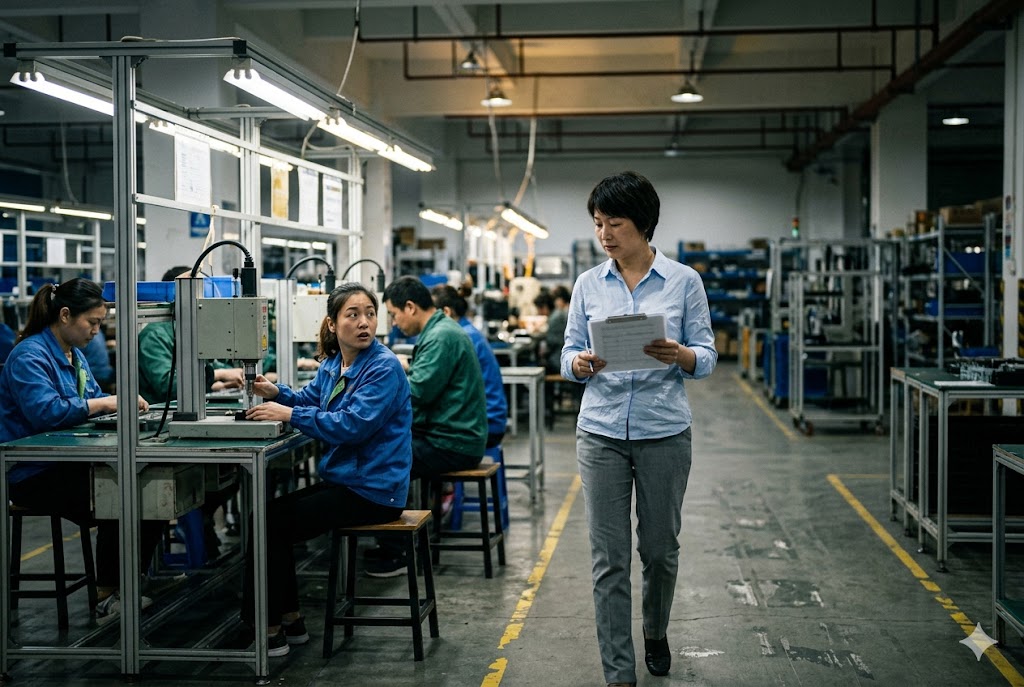
What to Include in Your Assembly Specification Package
Your assembly specification is a separate document from your part drawings. It covers the process, not just the product. At minimum, it should include:
Assembly Sequence Documentation
A step-by-step sequence with photographs or CAD-based illustrations for each operation. Each step should show the starting state, the action, and the expected end state. This is not optional. Without it, operators develop their own sequences, which may be functionally incorrect or simply inconsistent.
Torque and Force Specifications
Every fastened joint needs a defined torque value, not a range. Every press-fit or snap-fit interface needs a defined insertion or engagement force. These values come from your engineering team's design specifications. If you do not have them, your design is not ready for production release.
Acceptance Criteria at Each Stage
Define pass/fail criteria for each sub-assembly checkpoint. "Good quality" is not a criterion. "Gap between housing halves shall not exceed 0.3mm at any point" is a criterion. The more specific, the more consistent the output.
Anti-Subcontracting Clause
Include an explicit clause in your purchase agreement stating that no assembly operations may be performed at any facility not listed and approved in writing. Specify that violation of this clause gives you the right to reject the affected shipment and terminate the contract without penalty. A design for manufacturability (DFM) review 7 should be completed before finalizing these specifications to align engineering intent with what is actually achievable on the factory floor.
This clause alone, backed by unannounced audits during production, is the most effective practical control against unauthorized subcontracting.
For Regulated Products: Verify the Environment, Not Just the Certificate
If you are importing for a medical device or other regulated application, the assembly environment must match the cleanroom classification requirements 8 of your product — not just the molding environment. A supplier with an ISO Class 8 molding room who performs assembly in an uncontrolled factory area has broken the contamination control chain.
Verify that the ISO certification covering the supplier's cleanroom explicitly includes assembly operations as a covered process scope, not only molding. Ask to see the certificate scope statement, not just the certificate itself.
A Practical Audit Approach
Unannounced factory audits during production are more valuable than pre-award qualification audits. A supplier who knows an audit is scheduled will prepare. A supplier who does not know you are coming shows you their actual process.
We conduct both for clients. The pre-award supplier audit 9 qualifies the supplier. The in-production audit verifies that what was qualified is what is actually running.
Conclusion
Chinese injection molding suppliers can handle assembly — but capability varies widely, and what is claimed is not always what is delivered. Define your requirements precisely, verify in-house operations through audits, protect your IP before sharing drawings, and use functional testing as your quality gate. Importers who rely on one-stop manufacturing suppliers in China 10 that are genuinely capable of both molding and assembly consistently outperform those who manage fragmented supply chains. Get the right supplier and consolidation pays. Get the wrong one and it costs more than splitting operations ever would.
Footnotes
1. How robotic automation and vision systems improve injection-molded assembly consistency and throughput. ↩︎
2. How third-party quality control firms conduct unannounced factory audits for China-sourced goods. ↩︎
3. Why in-line functional testing during assembly outperforms visual inspection for quality assurance. ↩︎
4. Detailed explanation of tolerance stack-up in multi-part injection-molded assemblies and how to prevent it. ↩︎
5. Why NNN agreements provide stronger IP protection than NDAs when working with Chinese OEM manufacturers. ↩︎
6. Comprehensive guide to China NNN agreements covering non-disclosure, non-use, and non-circumvention clauses. ↩︎
7. How tolerance stack-up analysis during DFM prevents costly assembly failures before tooling is committed. ↩︎
8. ISO 13485 cleanroom requirements for medical device assembly environments and contamination control standards. ↩︎
9. How third-party inspection firms conduct pre-award and in-production supplier audits in China. ↩︎
10. Overview of leading Chinese injection molding suppliers offering verified one-stop molding and assembly services. ↩︎