Skip to main content Skip to footer

We see it happen on almost every new program: a buyer approves a sample, places a production order, and then rejects the shipment because the finish "doesn't look right." The part is dimensionally correct, but the surface is wrong. That one issue holds up payment, delays their customer's line, and costs everyone money.
When importing custom injection-molded parts from China, your main surface finishing options are in-mold polish and texture (SPI or VDI grades applied to the mold cavity), post-mold painting, electroplating, pad printing, laser engraving, and specialty coatings such as EMI shielding. Each method has different cost structures, design requirements, and quality control checkpoints.
Knowing which option fits your part — and how to specify it correctly — is the difference between a smooth program and an expensive dispute. Let's go through each one.
What Are the Most Common Surface Finishes for Injection-Molded Plastic Parts Made in China?
Our team reviews supplier quotations and DFM reports every week, and the most frequent gap we find is finish specification. Buyers write "matte black" or "glossy" on a drawing, and every supplier interprets it differently.
The most common surface finishes for injection-molded parts from China fall into two categories: in-mold finishes and post-mold finishes. In-mold finishes include SPI mirror polishes (A-1 to A-3), SPI semi-gloss and matte (B and C grades), and VDI 3400 EDM textures. Post-mold finishes include spray painting, electroplating, pad printing, and laser engraving.

In-Mold Finishes: SPI and VDI Standards
In-mold finish means the texture or polish is applied to the mold cavity itself. Every part produced from that mold carries the same surface. The cost is paid once, during tooling. There is no per-part finishing cost.
Chinese suppliers use two main grading systems. The SPI surface finish standard 1 was originally established by the Society of the Plastics Industry and covers 12 grades of polish across four categories — from mirror-bright to coarse matte. The VDI 3400 texture standard 2, developed by the Association of German Engineers, covers 45 grades of EDM-cut surface texture and is widely adopted for electronics housings and automotive interiors.
| Standard | Grade Range | Description | Typical Application |
|---|---|---|---|
| SPI | A-1 | Mirror, diamond-buffed | Optical lenses, display bezels |
| SPI | A-2 / A-3 | High gloss, slight haze | Consumer electronics housings |
| SPI | B-1 / B-2 / B-3 | Semi-gloss, paper-polished | General consumer goods |
| SPI | C-1 / C-2 / C-3 | Matte, stone-polished | Industrial enclosures |
| SPI | D-1 / D-2 / D-3 | Coarse matte, dry-blasted | Tool grips, rough surfaces |
| VDI 3400 | VDI 12–18 | Fine EDM texture | Electronic housings |
| VDI 3400 | VDI 21–30 | Medium grain | Automotive interior trim |
| VDI 3400 | VDI 33–45 | Coarse grain | Tool bodies, structural parts |
SPI grades use a number-and-letter code. VDI grades use a number. Never use words alone on a drawing. "Matte" means nothing. "SPI C-1" means something specific.
Why Mold Steel Matters for SPI A-Grade Finishes
SPI A-grade mirror polishes require hardened mold steels. Stainless steel is used for A-1. NAK80 steel works for A-2 and A-3. Softer steels like P20 cannot hold a mirror finish. The rotary polishing tool produces ripples and orange peel on soft steel.
If a supplier quotes you an A-1 finish on P20 tooling, flag it. Either they are misinformed or the finish they deliver will not meet the grade. Raise this during tooling quotation review, not after T1 samples.
VDI 3400 Textures and Draft Angle
VDI textures are cut into the mold by EDM machining. They produce a controlled matte grain. This is popular for electronics housings, automotive interiors, and grips.
There is a critical design rule most buyers miss: every 0.001 inch of VDI texture depth needs an additional 1.5° of draft angle on the textured wall. A part designed with 1° draft that gets retextured to VDI 33 will show drag marks and surface tearing during ejection. Draft angle and texture grade must be resolved together at DFM — not after first samples.
Chemical Etching and Laser Texturing
For custom patterns — wood grain, leather, geometric grids, in-mold logos — Chinese toolmakers use chemical etching or laser texturing on the mold cavity surface. EDM and mechanical polishing cannot produce these patterns.
The Mold-Tech texture catalog 3 is the most common proprietary catalog for engineered textures. If you want a specific pattern, provide the Mold-Tech reference number or a physical texture sample. A verbal description is not a specification.
How Do I Specify Surface Finish Requirements in My Technical Drawings for Chinese Injection Molding Suppliers?
When we review drawings sent to Chinese suppliers, under-specified surface finish is one of the most common errors we find. It generates unnecessary RFI rounds and creates a weak position if parts are rejected later.
To correctly specify surface finish on drawings for Chinese injection molding suppliers, use explicit standard and grade references such as "SPI A-2" or "VDI 3400 Ref. 27," include color specifications using a Pantone or RAL number, define color tolerance with a ΔE value, and note which surfaces carry which finish when a single part has multiple finish zones.
What to Include on the Drawing
A complete surface finish callout for an injection-molded part has several components. Leaving any one of them out creates a gap that the supplier will fill with their own judgment.
| Callout Element | Example | Why It Matters |
|---|---|---|
| Finish standard and grade | SPI B-1 | Removes ambiguity on gloss level |
| Applicable surface zone | "All A-side surfaces" | Parts often have multiple finish zones |
| Color reference | Pantone 432 C | Anchors color across batches |
| Color tolerance | ΔE ≤ 1.5 | Defines acceptable variation quantitatively |
| Texture reference (if VDI) | VDI 27 | Specifies EDM grain depth and coarseness |
| Draft angle (if textured) | Min 3° on textured walls | Prevents ejection defects with texture |
Color Is the Most Underspecified Element
Specifying "black" or "light gray" without a color standard produces batch-to-batch variation. The variation can be large enough to fail visual acceptance at goods receipt.
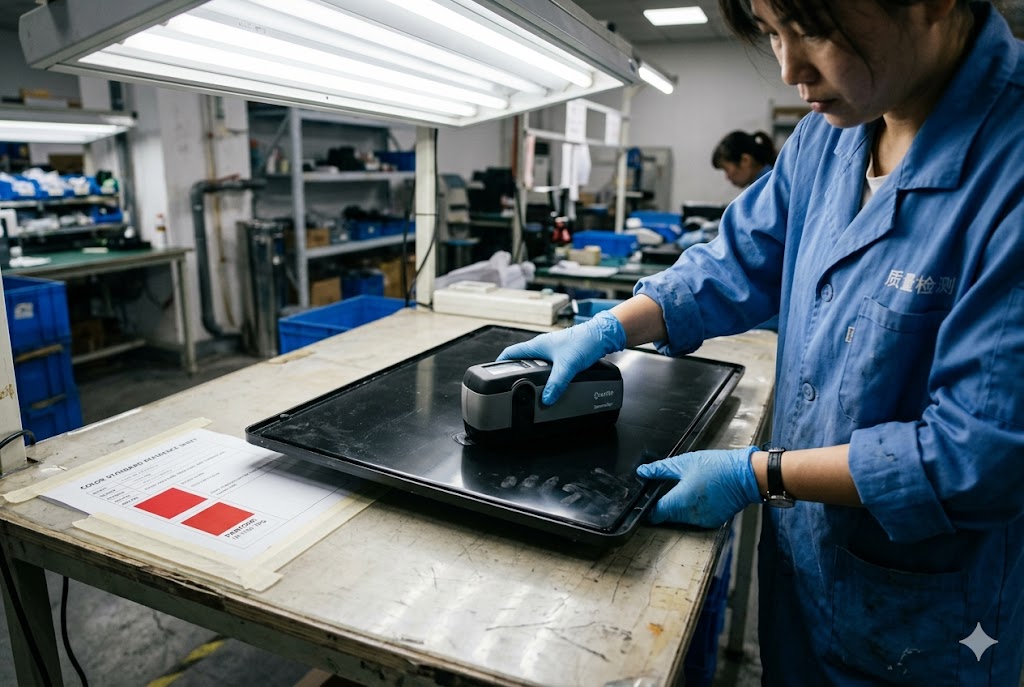
Require all colored parts to reference a Pantone Matching System (PMS) number 4 or a physical color chip approved against a first-article production sample. Add ΔE color tolerance values as a contractual acceptance criterion. A spectrophotometer reading of ΔE ≤ 1.5 is a common starting point for consumer goods. Tighter tolerances apply for color-matched assemblies.
Color disputes resolved after shipment are among the most common and costly finishing disagreements between Chinese suppliers and importers. Locking the standard before first production approval is the only reliable prevention.
Multi-Zone Finish Parts
Many parts carry different finishes on different surfaces. A consumer electronics housing might have an SPI A-2 cosmetic face, an SPI C-3 internal cavity, and a VDI 27 grip texture on the sides. Each zone needs its own callout on the drawing. A single "surface finish: matte" note on a drawing like this is unacceptable.
Use leader lines or a finish zone table on the drawing to assign a finish grade to each surface area. Confirm these callouts are visible on the 2D drawing the supplier uses for tooling and production — not only in the 3D model.
Can Chinese Injection Molding Factories Handle Painting, Electroplating, and Pad Printing In-House?
This question comes up early in supplier selection, and the answer directly affects lead time, quality accountability, and unit cost. We do factory audits specifically to check this — not just whether a supplier claims in-house capability, but whether the actual equipment and process controls support it.
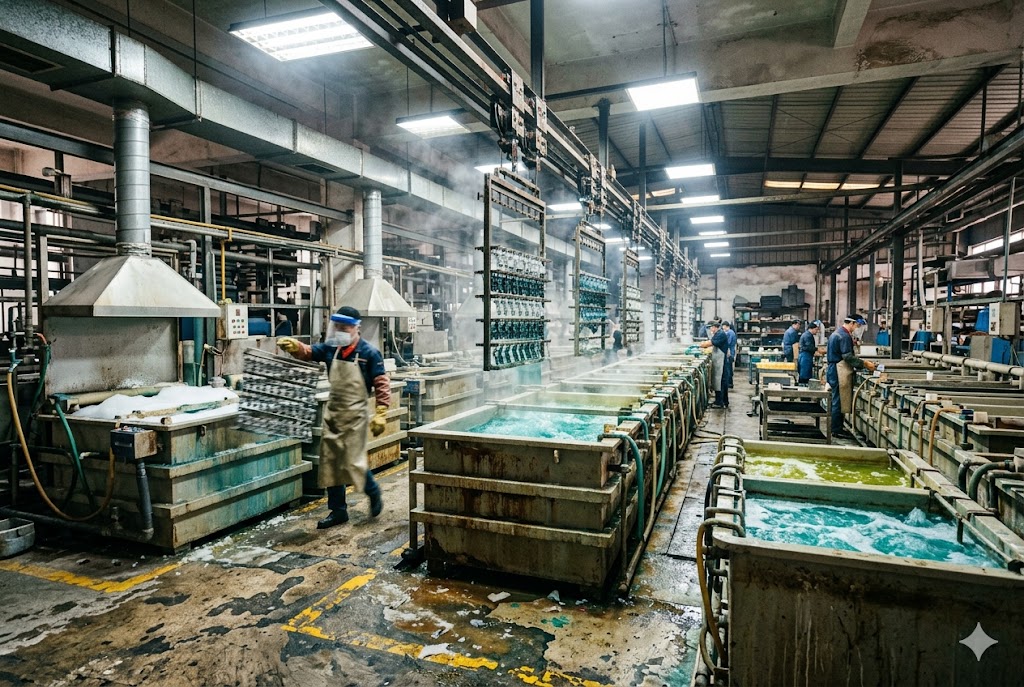
Many Chinese injection molding factories offer painting, pad printing, and laser engraving in-house. Electroplating is less commonly integrated — many suppliers outsource it to specialist plating shops. Full in-house capability reduces lead time and improves quality accountability, but requires verification during a supplier audit.
Spray Painting: The Most Common In-House Post-Mold Finish
Spray painting is the most widely available post-mold finish at Chinese full-service suppliers. It is used across consumer electronics, home appliances, and automotive interior components.
One practical supply chain advantage of painting is color flexibility. The same molded base part can be painted in multiple colors for variant SKUs. You change paint, not molds. This reduces tooling investment for color families.
The critical technical check: paint adhesion is material-dependent. Adhesion on ABS differs from adhesion on PP or PC. Require the supplier to provide cross-hatch adhesion test results per ASTM D3359 5 for the specific resin-and-paint combination on your part. Do not accept a generic "we paint ABS all the time" response. The resin formulation, surface energy, and paint system must be matched and tested.
Electroplating: Usually Outsourced, Needs Verification
Electroplating deposits chrome, nickel, or copper onto the part surface to create a metallic appearance or provide EMI shielding. It is technically demanding and requires significant capital investment in plating lines and wastewater treatment.
Most small and mid-size Chinese injection molders outsource plating to specialist shops. This is acceptable if the plating shop is qualified and the supplier manages the process. Problems arise when the supplier uses an unaudited subcontractor and has no visibility into the plating shop's process controls.
Key technical requirements for plated plastic parts:
- The base resin must be electroplating-grade ABS 6, specifically formulated for adhesion. Standard ABS, PC, and PP cannot be reliably electroplated.
- Part surfaces must be free of sink marks and knit lines. Both produce visible plating defects.
- Blind holes must be no deeper than half their diameter. Deep blind holes trap chemistry and result in poor plating coverage at the base.
Pad Printing and Laser Engraving
Both are widely available at Chinese suppliers and are the dominant methods for applying logos, part numbers, regulatory marks, and instructional text.
| Method | Best For | Durability | Specification Required |
|---|---|---|---|
| Laser Engraving | Traceability marks, permanent logos | Permanent | Location callout, depth, mark dimensions |
| Pad Printing | Multi-color graphics, curved surfaces | Moderate | Pantone color, vector artwork, location callout |
Laser engraving is permanent and requires no consumables. It is the preferred method for traceability and regulatory marks. Pad printing transfers ink via a silicone pad and handles curved surfaces and multi-color graphics well, but requires Pantone color numbers, 2D vector artwork files, and precise location callouts on the engineering drawing.
If you provide a JPG and say "put our logo here," expect poor results. Provide an AI or EPS vector file with a dimensioned location callout. That is the minimum to get consistent results across batches.
How Do I Ensure Consistent Surface Finish Quality Across Multiple Production Batches from China?
Batch-to-batch consistency is where most surface finish programs break down. First-article samples pass. Then production batch three looks different. Tracking down the cause takes weeks, and the parts are already on a ship.
To maintain consistent surface finish quality across production batches from Chinese suppliers, establish approved first-article samples as physical reference standards, specify color with a Pantone or RAL number plus a ΔE tolerance, require pre-shipment inspection covering cosmetic and finish criteria, and include finish acceptance criteria in the supplier contract — not just the drawing.

The First-Article Sample Is Your Reference Standard
The first approved production sample is the physical benchmark for every batch that follows. It should be signed off by both parties, documented with photographs, and a physical sealed sample retained at both the buyer's location and the supplier's facility.
If you do not have a physical reference sample at the factory, inspectors checking batch three have nothing to compare against. Variation slips through because there is no anchor.
Pre-Shipment Inspection for Surface Finish
Standard dimensional inspection does not catch surface finish variation. A separate cosmetic and finish inspection protocol is needed. This should cover:
- Color measurement using a spectrophotometer 7 against the approved PMS standard, with ΔE pass/fail criteria
- Gloss level reading using a gloss meter against the approved SPI or VDI grade
- Visual check under calibrated lighting for paint adhesion, orange peel, sink marks visible through finish, and pad print alignment
- Adhesion cross-hatch test sample from the batch (destructive, pull from lot)
Include this protocol in the purchase order or quality agreement. An inspector who only checks dimensions will not check these items unless they are explicitly required.
What to Include in Your Supplier Quality Agreement
A quality agreement supplements the purchase order and defines the rules for surface finish acceptance. It should include:
| Element | What to Specify |
|---|---|
| Color standard | Pantone/RAL number + ΔE ≤ [X] |
| Gloss standard | SPI or VDI grade + acceptable gloss meter range |
| Paint adhesion | ASTM D3359 cross-hatch, minimum rating |
| First-article approval | Signed sample retained at factory |
| Cosmetic defect limits | Maximum number/size of allowable marks by zone |
| Inspection trigger | 100% visual or AQL sampling level |
For structured supplier qualification frameworks, the Plastics Industry Association 8 publishes guidance on mold standards and quality benchmarks that can inform your quality agreement terms.
EMI Shielding Coatings: A Specialist Case
For electronics enclosures requiring electromagnetic shielding, some Chinese suppliers offer conductive interior coatings for EMI shielding 9 — either metal-loaded paints or vacuum-metallized coatings applied inside the housing. This converts a plastic part into a functional EMI shield without the weight of a metal enclosure.
If your part requires shielding effectiveness, specify the attenuation target in decibels across the relevant frequency range. Require third-party shielding effectiveness test data 10 — do not accept a supplier confirmation that "the coating is conductive." The test data is the only proof that the coating performs at the specified level across your frequency range.
Conclusion
Surface finish is a design decision, a specification task, and a quality control program — all three. Get one wrong and the others cannot save you. Use explicit grade standards, anchor color with a Pantone number and a ΔE limit, verify supplier capability before tooling, and inspect against a signed physical sample every batch.
Footnotes
1. Comprehensive guide to SPI surface finish grades for injection-molded plastic parts. ↩︎
2. VDI 3400 standard detail: texture grades, draft angle tables, and material-specific recommendations. ↩︎
3. Explanation of the Mold-Tech texture catalog and how to select and reference proprietary patterns. ↩︎
4. Guide to the Pantone Matching System and how PMS numbers ensure color consistency across manufacturers. ↩︎
5. Overview of the ASTM D3359 cross-hatch tape test for evaluating paint and coating adhesion strength. ↩︎
6. Design and molding guidelines for plastic parts intended for electroplating, including ABS resin requirements. ↩︎
7. Spectrophotometer instruments used for precise ΔE color measurement in manufacturing quality control. ↩︎
8. The Plastics Industry Association: U.S. trade body publishing mold standards and quality benchmarks. ↩︎
9. Overview of conductive coating approaches for achieving EMI shielding effectiveness in plastic enclosures. ↩︎
10. Technical article on advanced EMI shielding techniques and performance validation for plastic housings. ↩︎