Skip to main content Skip to footer

Every week, our team reviews supplier documentation for clients importing plastic components from China. The same problem appears repeatedly: a factory lists "RoHS compliant" in its product catalog, but when we ask for third-party test reports, the conversation goes quiet. That gap between claimed compliance and verified compliance is where importers get hurt.
RoHS and REACH compliance for injection-molded parts from Chinese factories requires more than a supplier declaration. You need traceable resin documentation, third-party test reports from ISO 17025-accredited labs, and a supply agreement that specifies substance thresholds, additive transparency, and re-screening triggers tied to SVHC Candidate List updates.
The four questions below cover what to verify, what to request, what to watch for in additives, and how to write compliance requirements into your supplier contract.
How Do I Confirm That Plastic Resins Used by a Chinese Injection Molding Supplier Are RoHS and REACH Compliant?
Resin compliance is the question most importers ask first — and it is only part of the picture. Our sourcing team has audited dozens of injection molding facilities across Guangdong, Zhejiang, and Jiangsu, and the pattern is consistent: the base resin may be clean, but what gets added to it often is not.
To confirm resin compliance, request the resin manufacturer's Material Safety Data Sheet (MSDS), a Certificate of Analysis (CoA) traceable to a specific production lot, and a third-party XRF screening report from an ISO 17025-accredited laboratory. Supplier declaration letters alone do not constitute defensible compliance evidence.
Why Base Resin Compliance Is Not Enough
Most reputable resin producers — whether domestic Chinese brands or international names like BASF, SABIC, or LG Chem — provide datasheets that address RoHS-restricted substances. These documents are a starting point, not a finish line.
The problem sits downstream. Chinese compounders and molders routinely add colorants, flame retardants, plasticizers, and UV stabilizers to base resins. These additives are sourced from sub-tier suppliers. The molder often has no visibility into the chemical composition of those additives beyond a product name and a price.
This means a factory can hand you a perfectly valid resin CoA and still ship parts containing restricted substances introduced through the compounding step.
The Correct Verification Path
Follow this sequence when evaluating a new supplier's compliance claims:
| Step | Action | What to Look For |
|---|---|---|
| 1 | Request resin MSDS | Confirm base polymer identity, lot traceability |
| 2 | Request Certificate of Analysis (CoA) | Match lot number to production records |
| 3 | Request compound formulation disclosure | Identify all additives including colorant, FR, plasticizer |
| 4 | Request XRF screening report | ISO 17025 accreditation on the test lab |
| 5 | Request ICP-MS for flagged materials | Confirmatory quantitative testing for RoHS substances |
Understanding the Regulatory Scope
RoHS Directive 2011/65/EU 1 is specific to electrical and electronic equipment (EEE). If your injection-molded part is not destined for an EEE end product — say, a structural bracket, a fluid fitting, or a mechanical housing with no electronic function — then RoHS does not legally apply to it. Demanding RoHS Certificates of Conformance for non-EEE parts adds cost and paperwork without providing legal protection.
REACH, by contrast, applies to all articles placed on the EU market regardless of product category. Your obligation as an importer is article-level: you must assess whether any substance on the SVHC Candidate List 2 (currently over 250 substances) is present above 0.1% w/w in any homogeneous material within your part. That is not the same as 0.1% of the finished part's total weight — it applies to each distinct material layer, including surface coatings, adhesive layers, and any post-process treatment.
On-Site Audit Checkpoint
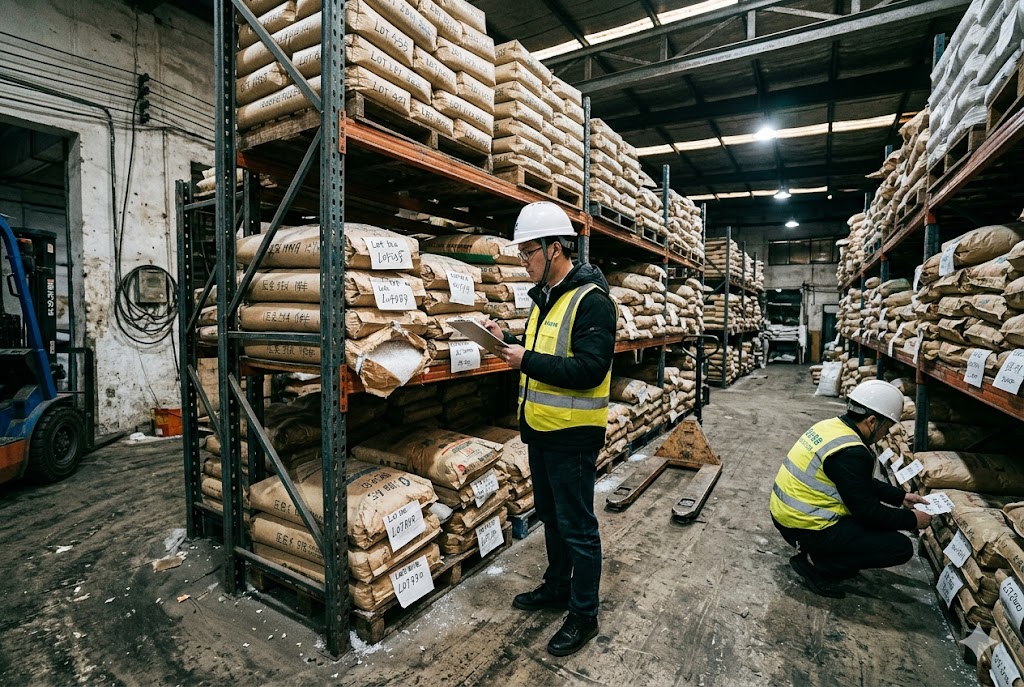
When we conduct factory audits for clients, we always check resin storage. Physical segregation of compliant and non-compliant resin stock is a direct indicator of how seriously a factory manages its compliance commitments. Co-mingled storage without color-coded labeling or physical barriers creates cross-contamination risk that can invalidate even accurate documentation.
| Audit Observation | Compliance Risk |
|---|---|
| Segregated storage with labeled bins | Low |
| Mixed storage, visual labels only | Medium |
| Co-mingled storage, no physical barrier | High — documentation unreliable |
| No traceability to resin lot on floor | Critical — production records not linkable |
What Documentation Should I Request from a Chinese Factory to Prove RoHS and REACH Compliance for My Parts?
When clients ask us to qualify a new injection molding supplier, we build a documentation checklist before the first sample is shipped. The right package is not long — but every item in it must be traceable and independently verifiable.
The minimum documentation package for defensible RoHS and REACH compliance includes: a resin MSDS, a lot-traceable Certificate of Analysis, a full additive disclosure from the compounder, and an ISO 17025-accredited 3 third-party test report covering XRF screening with ICP-MS confirmation for any flagged substances. For parts with surface treatments, separate documentation is required for each applied layer.

Document-by-Document Breakdown
Each document in a compliance package serves a specific and non-interchangeable function. Understanding what each one does — and does not — cover helps you push back when a factory substitutes one for another.
| Document | What It Covers | What It Does Not Cover |
|---|---|---|
| Resin MSDS | Base polymer identity, hazard classification | Additives added by compounder or molder |
| Certificate of Analysis (CoA) | Lot-level physical and chemical properties | Additive sub-tier sourcing |
| Additive disclosure sheet | Colorants, FRs, plasticizers, UV stabilizers | Sub-tier supplier's own additive package |
| XRF screening report 4 | Rapid surface elemental scan for heavy metals | Low-concentration organics (e.g., phthalates) |
| ICP-MS confirmatory report | Quantitative analysis of flagged elements | Real-time production monitoring |
| REACH SVHC Declaration | Substance presence above 0.1% w/w threshold | Automatically updates with new SVHC additions |
| EU Declaration of Conformity (DoC) | Self-declaration for CE-marked products | Independent verification — must be backed by test data |
Parts With Surface Treatments Require Separate Assessment
This is one of the most commonly missed compliance gaps we encounter. A factory provides a clean test report for the molded substrate. But the part also has a painted surface, a plated finish, or pad-printed text. Each of those layers must be assessed independently.
Post-process treatments that warrant separate compliance testing include:
- Electroplating — risk of hexavalent chromium (Cr VI) in surface treatments 5, restricted under both RoHS and REACH
- Painting or powder coating — risk of cadmium-based pigments, lead-containing driers, and restricted phthalate plasticizers in coatings
- Pad printing and laser marking inks — risk of azo dyes and heavy metal pigments
- Adhesive bonding — risk of restricted phthalates in adhesive formulations
Request a separate XRF screening report for each surface treatment. If the factory cannot produce it, require the treatment to be performed by a sub-supplier that can.
Documentation Review Workflow
When our team reviews a compliance package, we follow a defined sequence:
- Confirm all documents are in English or have a certified translation.
- Match lot numbers on the CoA to production records and shipping documents.
- Verify the test laboratory's ISO 17025 accreditation status independently — do not accept the factory's own statement.
- Check the test report date against the SVHC Candidate List update schedule. Reports older than 12 months may not reflect current substance restrictions.
- Flag any missing additive disclosure. If the compounder refuses to disclose additives, treat that as a compliance risk indicator.
Which Plastic Additives Commonly Used in China May Violate RoHS or REACH Requirements in the U.S. Market?
This is the question that most importers do not know to ask until there is a problem. Our engineers have reviewed material compositions across hundreds of parts sourced from Chinese molders, and the violations almost never come from the base resin. They come from the additives.
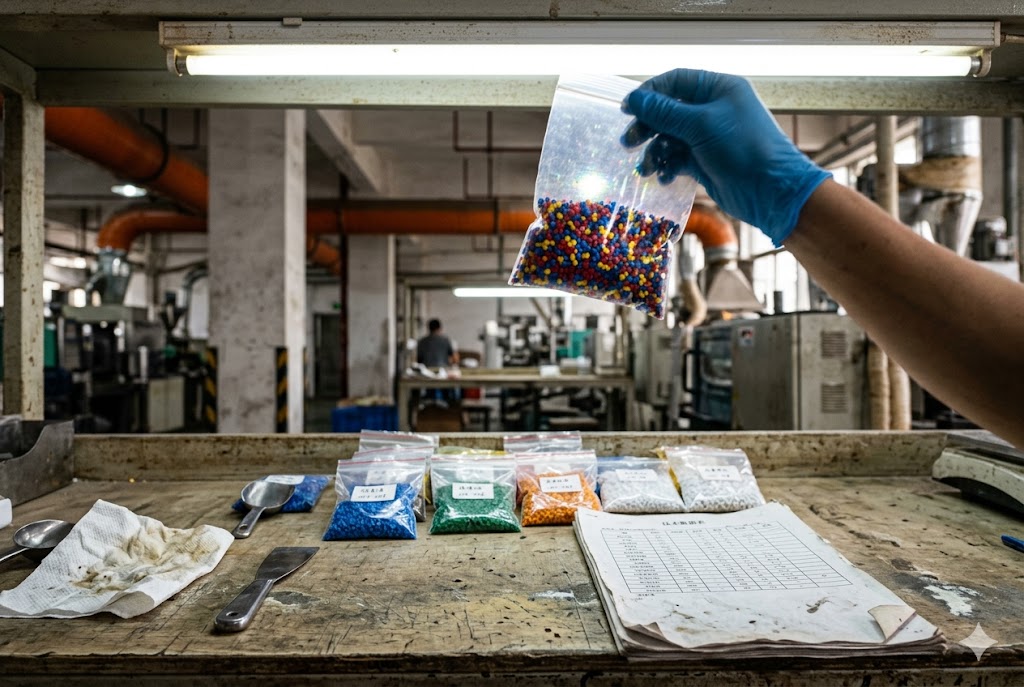
The highest-risk additive categories in Chinese injection-molded plastics are halogenated flame retardants, cadmium and lead-based colorants, DEHP and other restricted phthalate plasticizers, and hexavalent chromium compounds used in surface treatments. These substances appear in parts sold for both domestic Chinese and export markets.
Why Chinese Domestic Market Practices Create Export Risk
China RoHS 2 6 operates its own domestic chemical regulatory framework which restricts the same six core substances as EU RoHS. However, the enforcement model is different. China RoHS 2 allows non-compliant products to remain on the domestic market with disclosure labeling using the EFUP (Environment-Friendly Use Period) mark 7. There is no pre-market testing or certification requirement for domestic sale.
This means a factory serving both domestic Chinese and export customers 8 may apply different material standards to the two product streams — or may not distinguish between them at all when managing shared resin stock.
High-Risk Additives by Function
| Additive Category | Specific Substances | Regulatory Status |
|---|---|---|
| Flame retardants | Polybrominated biphenyls (PBBs) 9 | RoHS restricted (0.1% w/w) |
| Flame retardants | Polybrominated diphenyl ethers (PBDEs) | RoHS restricted (0.1% w/w) |
| Plasticizers | DEHP, BBP, DBP, DIBP | RoHS restricted in EEE (0.1% w/w); REACH SVHC |
| Colorants | Cadmium-based pigments (CdS, CdSe) | RoHS restricted (0.01% w/w); REACH authorization |
| Stabilizers | Lead-based heat stabilizers (in PVC compounds) | RoHS restricted (0.1% w/w) |
| UV stabilizers | Certain benzotriazole compounds | REACH SVHC Candidate List |
| Surface treatment | Hexavalent chromium (Cr VI) in plating | RoHS restricted (0.1% w/w) |
The Compounder Visibility Gap
The molder you contract with typically purchases pre-compounded resin from a separate compounder. That compounder purchases colorant masterbatches, flame retardant packages, and stabilizer blends from yet another tier of suppliers. The molder cannot see into that supply chain without actively requesting formulation disclosure — and many Chinese compounders treat additive formulations as proprietary.
This is where our supplier qualification process focuses attention. We require factories to provide the compounder's full technical data sheet and any available formulation disclosure, and we treat a refusal to provide additive detail as a substantive compliance risk, not a commercial preference.
SVHC List Updates and Static CoC Risk
The REACH SVHC Candidate List is updated periodically throughout the year. A resin compound that passed testing at supplier qualification may fall out of compliance when new substances are added to the list. A one-time Certificate of Conformance issued at qualification has no mechanism to flag this.
For this reason, static CoCs are not adequate for ongoing production. Compliance documentation needs to be tied to production lots, and supply agreements need to include a re-screening trigger whenever the SVHC list is updated.
How Do I Include RoHS and REACH Compliance Requirements in My Supplier Quality Agreement with a Chinese Factory?
A compliance requirement that lives only in a purchase order is not enforceable. Our team has helped clients structure supplier quality agreements that give compliance teeth — specifying what documentation is required, when it must be updated, and what happens when a factory cannot provide it.
A supplier quality agreement should specify substance thresholds by name, require ISO 17025-accredited third-party test reports for each new compound qualification, mandate additive-level disclosure from the compounder, include a re-screening trigger tied to SVHC Candidate List updates, and define corrective action and shipment hold procedures for non-conforming material.

Core Clauses to Include
A well-drafted compliance section in a supplier quality agreement covers six areas:
1. Substance Restriction Schedule
Attach a substance restriction schedule as an exhibit to the agreement. List each restricted substance, its applicable regulation, and the maximum permitted concentration in any homogeneous material. Do not rely on generic "RoHS compliant" language — name the substances and the thresholds.
Example language:
"Supplier warrants that no homogeneous material within any delivered part contains lead (Pb) at or above 1,000 ppm (0.1% w/w), cadmium (Cd) at or above 100 ppm (0.01% w/w), or any SVHC substance listed on the ECHA Candidate List at or above 1,000 ppm (0.1% w/w) as of the shipment date."
2. Documentation Requirements
| Document | Trigger | Minimum Frequency |
|---|---|---|
| Resin MSDS | New resin qualification | Per new material |
| Lot-traceable CoA | Each production order | Per lot |
| XRF + ICP-MS test report | New compound qualification | Per new compound |
| Additive disclosure | New compounder or formulation change | Per change |
| REACH SVHC Declaration | SVHC list update | Per update cycle |
| Surface treatment compliance report | Any plating, painting, or coating | Per process qualification |
3. Sub-Tier Supplier Notification
Require the factory to flow compliance requirements down to its compounder and colorant/additive suppliers. Without this clause, a molder may comply with your agreement while purchasing non-compliant additive packages from a sub-tier vendor.
4. SVHC Re-Screening Trigger
Write a specific clause requiring the factory to initiate re-screening within 60 days of any ECHA SVHC Candidate List update 10. If re-screening results are not provided within 90 days of an update, shipments are placed on hold pending documentation.
5. Material Change Notification
Require a minimum 30-day advance written notice before any change to:
- Base resin grade or supplier
- Compounder or compound formulation
- Colorant or additive package
- Surface treatment process or chemistry
An undisclosed material change is one of the most common ways compliance breaks down on a long-running production program.
6. Corrective Action and Shipment Hold
Define a clear escalation path: if a test report reveals a substance above the permitted threshold, specify the hold procedure, the corrective action timeline, and the root cause analysis format you expect. A supplier that has agreed to this in writing before a problem occurs is easier to hold accountable than one responding to an ad hoc demand after a shipment has arrived.
Conclusion
Compliance claims from Chinese injection molding suppliers are common. Verified compliance is not. The difference between a declaration and a defensible compliance record is specific documentation, independent testing, additive-level transparency, and contractual re-screening obligations. Build that structure before production begins, not after a shipment is flagged.
Footnotes
1. Official EU source for RoHS Directive 2011/65/EU scope and harmonised standards. ↩︎
2. ECHA's live database of substances of very high concern under REACH. ↩︎
3. ANAB overview of ISO/IEC 17025 testing laboratory accreditation requirements. ↩︎
4. RoHS Guide explains XRF screening methods and their limits for compliance testing. ↩︎
5. ECF Inc. explains REACH scope, hexavalent chromium restrictions, and surface finishing obligations. ↩︎
6. Wikipedia overview of China RoHS regulation, EFUP marking, and domestic enforcement model. ↩︎
7. Assent explains China RoHS EFUP labeling requirements and differences from EU RoHS. ↩︎
8. Z2Data compares China RoHS domestic vs. export compliance standards for manufacturers. ↩︎
9. Wikipedia RoHS article covering all ten restricted substances including PBBs and PBDEs. ↩︎
10. Assent explains REACH SVHC authorization obligations and re-screening triggers for supply chains. ↩︎