Skip to main content Skip to footer

We have processed thousands of injection-molded part orders, and the question that comes up more than almost any other is this: where is the material documentation? Missing or fake COAs have caused real program failures for our clients — failed audits, rejected shipments, and costly requalification cycles.
To request a material COA from a Chinese injection molding supplier, specify the exact resin grade on your purchase order, tie COA delivery to a pre-shipment milestone in your contract terms, and require the original resin manufacturer's document — not a substitute issued by the molder or distributor. Include this requirement in writing before production begins.
This article breaks down exactly what to ask for, how to verify it, and what to do when a supplier pushes back.
What Information Must Be Included in a Valid COA for Injection Molding Resin from a Chinese Supplier?
Most quality problems we trace back to material start the same way: a COA was accepted without checking whether it contained the right data fields. A document with a company logo and a few numbers is not automatically a valid COA.
A valid resin COA must include the resin manufacturer's name and lot number, full commercial grade designation, test results for melt flow index, tensile strength, density, and moisture content, the test method standard used for each value, and the date of manufacture. All values must match the resin maker's published datasheet for that grade.
The COA Is a Resin-Level Document, Not a Parts-Level Document
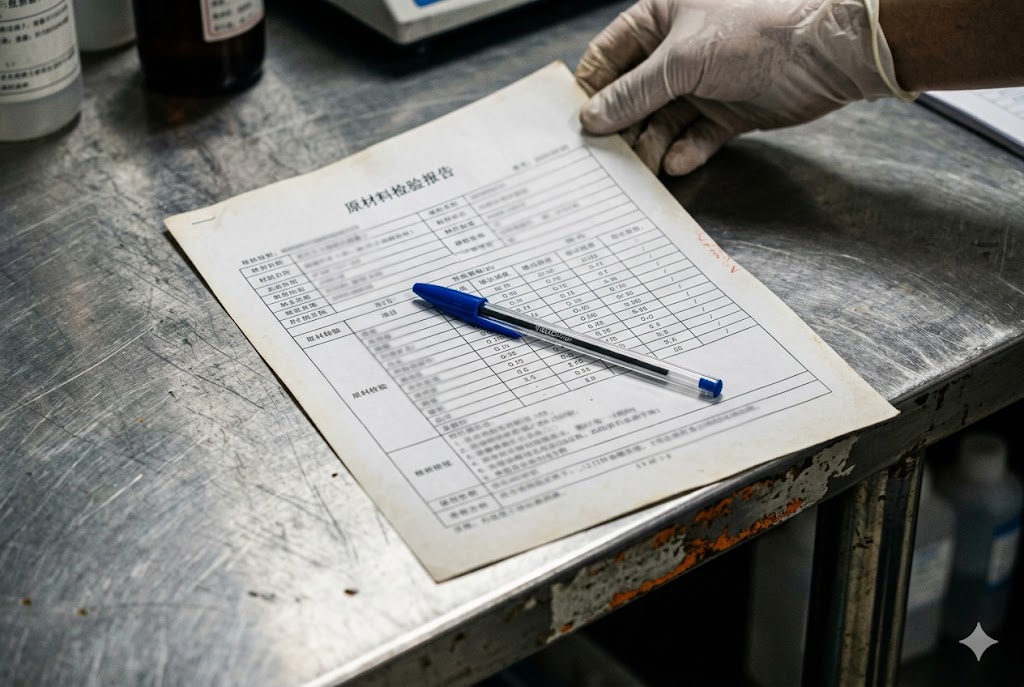
This distinction matters. A certificate of analysis 1 certifies the incoming polymer batch — the pellets that go into the barrel — not the finished part itself. It is issued by the resin manufacturer, companies like BASF, LG Chem, Sabic, or their licensed distributors, not by the molder.
When a Chinese molder hands you a document on their own letterhead stating material properties, that is an in-house statement, not a COA. It carries no traceability back to a specific production batch at the resin plant. Require the supplier to pass through the original resin maker's COA, unaltered.
Core Data Fields Required in Every COA
| Data Field | Why It Matters | Acceptable Format |
|---|---|---|
| Resin manufacturer name | Identifies the issuing party | Full legal entity name |
| Commercial grade designation | Enables datasheet cross-check | E.g., BASF Ultramid A3WG6 |
| Lot / batch number | Enables chain-of-custody tracing | Alphanumeric, unique per batch |
| Melt flow index (MFI) | Process compatibility verification | g/10 min at specified temp/load |
| Tensile strength | Mechanical property confirmation | MPa, per ASTM D638 or ISO 527 |
| Density | Grade identity check | g/cm³ |
| Moisture content | Drying requirement confirmation | % by weight |
| Date of manufacture | Shelf-life and storage tracking | Month/Year minimum |
| Test method standards | Result validity confirmation | ASTM or ISO designation |
Regulated Applications Require Additional Fields
For parts used in food contact, medical, or electrical applications, a standard mechanical COA is insufficient. You must specify in your purchase order which additional fields are mandatory.
The SafetyCulture COA guide 2 notes that the FDA requires each COA to be dated and signed by an authorized representative of the manufacturer's quality unit before release — a requirement that flows through to regulated resins regardless of the country of origin.
| Application | Additional COA Field Required |
|---|---|
| Food contact | FDA compliance letter or declaration |
| Electrical / EE | UL Yellow Card number |
| Automotive / safety | Specific ASTM or ISO test result values |
| Export to EU | RoHS/REACH declaration |
| Medical | ISO 10993 biocompatibility reference |
Generic COAs will not include these fields unless you ask for them explicitly in writing. Verbal requests at the sample stage are rarely carried forward into production documentation.
Vague Material Callouts Break COA Verification
If your purchase order says "PA66+GF30," the COA cannot be verified against any specific datasheet. There are dozens of PA66+GF30 grades across multiple resin makers, each with different mechanical profiles, processing windows, and compliance status.
Specify the full commercial designation. For example: BASF Ultramid A3WG6, or LG Chem Lupoy HI-121H. This is the only way to cross-check the COA test values against published data. If you don't know the exact grade, require your supplier to disclose and lock in the designation before production starts — make it a named field on the purchase order.
How Do I Verify That the COA Provided by a Chinese Injection Molding Supplier Is Authentic?
We have seen fabricated COAs. They look real. The formatting is clean, the test values fall within spec, and the resin manufacturer's name is correct. The forgery only becomes visible when you know what to check.
To verify a COA from a Chinese supplier, cross-reference the lot number against the resin manufacturer's records by contacting their technical sales team directly, compare every test value against the published datasheet, and require the molder to provide the original incoming material receiving record that links the lot number to their production run.

Step 1: Contact the Resin Manufacturer Directly
Every major resin maker — BASF, Celanese, Sabic, DSM, LG Chem — has a technical sales or customer service channel. Provide the lot number from the COA and ask them to confirm it was issued for that batch. This takes one email and usually resolves in 24 to 48 hours.
Most buyers skip this step because they assume it is the supplier's responsibility to prove authenticity. It is. But verification is your protection.
Step 2: Compare Test Values Against the Published Datasheet
Pull the resin manufacturer's official datasheet for the exact grade listed on the COA. Check every COA test value against the datasheet's typical or minimum/maximum values. COA values should fall within the published range, not simply match the nominal value exactly.
The melt flow index measured per ASTM D1238 3 is one of the most telling values to cross-check — it is part of the polymer's identity and used directly to verify that the resin grade falls within its required fluidity range. A suspiciously perfect match — every COA value exactly equal to the datasheet nominal — is a red flag. Real production batches show small variation. If every value is exactly on the nominal, the document may be copied from the datasheet rather than generated from actual test results.
Step 3: Require the Molder's Incoming Material Receiving Record
This is the chain-of-custody link. When the molder receives a shipment of resin, they should log the lot number, quantity, date received, and supplier name in an incoming material register. Request this record and confirm it contains the same lot number as the COA.
| Verification Step | Document to Request | Who Issues It |
|---|---|---|
| Lot number authenticity | Confirm with resin OEM directly | Resin manufacturer |
| Test value accuracy | Published datasheet comparison | Resin manufacturer website |
| Incoming material receipt | Incoming material receiving log | Molder's QC department |
| Distributor traceability | Distributor packing slip or delivery note | Distributor |
Chinese Molders Often Source Through Distributors
Most Chinese injection molders do not buy resin directly from the resin OEM. They purchase from domestic distributors. This adds a step in the chain. The distributor may re-issue their own delivery document, which can look like a COA but carries only the distributor's lot reference, not the original manufacturer's production batch number.
Require the molder to provide the upstream mill or manufacturer COA, not the distributor's re-issued document. Ask specifically: "Please provide the resin OEM's COA, not the distributor's delivery note." If the molder cannot obtain it from their distributor, that is a traceability gap you need to flag before production ships.
Build a COA Archive Protocol Into Your Quality Agreement
A COA has no long-term value unless it is stored and linked to production records. Specify in your quality agreement that each production run's COA must be filed against the shipment invoice number and retained for a defined period. Three years is a minimum for industrial parts. Safety-critical applications typically require ten years or more.
Without an archive protocol, COAs become one-time documents. If a field failure surfaces two years later, you have no material traceability to support a root-cause investigation.
Should I Require a COA for Every Batch or Only for the First Production Run from a Chinese Factory?
This is the question buyers get wrong most often. The logic behind "first run only" is understandable: you qualified the material at PPAP, so why repeat it? The problem is that material qualification at PPAP does not prevent resin substitution on the second or third production run.
Require a COA for every production batch, not only the first run. Resin lot changes occur between production runs without buyer notification, distributor inventory practices introduce untracked lot variation, and material substitution risk is highest on repeat orders where buyers have reduced oversight. Batch-level COA requirements are the only contractual mechanism that creates ongoing traceability.

Why First-Run-Only COA Requirements Fail
When a molder qualifies a resin grade for PPAP, they use a specific lot. The qualification data — dimensions, mechanical test results, surface appearance — is tied to that lot. But resin is a consumable. The molder exhausts that lot and orders more. The next lot may be from the same grade and OEM, or it may not be.
Resin lots vary within a grade's published specification range. Tensile strength data obtained per ASTM D638 4 can shift between lots that both meet the published specification — a variation that is acceptable to the resin manufacturer but may not be acceptable to your part geometry or your customer's assembly process.
The Batch-Level COA and Process Parameters Cross-Check
When you receive a COA for each production batch, you can cross-validate the melt flow index against the molder's injection process parameters. A molder running a resin at significantly higher melt temperature or injection pressure than the standard process to compensate for a worn tool or an MFI shift is a defect precursor. That signal only becomes visible when COA data is compared against actual process records.
In a full PPAP submission for injection molding 5, resin traceability and the COA are required elements of the Material Evidence pillar — alongside dimensional results and process capability data. Batch-level COA collection is the natural extension of that requirement into serial production.
| Scenario | COA Required? | Reason |
|---|---|---|
| First production run (PPAP) | Yes | Material qualification baseline |
| Repeat production, same resin lot | Confirm lot continuity | Lot number must match prior COA |
| Repeat production, new resin lot | Yes — new COA required | New lot requires independent traceability |
| Resin supplier change | Yes — plus advance notification | New supplier requires full requalification |
| Emergency material substitution | Yes — plus written buyer approval | Substitution without approval is a contract breach |
Tie COA Submission to Payment or Shipment Milestones
The most effective enforcement mechanism is contractual timing. Require COA delivery before or concurrent with shipment, not after. A supplier who receives full payment before documentation is delivered has no incentive to provide it. State this explicitly in your purchase order terms: "Final invoice will not be approved until COA for the shipped batch is received and accepted."
PPAP and COA as a Named Deliverable
If your supplier is PPAP-capable, the COA is a required element of the Material Evidence submission under a Level 3 PPAP package. Request it as a named deliverable with a cross-reference to the ballooned drawing and the production part approval record. This connects the material documentation to the dimensional and functional approval data in a single traceable package.
What Should I Do If a Chinese Injection Molding Supplier Refuses to Provide a Material COA?
Refusal is a data point. Understanding why a supplier refuses to provide a COA tells you something specific about the risk you are carrying.
If a Chinese injection molding supplier refuses to provide a resin COA, first determine whether the refusal is due to a genuine traceability gap — no original OEM document exists in their supply chain — or a deliberate attempt to avoid material scrutiny. Then respond with specific contractual consequences: hold shipment, escalate to a third-party inspection agency, or terminate the order under your quality agreement's non-conformance clause.
Common Reasons for Refusal and How to Respond
Not all refusals are acts of bad faith. Some have operational explanations. Each requires a different response.
Reason 1: The molder cannot obtain the OEM COA from their distributor.
This is the most common legitimate reason. Many Chinese distributors do not provide OEM COAs as standard practice. Your response: require the molder to source material directly from an authorized distributor who can supply original manufacturer documentation. Give them a timeframe. If they cannot source COA-traceable material, they are not qualified for your program.
Reason 2: The molder uses a domestic Chinese resin brand without international documentation practices.
Some smaller Chinese molders source from domestic resin producers who issue Chinese-language internal test reports rather than internationally formatted COAs. Your response: require the molder to switch to an internationally recognized resin grade covered by a datasheet you can verify. Add this as a qualification requirement, not a request.
Reason 3: The molder is using a substitute material and cannot document what it actually is.
This is the high-risk scenario. If a molder cannot or will not provide a COA for a repeat production run, and the original qualification run did include one, the most probable explanation is a resin change. Your response: halt shipment, commission differential scanning calorimetry (DSC) testing 6 on retained samples through a third-party lab, and invoke your quality agreement's material non-conformance clause. DSC is a proven tool for identifying contaminating or substitute polymeric material when the thermal properties of the contaminant differ from those of the specified resin.
Electrical and EU-Destined Parts Carry Additional Documentation Obligations
For parts destined for electrical or electronic assemblies, COA refusal compounds a second compliance gap. Resin used in electrical enclosures or components must typically carry a UL 94 flammability rating 7 traceable to a UL Yellow Card for the specific grade and thickness. A molder who cannot supply the resin COA almost certainly cannot supply the Yellow Card either.
For parts being exported to EU markets, the combination of COA absence and undisclosed material substitution can trigger a RoHS and REACH compliance 8 gap. Without knowing the actual resin identity and its additive package, there is no basis for issuing a declaration of conformity. Non-compliance with RoHS or REACH can result in fines, product recalls, and reputational damage for the importer of record.
Contractual Language That Prevents Refusal
The most effective tool against COA refusal is a purchase order clause that makes COA delivery a condition of payment and shipment. The language does not need to be complex.
Include the following in your PO terms:
- "Supplier shall provide the resin manufacturer's original COA for each production batch prior to or concurrent with shipment."
- "Shipment release and final payment are contingent upon receipt of an acceptable COA."
- "Any resin supplier or lot change requires written buyer approval prior to production."
For programs with long supply relationships, include a resin change notification clause in your quality agreement. In Chinese manufacturing contracts governed under CIETAC arbitration, this obligation must be stated explicitly. It is not implied by general quality standards language or ISO certification.
When to Escalate to Third-Party Inspection
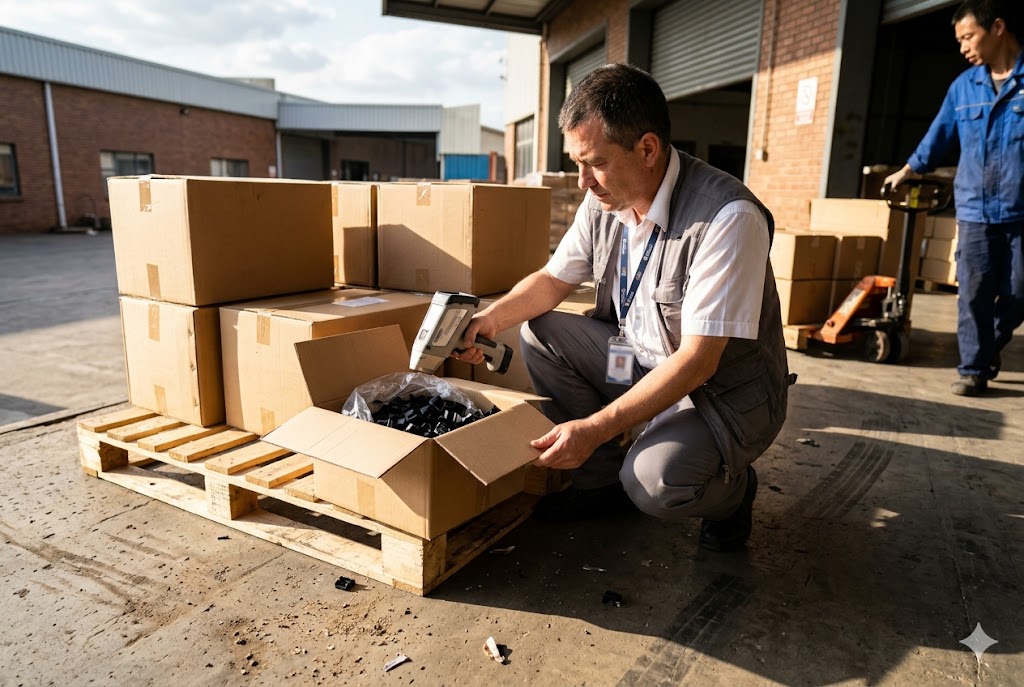
If a supplier refuses to provide a COA and shipment is imminent, engage a third-party pre-shipment inspection agency in China 9 — SGS, Bureau Veritas, or equivalent — to conduct pre-shipment material sampling. DSC testing can confirm resin identity. XRF can screen for undisclosed additives or filler content.
This is not a substitute for contractual COA requirements, but it gives you independent material evidence before goods leave China. The cost of a pre-shipment inspection is a fraction of the cost of a field failure or a customer rejection. For medical-grade parts, the COA must also reference ISO 10993 biocompatibility 10 data when the resin will contact the human body — a requirement that no pre-shipment workaround can substitute for. Without the original resin OEM's documentation, ISO 10993 traceability is impossible to establish.
Conclusion
A material COA is only useful if it is authentic, complete, and tied to a specific production batch. Specify the resin grade in writing, require the original OEM document, link COA delivery to shipment release, and verify every run — not just the first.
Footnotes
1. Wikipedia overview of what a certificate of analysis is and what it must contain. ↩︎
2. SafetyCulture guide on COA requirements including FDA signature and dating rules. ↩︎
3. Instron reference on ASTM D1238 melt flow index testing for thermoplastic polymers. ↩︎
4. Instron guide to ASTM D638 tensile property testing for reinforced and unreinforced plastics. ↩︎
5. Injection molding PPAP document requirements including COA as Material Evidence. ↩︎
6. EAG Laboratories application note on DSC for identifying substitute or contaminated resin. ↩︎
7. Wikipedia entry on UL 94 flammability standard and Yellow Card certification for plastics. ↩︎
8. Source Intelligence comparison of EU RoHS and REACH compliance obligations for exporters. ↩︎
9. Maple Sourcing guide to top pre-shipment inspection providers in China including SGS and Bureau Veritas. ↩︎
10. Wikipedia overview of ISO 10993 biocompatibility evaluation standards for medical devices. ↩︎