Skip to main content Skip to footer

Every year, our team processes hundreds of sourcing projects for custom injection-molded parts. One issue we see repeatedly — and one that causes real losses — is buyers not knowing what is actually inside their parts. The additives your supplier uses determine whether your parts hold up in the field or fail at the worst possible moment.
Glass fiber and flame retardant additives are the two most consequential variables in injection-molded part performance. Glass fiber increases strength but introduces warpage risk and directional weakness. Flame retardants must match your target market's regulations — halogenated systems are cost-efficient but restricted under RoHS and REACH, while halogen-free systems require careful formulation to avoid strength loss.
Understanding these variables before you place an order is far cheaper than dealing with failed parts, failed audits, or failed shipments at the U.S. border.
How Does Glass Fiber Reinforcement Change the Mechanical Properties and Moldability of Injection-Molded Parts from China?
When we review drawing packages from clients sourcing glass-fiber-reinforced parts, most specs list a single number: "30% GF." That number tells only part of the story. Fiber grade, sizing chemistry, and gate placement matter just as much — and most suppliers will not raise this unless you ask.
Glass fiber reinforcement at 10–40% loading significantly increases tensile strength and stiffness, but fibers align with melt flow during molding, making parts stronger along the flow axis and weaker across it. This anisotropy must be accounted for in structural design. Differential shrinkage between flow and transverse directions also makes warpage a predictable risk that requires mold simulation before tooling approval.
What Glass Fiber Actually Does to Your Part
Glass fiber does not just make plastic harder. It changes the entire behavior of the material during and after molding.
When molten resin flows through a mold, fibers align parallel to the flow direction. This creates a part that behaves very differently depending on which direction you load it. Tensile strength along the flow axis can improve by 50–100% compared to unfilled resin. But in the transverse direction, that improvement is much smaller. If a structural load on your part does not align with the flow direction, your design assumptions based on material datasheets may be wrong.
Shrinkage tells a similar story. Unfilled nylon or polypropylene may shrink around 0.8–1.5% uniformly. Add 30% glass fiber and longitudinal shrinkage can drop below 0.1%, while transverse shrinkage stays much higher. This gap causes warpage — the part wants to curl because the two directions are fighting each other. This is not a defect that appears randomly. It is predictable with mold flow simulation software 1 such as Moldflow or Moldex3D. Any supplier telling you warpage only becomes visible after the first sample is not doing their job upstream.
The Fiber Grade Problem
Here is something most buyers never check: not all glass fiber is equal, even at the same weight percentage.
| Fiber Variable | Why It Matters | What to Specify |
|---|---|---|
| Fiber diameter | Finer fibers give better surface and impact resistance | Typical: 10–13 µm; specify max |
| Sizing chemistry | Determines adhesion to matrix resin | Must match base resin (PA, PBT, PP) |
| Chopped strand length | Affects flow and final part strength | Typically 3–4.5 mm for injection molding |
| Fiber supplier | Grade consistency between production runs | Specify by name: Owens Corning, Jushi, NEG |
Chinese tier-2 compounders routinely substitute fiber grade without disclosing the change. Why? Because fiber specifications are rarely captured in a Certificate of Conformance. If your CoC only says "30% glass fiber," it says nothing about which glass fiber. The supplier can swap from a premium Owens Corning grade to a lower-cost domestic alternative and your paperwork will look identical.
The fix is straightforward but requires you to ask for it: require material data sheets that reference a specific fiber supplier and grade. Then validate with LOI (loss-on-ignition) testing 2 on incoming pellets. LOI measures the actual fiber content by burning off the resin. It takes about 20 minutes and costs almost nothing compared to the risk.
Fiber Blooming: A Defect That Must Be Defined Upfront
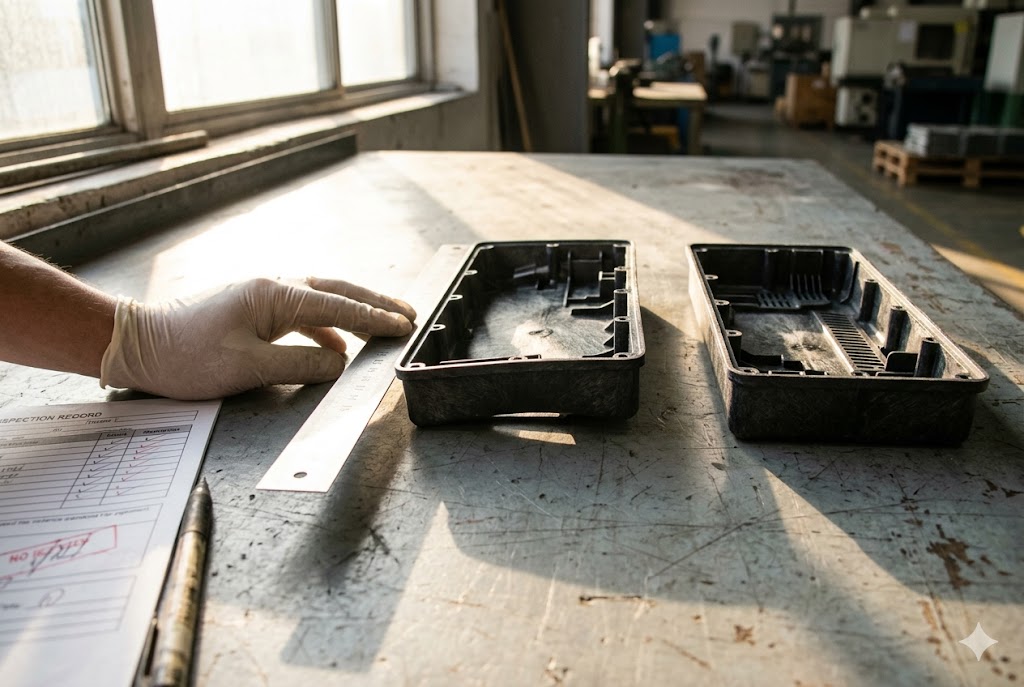
Fiber "blooming" — where glass fibers migrate to the part surface during molding — is common and consequential. It creates a rough, abrasive texture. In electrical enclosures, surface-exposed glass fibers can compromise insulation resistance.
Blooming gets worse with high injection speed, low mold temperature, or incorrect screw geometry. It is manageable with the right process setup. But if you do not define acceptance criteria for it in your part spec, the supplier has no obligation to control for it. Include surface texture requirements, specify whether visual inspection or cross-section sampling is required, and make this explicit in your purchase order.
Warpage Tolerance and Mold Simulation
Run simulation before cutting steel. This is not optional for GF-reinforced parts. Research shows that differential shrinkage between flow and transverse directions 3 is the dominant driver of warpage in fiber-reinforced injection-molded parts, with shrinkage ratios typically ranging from 2:1 to 4:1.
| Fiber Content | Approx. Longitudinal Shrinkage | Approx. Transverse Shrinkage | Warpage Risk Level |
|---|---|---|---|
| 0% (unfilled) | 0.8–1.5% | 0.8–1.5% | Low |
| 10% GF | 0.4–0.6% | 0.6–0.9% | Moderate |
| 20% GF | 0.2–0.4% | 0.5–0.8% | High |
| 30% GF | 0.05–0.15% | 0.4–0.7% | High |
| 40% GF | <0.1% | 0.3–0.6% | Very High |
Gate placement, wall thickness transitions, and cooling channel layout all influence final warpage. Requiring a Moldflow simulation report before tooling approval is a reasonable contract requirement. If a supplier cannot provide it, that tells you something.
What Flame Retardant Standards Should I Require for Injection-Molded Parts Destined for the U.S. Market?
In our experience reviewing compliance documentation from Chinese suppliers, "RoHS compliant" stamped on a CoC is one of the most overused and least meaningful phrases in the industry. It can mean almost anything — or nothing — depending on which RoHS standard was tested against and by whom.
For injection-molded parts sold or used in the U.S. market, UL 94 is the primary flammability standard. The required rating — V-0, V-1, or V-2 — depends on your end-use application. Parts in electrical enclosures or near ignition sources typically require V-0. Halogenated flame retardants achieve these ratings at low loading but are restricted by EU RoHS and REACH; halogen-free alternatives are compliant but require higher additive loading and careful formulation management.

UL 94 Ratings Explained
UL 94 4 is the standard most U.S. buyers and their end customers care about. It tests how a material responds to a flame applied directly to the part.
| UL 94 Rating | Description | Typical Applications |
|---|---|---|
| HB | Self-extinguishing at a slower rate; lowest classification | Non-critical housings, enclosures away from ignition sources |
| V-2 | Extinguishes within 30s; burning drips allowed | General electrical housings |
| V-1 | Extinguishes within 30s; no burning drips | Industrial equipment, connectors |
| V-0 | Extinguishes within 10s; no burning drips | Power supplies, circuit breaker housings, EV components |
| 5VA / 5VB | Highest classification; no burn-through of plaque | Server chassis, high-voltage enclosures |
Specify the rating you need in your purchase order and drawing. Do not leave it to the supplier to decide. Many suppliers default to whatever is cheapest that still achieves the listed rating, which may not be what your downstream customer requires.
Halogenated vs. Halogen-Free: The Real Trade-Off
Halogenated flame retardants — primarily bromine-based systems using compounds like decabromodiphenyl ether plus antimony trioxide as a synergist — are effective at low loading levels. That makes them cheap to compound and easy to process.
The problem: specific compounds including PBB and PBDE are explicitly restricted under the EU RoHS Directive 2011/65/EU 5 and are on the REACH SVHC candidate list 6. If your parts go anywhere near the EU, or if your U.S. customer sells into the EU, halogenated formulations are a liability.
Halogen-free flame retardant (HFFR) systems 7 — typically phosphorus-nitrogen intumescent chemistry 8 — are RoHS and REACH compliant. They produce lower smoke and no dioxins when burned. That matters for safety ratings in enclosed spaces.
The trade-off: HFFR systems need higher loading to achieve equivalent UL 94 ratings. Higher loading increases the risk of impact strength reduction, greater moisture absorption, and processing complications if the formulation is not properly engineered. A supplier who under-specifies the HFFR loading to save cost will give you parts that fail the flame test on a subsequent production run.
Combining Glass Fiber and Flame Retardants: A Formulation Tension
This is the area where problems cluster in GF/FR compounded parts.
Glass fiber raises the processing temperature requirement — typically 10–30°C above unfilled resin. Many flame retardant additives have finite thermal stability windows. If a commodity compounder in China is not carefully matching the FR chemistry to the processing temperature, partial decomposition of the FR additive can occur during molding. The result: parts that degrade both in flame performance and mechanical properties. The part looks fine visually but fails a UL 94 retest.
This is not a theoretical risk. Our quality team has seen it on incoming inspection. The fix is requiring a compounding specification that lists both the FR additive and the processing temperature range, then verifying through third-party testing on production samples — not just on the initial approval sample.
How Do I Verify That Additives Used by a Chinese Injection Molding Supplier Meet UL 94 or Other Safety Requirements?
Our sourcing team has audited dozens of injection molding suppliers across China and Vietnam. The gap between what a supplier claims on paper and what ends up in the compound is one of the most consistent risks we document. The solution is not distrust — it is systematic verification built into your contract and receiving process.
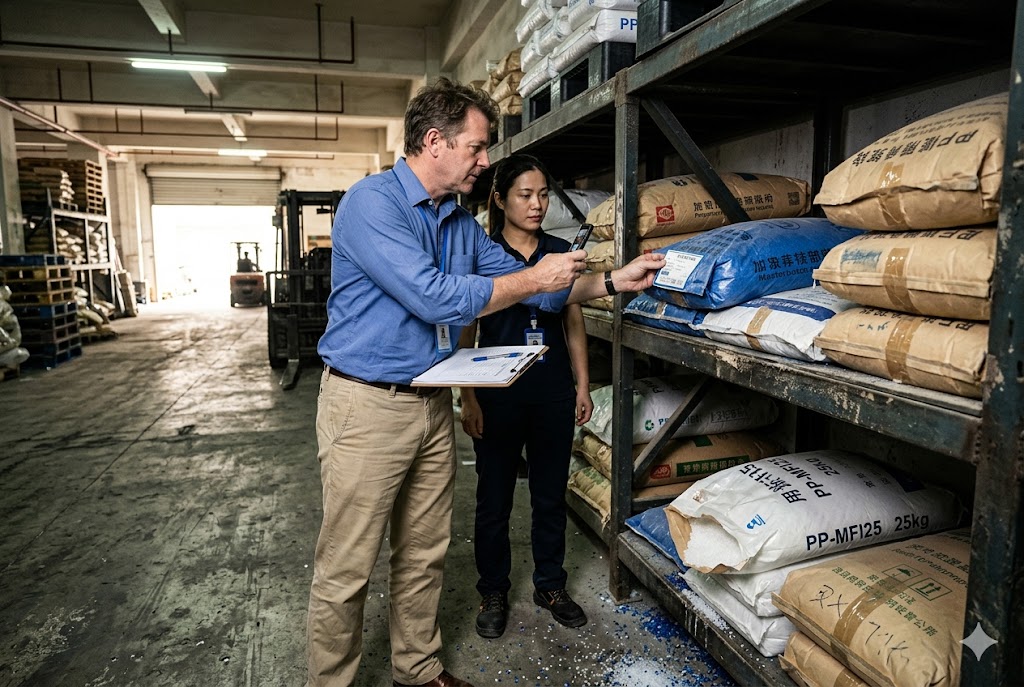
To verify additive compliance at a Chinese injection molding supplier, require batch-level Certificates of Conformance that identify the FR chemistry by name — not just the UL 94 rating — and back this with third-party XRF screening or ICP-MS analysis on production samples. Auditing the supplier's incoming material records for resin and masterbatch lots is equally critical.
What a Certificate of Conformance Should Actually Say
Most CoCs from Chinese suppliers say very little. A generic CoC for a flame-retardant compounded resin might list: material grade, UL 94 rating, tensile strength, and a RoHS tick box. This is not sufficient for traceability.
A CoC that provides actual assurance should include:
- Base resin grade and supplier name
- Flame retardant additive type (halogenated or halogen-free), active chemistry class, and brand name
- Glass fiber supplier and grade designation (if applicable)
- Lot number linked to a specific production run
- Test report reference number from UL 94 testing, including the test date and lab
If a supplier cannot or will not provide this level of detail, that is a red flag about their traceability and their compound consistency.
Third-Party Testing Methods
Do not rely solely on supplier-provided documentation. Two testing methods are worth building into your receiving inspection process:
XRF Screening — X-ray fluorescence screening 9 detects elemental composition. It can identify the presence of bromine, chlorine, antimony, phosphorus, and other elements that indicate what type of FR system is in use. It is fast (results in minutes), non-destructive, and low-cost. It will not give you compound concentrations, but it will flag halogenated systems immediately.
ICP-MS Analysis — Inductively coupled plasma mass spectrometry 10 gives quantitative elemental data at trace levels. Use this when XRF flags a concern or when you need documentation for regulatory purposes (REACH SVHC substances require quantitative analysis to confirm compliance against threshold levels).
LOI Testing — Loss-on-ignition, discussed earlier for glass fiber, also works for overall filler content verification. Combine with material density measurement for a low-cost incoming check on compound composition.
Building Verification Into Your Contract
Supplier conversation alone does not protect you. Requirements must be in writing — in the purchase order or the quality agreement. Specify:
- Required UL 94 classification for the part
- Halogen-free vs. halogenated requirement (or prohibition)
- Required documentation at each shipment: lot-level CoC with FR chemistry identification
- Right-to-test clause: you can submit production samples to a third-party lab at any time
- Corrective action requirement if testing reveals substitution
Suppliers who object to these terms are telling you something about how they operate.
Moisture, Storage, and Pre-Drying
One factor that gets overlooked: halogen-free phosphorus-nitrogen FR systems increase hygroscopicity. Glass fiber sizing also degrades at elevated moisture content.
Parts or pellets stored in humid conditions without proper pre-drying can absorb enough moisture to cause a 15–30% reduction in impact resistance and dimensional instability. This degradation may not appear during initial first-article inspection. It surfaces later, during production use in a humid environment or after long storage in a warehouse.
Pre-drying protocols should be specified in your molding specification. Require the supplier to document drying temperature, time, and moisture content verification before molding begins.
What Are the Risks of Undisclosed Additive Substitution by Chinese Injection Molding Suppliers?
Our team has dealt with this directly on behalf of clients. Undisclosed substitution — swapping an additive for a cheaper alternative without telling the buyer — is not rare. It is a predictable outcome of cost pressure in a commodity supply chain, unless you build controls to prevent it.
Undisclosed additive substitution by Chinese injection molding suppliers can cause flame performance failure, dimensional instability, regulatory non-compliance, and part rejection. It is most common in glass fiber grade and FR masterbatch reformulations. The risk increases significantly when buyers rely only on initial approval documentation without requiring lot-level traceability across production runs.
Why Substitution Happens
Understanding the motive makes it easier to defend against.
Chinese tier-2 compounders operate on thin margins. The cost difference between a premium fiber grade and a domestic alternative, or between a name-brand FR masterbatch and a reformulated generic, can be meaningful on a per-kilogram basis. When a supplier is absorbing material cost increases, substitution is a lever they can pull without the buyer noticing — at least not immediately.
Masterbatch producers face a similar pressure. They may maintain the same product code and branding while reformulating the active FR chemistry to lower-cost ingredients. The UL 94 test certificate is tied to the original formulation, not to every subsequent batch produced under that product name.
Where Substitution Is Most Likely
| Component | Typical Substitution | Risk to Part Performance |
|---|---|---|
| Glass fiber grade | Lower-cost domestic fiber, different sizing | Reduced strength, poor matrix adhesion, inconsistent shrinkage |
| FR masterbatch | Reformulated active chemistry at same product code | Flame performance failure, possible regulatory non-compliance |
| Base resin | Lower-viscosity grade or recycled content blending | Dimensional variation, mechanical property drop |
| Colorant masterbatch | Heavy-metal-based pigments (cadmium, lead) | RoHS/REACH violation |
What Substitution Looks Like in Practice
Parts look normal on visual inspection. Dimensions may be within tolerance. The problem surfaces in one of three places:
Failed retesting — A client's customer runs a UL 94 retest on a production lot and it fails. The approval sample passed. The compound has been quietly reformulated since then.
Field failure — Parts in a humid environment start showing dimensional shift or reduced impact resistance. The change in HFFR loading or fiber grade has increased moisture absorption, and the problem only emerges after months of storage or use.
Customs or regulatory audit — A shipment is held because XRF screening at the border or by a third-party lab detects bromine above the EU RoHS threshold. The supplier's CoC said "halogen-free." The masterbatch reformulation included a halogenated component the supplier either did not know about or did not disclose.
Controls That Actually Work
The most effective controls are contractual and operational — not just relational.
First, require lot-level traceability. Every shipment should be traceable to a specific compound lot, which is traceable to specific raw material lots for resin, fiber, and FR masterbatch. This creates accountability.
Second, require a right-to-audit clause covering material procurement records. When you conduct a factory audit, review incoming material records. Check that the fiber supplier listed in the CoC matches the actual incoming delivery records for that production run.
Third, use periodic third-party testing — not just on FAI samples, but on production lots selected randomly throughout the year. Even one or two tests per year creates a deterrent.
Fourth, if substitution is discovered, treat it as a serious contract breach. Suppliers who face real consequences for undisclosed substitution are less likely to attempt it.
Conclusion
Additives determine how your injection-molded parts perform, comply, and survive in the field. Know what is in your compound, specify it in writing, verify it with testing, and build traceability into every production run.
Footnotes
1. Detailed overview of 3D fiber orientation simulation for anisotropic shrinkage and warpage control in GF-reinforced parts. ↩︎
2. Explains the loss-on-ignition method used to measure filler content in composites and glass fiber materials. ↩︎
3. Analysis of differential shrinkage as the dominant driver of warpage in fiber-reinforced injection-molded parts. ↩︎
4. Wikipedia overview of UL 94 flammability classifications for plastic materials used in devices and appliances. ↩︎
5. Explains the 10 restricted substances under EU RoHS Directive 2011/65/EU and compliance obligations for importers. ↩︎
6. ECHA official update on REACH SVHC Candidate List additions and supplier notification obligations. ↩︎
7. 2026 guide to halogen-free flame retardant chemistry including phosphorus- and nitrogen-based systems for thermoplastics. ↩︎
8. Peer-reviewed review of phosphorus–nitrogen intumescent flame retardants as halogen-free alternatives for polymers. ↩︎
9. Technical guide to XRF and combustion IC halogen testing methods for RoHS and REACH compliance screening. ↩︎
10. Academic overview of ICP-MS for quantitative trace-element analysis in plastics and regulated materials. ↩︎