Skip to main content Skip to footer

Every year, we help clients source injection-molded parts that have to perform under real stress — high heat, heavy loads, tight tolerances. When those requirements show up in a drawing, material selection is not a detail. It is the decision. Get it wrong and the part fails. Get it right and you have a component that lasts.
The best engineering plastics for high-temperature or high-strength injection-molded parts sourced from China include PEEK, PEI (Ultem), PPS, PBT, LCP, and glass-fiber-reinforced PA66. Each material covers a different range of heat resistance, strength, and cost. The right choice depends on your application temperature, load requirements, chemical environment, and how well your Chinese supplier is equipped to process that specific resin.
Choosing the wrong material — or working with a supplier who cannot process the right one correctly — creates problems that show up after shipment. Let's go through each option clearly.
What Are the Best Engineering Plastics Available from Chinese Injection Molding Suppliers for Heat-Resistant Applications?
Our engineers review dozens of material specifications every month. Heat resistance is one of the most common requirements we see under-specified on customer drawings. When a client lists "high-temperature plastic" without defining the actual service temperature, that gap causes quoting errors, wrong material selection, and failed parts.
The best heat-resistant engineering plastics available from Chinese injection molding suppliers are PEEK (continuous use to 260°C), PEI/Ultem (continuous use to ~170°C), PPS (continuous use to ~220°C), PBT (HDT ~120–130°C), LCP (continuous use to ~200°C), and glass-fiber-reinforced PA66 (HDT ~200–250°C depending on fiber loading). Each has a different processing requirement that determines whether your Chinese supplier can actually run it correctly.
Why Service Temperature Is Not the Only Number That Matters
Heat resistance in plastics has two sides. One is the continuous service temperature — the temperature the part can survive during normal operation without losing its properties. The other is the Heat Deflection Temperature (HDT) 1 — the temperature at which the material deforms under a specific load in a standardized test.
Both numbers matter. A part in a static assembly behaves differently from a part under mechanical load at elevated temperature. Specifying only one of them in your RFQ leaves room for misinterpretation.
Here is a side-by-side comparison of the most common heat-resistant engineering plastics:
| Material | Continuous Service Temp | HDT (at 1.82 MPa) | Tensile Strength (unfilled) | Common Applications |
|---|---|---|---|---|
| PEEK | 260°C | ~160°C | 100 MPa | Aerospace bearings, semiconductor fixtures, implants |
| PEI (Ultem) | ~170°C | ~200°C | 105 MPa | Electronics brackets, medical housings, aerospace clips |
| PPS | ~220°C | ~260°C (GF-filled) | 65–70 MPa | Automotive connectors, pump parts, valves |
| LCP | ~200°C | ~250°C (GF-filled) | 170–180 MPa (GF-filled) | Multi-pin connectors, sensor housings |
| PA66-GF30 | ~130°C continuous | ~200°C | ~165 MPa | Power tools, gears, automotive under-hood |
| PBT | ~120°C | ~120–130°C | 52–56 MPa | Electrical connectors, tool housings |
PEEK: The Top-Tier Choice and Why It Demands Qualified Suppliers
PEEK injection molding 2 demands equipment that most general-purpose Chinese molders do not have. Processing requires barrel temperatures above 400°C and mold temperatures around 160°C. Standard commodity injection presses are not built for those conditions. If your supplier runs PEEK on standard equipment, the resin will degrade, and the parts will be brittle or dimensionally unstable. PEEK is the strongest, most heat-resistant injection-moldable thermoplastic in standard commercial use. It handles continuous temperatures up to 260°C, resists almost all industrial chemicals, and maintains its mechanical properties under sustained load.
When we audit suppliers for PEEK capability, we look for dedicated high-temperature presses, documented process records for PEEK specifically, and reference customer parts they have produced. A supplier who says "yes, we can do PEEK" without showing past experience is a red flag.
PEI (Ultem): The Cost-Effective Step Down
PEI, sold under the Ultem brand by SABIC, runs continuous service temperatures up to approximately 170°C with an HDT around 200°C. It carries inherent UL 94 V-0 flame retardancy 3 — important for electronics and medical device applications — and holds tight tolerances well.
For applications where PEEK performance is not required, PEI is the smarter choice. It costs significantly less, and more Chinese suppliers are equipped to process it correctly. It is widely used in electronics housings, aerospace mounting brackets, and medical device components.
PPS: The Workhorse for Automotive and Chemical Environments
PPS 4 delivers outstanding chemical resistance — it is resistant to virtually all organic solvents and many acids. Its HDT climbs above 260°C in glass-fiber-filled grades. It flows well in the mold, which benefits complex thin-wall geometries like connector housings.
Automotive under-hood components and electrical connectors are the most common PPS applications. Chinese suppliers with automotive customer experience typically have PPS processing well established. Verify that they are using name-brand resin (Toray Torelina, Solvay Ryton) rather than domestic Chinese-grade PPS compounds, which can vary in purity and lot consistency.
How Do I Compare PEEK, PPS, PEI, and PA66 for Demanding Injection Molding Applications Sourced from China?
When clients send us an RFQ with multiple material options listed, it usually means the design is not locked. That is actually a useful moment — it is cheaper to finalize the material before tooling than to re-cut a mold after a failed prototype.
To compare PEEK, PPS, PEI, and PA66 for demanding applications sourced from China, evaluate four criteria: continuous service temperature, mechanical strength under load, chemical exposure, and supplier processing capability. PEEK leads on thermal and mechanical performance but costs the most and has the narrowest supplier base in China. PA66-GF is the most widely available and lowest cost. PPS and PEI fill the middle ground.
Head-to-Head Comparison: Four Key Dimensions
The table below compares the four materials across the dimensions that matter most for industrial sourcing decisions:
| Criteria | PEEK | PEI (Ultem) | PPS | PA66-GF30 |
|---|---|---|---|---|
| Continuous Service Temp | 260°C | ~170°C | ~220°C | ~130°C |
| Tensile Strength (filled grade) | ~200 MPa (CF-filled) | ~165 MPa (GF-filled) | ~135 MPa (GF-filled) | ~165 MPa |
| Chemical Resistance | Excellent | Good | Excellent | Moderate |
| Moisture Sensitivity | Very low | Low | Very low | High |
| Relative Resin Cost | Very high | High | Moderate | Low |
| Supplier Availability in China | Limited | Moderate | Good | Very wide |
| Processing Difficulty | Very high | Moderate | Moderate | Low–moderate |
PA66-GF: The Most Sourced But Most Misspecified
Glass-fiber-reinforced PA66 is the most commonly sourced high-strength engineering plastic in China. Suppliers know how to run it. Toolmakers know how to design for its shrinkage. Pricing is competitive.
But PA66 absorbs moisture 5. Moisture changes its mechanical properties significantly. Parts tested at dry-as-molded condition will behave differently after weeks in a humid warehouse or in a machine that gets wet. If your application requires predictable strength over time, your drawing must specify whether mechanical properties are dry-as-molded or conditioned to equilibrium moisture content.
Suppliers who do not pre-dry PA66 resin properly before molding will produce parts with voids, splay, and reduced tensile strength. Resin drying is a basic process control step — but we have seen it skipped on orders where the buyer did not specify or inspect it.
When to Choose PEI Over PEEK
PEI covers most applications that seem to require PEEK but do not actually reach the 200°C+ continuous service range. If your part operates below 170°C, PEI is almost always the better commercial decision — lower resin cost, wider supplier availability in China, and easier processing means lower part cost and more sourcing options.
Reserve PEEK for applications that genuinely see continuous service above 200°C, require exceptional wear resistance (bearings, bushings), or are in contact with aggressive chemicals where PEI would degrade.
Asking the Right Questions During Supplier Qualification
Before you award a high-performance plastic order to a Chinese supplier, ask these questions directly:
- What is the maximum barrel temperature your presses can reach?
- Do you have documented processing parameters for this specific material?
- Can you show reference parts you have produced in this material?
- Who is your resin supplier, and can you provide lot traceability documentation?
- Do you have a resin dryer dedicated to this material, or shared with other resins?
A supplier who cannot answer these questions specifically does not have the capability, regardless of what their capability statement says.
Can Chinese Injection Molding Factories Reliably Process High-Performance Engineering Plastics for Industrial Parts?
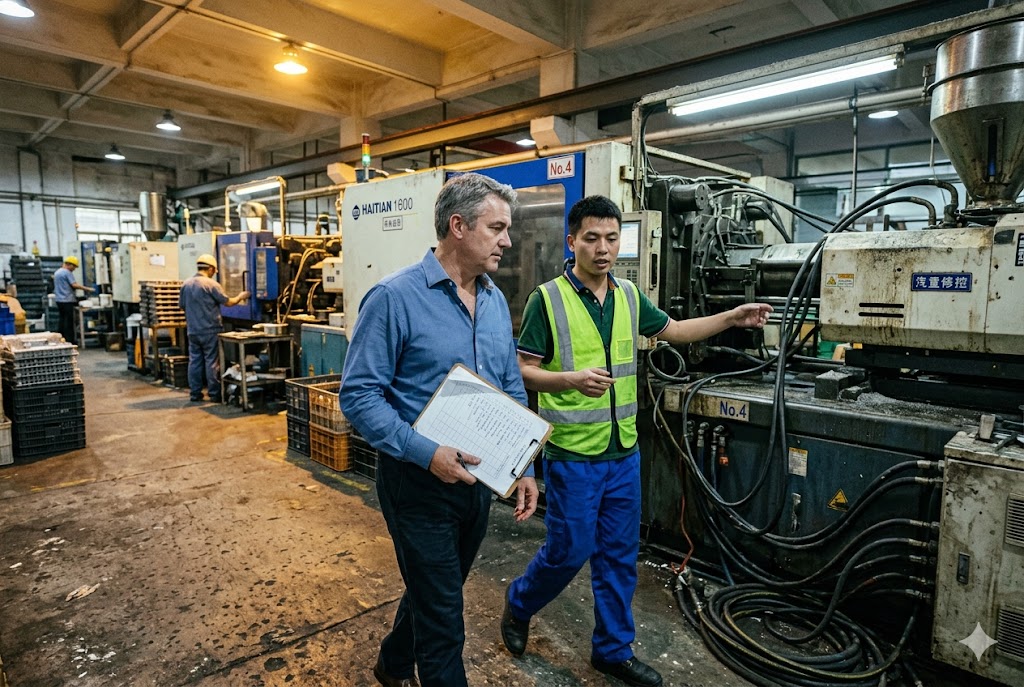
This is the question we get asked most often by new clients, and it deserves a direct answer. China has excellent injection molding capability — but it is unevenly distributed. The factories that can reliably process PEEK, PEI, and LCP are a small subset of the total supplier base.
Yes, Chinese injection molding factories can reliably process high-performance engineering plastics including PEEK, PPS, PEI, and LCP — but only a minority have the required equipment, process controls, and documented experience. Supplier selection and factory audit are essential steps. Awarding a high-performance plastic order to a supplier based on price alone, without capability verification, is the most common sourcing mistake in this category.
The Real Risk: Material Substitution
Material substitution is a persistent risk in the China supply chain that buyers consistently underestimate. A supplier who quotes on PEEK may run production with PPS or a PA66-GF compound. The finished parts look identical. The part number is the same. But the thermal and mechanical properties are entirely different.
This is not always intentional fraud. Sometimes a supplier cannot actually process the specified material and substitutes without disclosure. Sometimes a purchasing agent at the factory makes a cost-saving decision without telling their own sales team.
The most defensible defense against this is contractual and procedural:
- Require resin manufacturer lot traceability documentation with every shipment.
- Request that virgin resin pellet samples from the production lot be shipped alongside finished parts.
- Specify third-party DSC (Differential Scanning Calorimetry) 6 testing as an incoming inspection gate. DSC identifies polymers definitively by their melt transition signatures — it will catch a PPS part sold as PEEK immediately.
Glass-Fiber Loading Variation: An Underappreciated Quality Risk
Chinese compounders producing glass-fiber-reinforced grades frequently vary actual fiber loading by ±5–8% from the nominal specification across production lots. A PA66-GF30 compound from a domestic Chinese compounder may be 25% glass in one lot and 33% in another.
That variation meaningfully shifts tensile strength, HDT, and warpage behavior. Parts from your approved sample will behave differently from mass production parts — not because the molder changed anything, but because the resin changed under them.
Specify fiber content with a tolerance band in your purchase specification. For example: "Glass fiber content: 30% ±2% by weight." Then require third-party burn-off testing per ISO 3451 7 or TGA testing on resin certificates of conformance for structural-grade applications. This is a reasonable ask for any order above a few hundred kilograms.
What a Proper Supplier Audit Covers
When we conduct factory audits on behalf of clients sourcing high-performance plastic parts, we check the following:
| Audit Area | What We Verify |
|---|---|
| Machine capability | Maximum barrel temperature, clamp tonnage, shot size range |
| Mold temperature control | Dedicated temperature controllers, oil vs water heating |
| Resin handling | Dedicated dryers per material, logged drying time and temperature |
| Process documentation | Recorded process parameters per material and part number |
| Quality inspection | CMM availability, first-article inspection records, in-process checks |
| Resin traceability | Resin supplier certificates, lot numbers linked to production records |
| Reference parts | Existing parts in same or similar material with customer approval evidence |
A supplier who passes all seven areas is a qualified candidate. A supplier who passes three or four is a risk that needs a mitigation plan.
LCP and Torlon PAI: Where Chinese Capability Gets Thin
LCP (Liquid Crystal Polymer) 8 capability in China exists, but is concentrated in the Shenzhen and Dongguan electronics manufacturing clusters. LCP's near-zero warp and very low moisture absorption make it excellent for tight-tolerance multi-pin connectors — applications where PA66-GF and PBT distort under assembly loads. Specifying brand-name resin (Celanese Vectra, Sumitomo Sumikasuper) on your BOM is the most effective protection against domestic off-brand LCP substitution.
Torlon PAI (Polyamide-Imide) is the highest-performing injection-moldable thermoplastic, with continuous service temperatures exceeding 260°C. Chinese supplier capability for Torlon is genuinely limited. The narrow melt processing window, machine sizing sensitivity, and mandatory post-mold annealing cycles mean very few Chinese molders can produce dimensionally stable, fully developed-property PAI parts. If your application requires Torlon, supplier qualification must verify specific PAI molding experience — not just general high-temperature plastic capability.
How Do I Specify Heat Deflection Temperature and Tensile Strength Requirements in My RFQ to Chinese Suppliers?
Vague RFQs produce unreliable quotes. When a drawing says "high-strength plastic" without a number, every supplier interprets it differently. Specifying HDT and tensile strength as measurable requirements on your RFQ is the simplest way to reduce that ambiguity.
To specify heat deflection temperature and tensile strength in an RFQ to Chinese suppliers, state the minimum HDT (in °C, at a defined load per ISO 75 or ASTM D648), minimum tensile strength (in MPa, per ISO 527 or ASTM D638), the test condition (dry-as-molded or conditioned), and whether the values apply to base resin or a specific filled grade. Attach a material data sheet or specify a brand name and grade where possible.

Why Test Standard and Condition Must Be Stated
HDT and tensile strength values are meaningless without the test standard and test condition. Consider these two specifications:
- "Minimum HDT: 200°C"
- "Minimum HDT: 200°C per ISO 75 Method A 9 (1.82 MPa load), dry-as-molded condition"
The first statement can be met by dozens of materials and filled grades. The second one narrows the candidate materials significantly and removes interpretation risk.
The same logic applies to tensile strength. PA66-GF30 tested dry-as-molded has a tensile strength around 165 MPa. The same material tested after moisture conditioning may be 90–110 MPa. If your application loads the part in a humid environment, the conditioned value is the one that matters — and you need to say so.
How to Structure a Material Specification in Your RFQ
Use this format when writing material requirements into a purchase specification or drawing callout:
| Field | Example Entry |
|---|---|
| Material type | Polyamide 66, 30% glass fiber reinforced |
| Brand / grade (if applicable) | BASF Ultramid A3HG6 or equivalent |
| Minimum tensile strength | 160 MPa (ISO 527, dry-as-molded) |
| Minimum HDT | 200°C (ISO 75 Method A, 1.82 MPa load) |
| Fiber content tolerance | 30% ±2% by weight |
| Resin certification required | Yes — resin manufacturer CoC with lot number |
| Third-party testing required | Burn-off test (ISO 3451) for fiber content verification |
When you send this to a Chinese supplier, they know exactly what they are quoting. There is no room to substitute a lower-cost domestic compound and claim it meets requirements.
When to Name a Brand vs. Allow Equivalents
Naming a specific resin brand (BASF, DSM, DuPont, Solvay, SABIC) on your BOM is the most direct way to control material quality. It also limits your supplier's ability to substitute without disclosure.
However, some Chinese suppliers cannot source brand-name resins at competitive cost. If you allow equivalents, require that the supplier submit the proposed equivalent resin's data sheet before production starts, and compare it against the named brand's data sheet yourself. Do not accept "equivalent" as a verbal assurance.
For critical structural or thermal applications — aerospace, medical devices, safety-critical automotive parts — name the brand and do not accept equivalents.
Using Your RFQ as a Supplier Screening Tool
A well-written material specification does more than protect your part quality. It also screens out suppliers who are not qualified. A supplier who responds to a PEEK RFQ with a question like "Can we use PPS instead? It has similar properties" is telling you they do not have PEEK capability and do not fully understand the material difference. That response is useful information — it saves you from awarding the order to the wrong factory.
The RFQ is your first quality gate. Make it specific enough to do that job. For example, one useful way to validate incoming material quality is to reference ash content testing methods 10 such as ASTM D5630 and ISO 3451, which independently verify glass fiber loading in reinforced compounds.
Conclusion
Material selection for high-temperature injection-molded parts is a technical decision with real supply chain consequences. Specify the right material with measurable requirements, audit the supplier's actual processing capability, and verify incoming material with third-party testing. Those three steps eliminate most of the risk.
Footnotes
1. Explains heat deflection temperature (HDT) and its role in comparing plastics under thermal load. ↩︎
2. Details PEEK injection molding requirements including high-temperature processing parameters. ↩︎
3. SABIC's official page on Ultem resin properties including inherent UL 94 V-0 flame retardancy. ↩︎
4. Solvay's Ryton PPS product page covering chemical resistance and automotive applications. ↩︎
5. Peer-reviewed study on how moisture absorption affects mechanical properties of glass-fiber PA66. ↩︎
6. Application note on using DSC to characterize and identify polymer materials definitively. ↩︎
7. ISO 3451 standard page for ash content determination in plastics, used to verify fiber loading. ↩︎
8. Celanese's official LCP product page for Vectra and Zenite grades used in precision connectors. ↩︎
9. ZwickRoell technical guide to HDT testing under ISO 75 Method A and ASTM D648. ↩︎
10. Overview of ash content testing methods (ASTM D5630, ISO 3451) for verifying filler content in plastics. ↩︎