Skip to main content Skip to footer

Color failures are expensive. We see it repeatedly when new clients come to us after a first production run from a previous supplier — parts arrive looking nothing like the approved sample, and the supplier insists the color is "close enough." Managing Pantone color consistency across batches requires more than sending a color code in an email.
Managing Pantone color consistency in Chinese injection molding requires specifying Plastics-series chip codes (TCX or TPG), locking masterbatch lot numbers, defining acceptance in ΔE numerical terms, and approving a physical limit sample set before any tool is released to production.
The sections below break down each stage: specification, verification, environmental factors, and inspection. Follow all four, and batch-to-batch color drift becomes a manageable variable rather than a supplier lottery.
How Do I Specify Pantone Color Numbers to a Chinese Injection Molding Supplier to Ensure Batch-to-Batch Consistency?
Sending a Pantone number is not the same as sending a color specification. We learned this the hard way on early programs — a buyer sends "Pantone 485 C," the supplier picks the nearest masterbatch from their shelf, and the first article looks orange-red instead of fire-engine red.
Specifying Pantone color to a Chinese injection molder correctly means using the Plastics chip series (TCX or TPG), stating the masterbatch let-down ratio (2–4%), requiring masterbatch manufacturer and lot number disclosure, and archiving a physical golden sample approved by both parties before production starts.

Use the Right Pantone Series
Pantone publishes separate chip systems for different materials. The graphic arts Coated (C) and Uncoated (U) series are formulated for print inks. They do not translate directly to plastic pigments. Use the Pantone Plastics series instead — either TCX (textile cotton, used for soft goods) or TPG (textile paper, the newer fan deck). Both are closer to the pigment systems used in masterbatch compounding than graphic arts codes.
When you send a C or U code to a Chinese compounder, their colorist must manually translate it to a plastic pigment mix. That translation introduces error. When you send a TPG or TCX code 1, most major masterbatch suppliers in China can match directly against their library. The spec is tighter from the start.
Define the Masterbatch Requirements
Masterbatch 2 is the standard colorant delivery method for injection molding in China. The colorant is pre-dispersed into a carrier resin pellet, then blended with the natural base resin at a let-down ratio before molding.
Include the following in your technical package:
| Requirement | What to Specify | Why It Matters |
|---|---|---|
| Pantone code | TPG or TCX chip number | Correct series for plastics |
| Let-down ratio | 2–4% masterbatch by weight | Controls pigment concentration |
| Carrier resin compatibility | Must match base resin family | Prevents delamination and blooming |
| Masterbatch manufacturer | Named and approved vendor | Enables lot traceability |
| Lot number disclosure | Required per production run | Enables batch-to-batch comparison |
Requiring the supplier to disclose the masterbatch manufacturer and lot number 3 on every production order is not bureaucratic overhead. It is the only mechanism that lets you trace a color shift back to a raw material change.
Lock a Physical Golden Sample
A Pantone code is a number. A golden sample is a physical object. Both are necessary.
Before tool release, produce a first-article shot, get it approved by your team under your specified lighting conditions, and archive copies at three locations: your facility, the supplier's facility, and a neutral third-party inspection firm in China. The third-party archive is critical. If a color dispute reaches formal arbitration, the supplier-held sample is not a neutral reference — they control it.
Negotiate a Colorant Lock Clause
Include a contractual clause requiring written approval before the supplier changes any of the following:
- Masterbatch supplier or brand
- Pigment chemistry (even if the nominal Pantone code stays the same)
- Carrier resin
- Let-down ratio
Chinese manufacturers routinely switch masterbatch vendors mid-production for cost reasons. This is the single most common cause of inter-batch color drift on long-running programs. A colorant lock clause does not prevent substitution — but it converts an unauthorized substitution into a contract breach, which changes the commercial dynamic.
What Tools and Processes Should a Chinese Factory Use to Match and Verify Pantone Colors in Injection-Molded Parts?
A supplier who relies on visual sign-off alone will fail on any program where color matters. Our quality team has seen factories approve batches under fluorescent shop lighting that looked completely wrong under D65 — the contractual standard. Tools matter as much as intent.
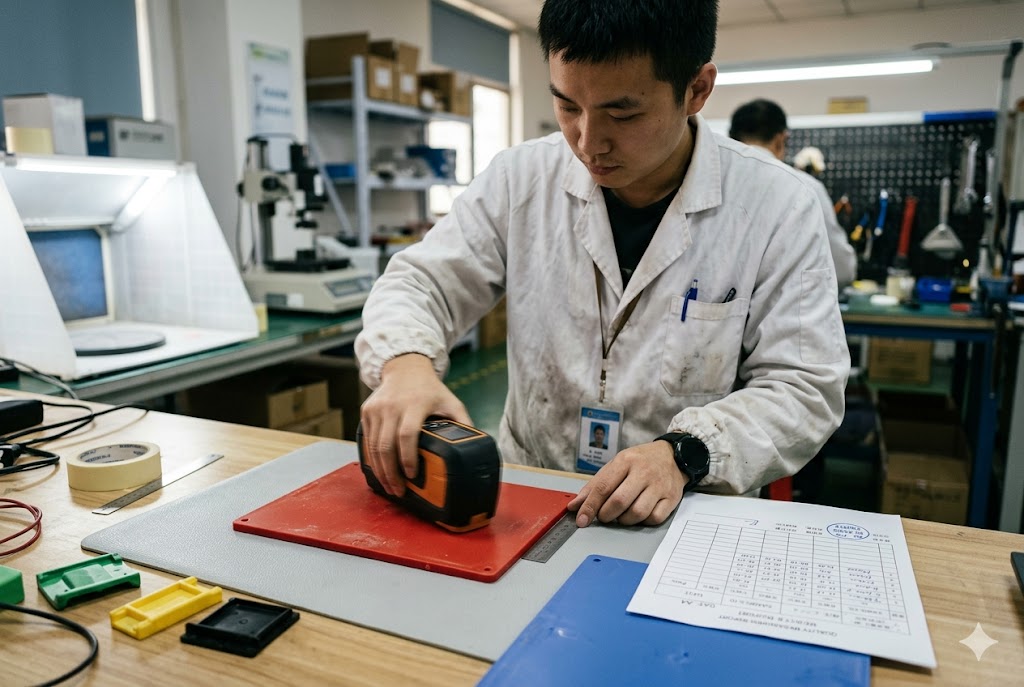
A Chinese injection molder should use a calibrated spectrophotometer (not colorimeter) for color measurement, report results in CIEDE2000 ΔE values against the golden sample, and evaluate parts under a D65 standard illuminant light booth before releasing any batch for shipment.
Spectrophotometer vs. Colorimeter
These two instruments are often confused, and the difference matters.
| Instrument | How It Works | Use Case |
|---|---|---|
| Colorimeter | Filters light through tristimulus sensors | Pass/fail against a stored reference, lower cost |
| Spectrophotometer | Measures full reflectance curve across wavelengths | Detects metamerism, more accurate across illuminants |
For injection-molded parts where color consistency across multiple production runs is the requirement, a spectrophotometer 4 is the correct tool. It captures the full spectral reflectance of the part, which means it can detect metamerism — a condition where two parts match under one light source but diverge under another.
A colorimeter will not catch metamerism. For branded consumer parts or assemblies where components must match each other, colorimetry alone is not sufficient.
Delta E Acceptance Limits
Define your acceptance criterion numerically. "Acceptable" and "close enough" are not engineering specifications.
| Application | Recommended ΔE Limit (CIEDE2000) | Notes |
|---|---|---|
| Branded consumer parts, tight color control | ΔE ≤ 1.5 | Visible difference threshold for most observers |
| Standard industrial parts | ΔE ≤ 3.0 | Practical ceiling for most programs |
| Non-visible internal components | ΔE ≤ 5.0 | May be acceptable depending on application |
Require the supplier to provide printed spectrophotometer reports 5 — not just a verbal or visual sign-off — on every first article and on any batch where the masterbatch lot changes. The CIEDE2000 formula 6 is the internationally standardized method for quantifying perceived color difference and should be named explicitly in your purchase order.
The D65 Standard Illuminant
Daylight-equivalent D65 illuminant 7 at 6500K color temperature is the international standard for evaluating color in manufactured goods. Your contract should name it explicitly.
Most credible Chinese injection molders have a standard light booth. Verify this during factory audit. Ask to see the booth's certification and the last recalibration date. An uncalibrated light booth is as unreliable as no light booth.
For multi-illuminant evaluation (important when parts will be seen under store lighting, office lighting, and daylight), specify that the supplier must check under D65 and CWF (cool white fluorescent) before batch approval. This is the fastest way to catch metamerism before parts ship.
How Do Lighting Conditions and Surface Texture Affect Pantone Color Matching in Chinese Injection Molding Production?
Two parts can be molded from the same masterbatch lot, in the same tool, on the same machine — and still look like different colors. Surface texture and lighting are the reason. Our engineers flag this consistently on programs where parts have both matte and glossy zones.
Surface finish (SPI or VDI grade) must be locked alongside the Pantone code in your drawing package, because a matte and a gloss surface on identically formulated resin will read as visually different colors under most lighting conditions. Changing surface texture mid-production is an unauthorized color change even if the pigment formula is identical.

Why Surface Finish Changes Perceived Color
Light hitting a glossy surface reflects directionally. Light hitting a matte surface scatters in multiple directions. The ratio of absorbed to reflected light — which is what we perceive as color — changes with the scatter pattern. A high-gloss surface concentrates reflected light toward the observer. A matte surface distributes it. The same pigment concentration reads as a lighter, more saturated color on gloss and a flatter, slightly darker color on matte.
This is not a defect. It is physics. The implication is that your color standard must be tied to a specific surface finish, not just a Pantone code.
SPI and VDI Texture Standards
Specify surface finish using recognized industry standards, not descriptive words like "matte" or "shiny." Chinese toolmakers work routinely with both systems.
| Standard | Origin | Grades | Typical Application |
|---|---|---|---|
| SPI (Society of Plastics Industry) | USA | A1–A3 (gloss), B1–B3 (semi-gloss), C1–C3 (matte), D1–D3 (textured) | Consumer goods, enclosures |
| VDI 3400 | Germany | VDI 0–45 (fine to coarse) | Industrial parts, automotive |
An SPI A2 surface 8 (high polish) and a SPI D2 surface (bead-blast texture) are not color-comparable even when the pigment is identical. Specify the exact SPI or VDI grade on your drawing, and include it in your first-article approval checklist.
Multi-Component Assembly Matching
When multiple injection-molded parts will be assembled and seen together, surface finish consistency across components is as important as pigment consistency. Components from different tools, or shot from different machines, can have slightly different surface textures even when the tool steel finish specification is the same.
The most reliable approach for tight color matching across components is a family mold 9 — all mating parts shot in a single tool from the same resin batch. When separate tools are unavoidable, require simultaneous production from the same masterbatch lot with sequential colorimeter verification before assembly.
Resin Base Color as a Variable
Natural (unfilled) resin is not colorless. Depending on the resin manufacturer and lot, the base polymer can have a yellowish or blue-white cast. This upstream variable shifts your final color relative to the golden sample.
Specify natural resin base L*a*b* acceptance limits in your technical package alongside your Pantone requirement. Require material test reports (MTRs) traceable to the resin manufacturer — not just the compounder — to catch undisclosed base resin substitutions. A supplier who switches resin sources mid-program without disclosure can introduce color drift that looks like a masterbatch problem but is actually a base polymer problem.
What Should I Include in My Quality Inspection Checklist to Verify Color Consistency of Injection-Molded Parts from China?
A color specification without an inspection checklist is a wish, not a requirement. When our team conducts pre-shipment inspections for clients, color verification follows a structured sequence — instruments first, visual assessment second, documentation third.
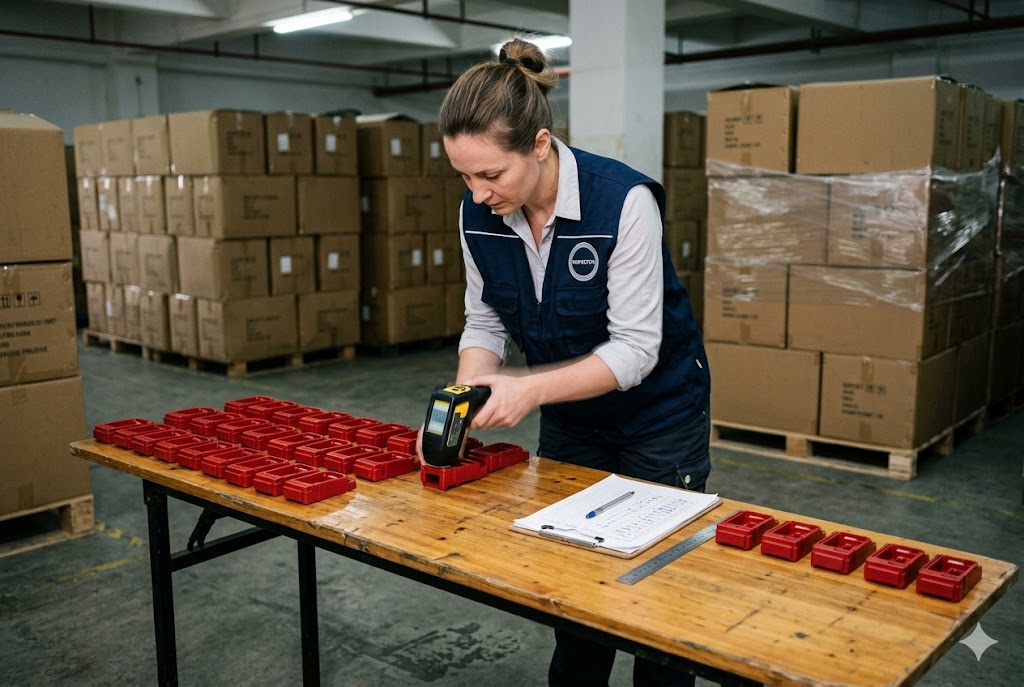
A color inspection checklist for injection-molded parts from China must include: spectrophotometer ΔE measurement against the archived golden sample, visual evaluation under D65 and CWF illuminants, surface finish grade confirmation, masterbatch lot verification, and a limit sample comparison before batch acceptance.
The Pre-Shipment Color Inspection Sequence
Follow this sequence in order. Do not skip to visual assessment before completing instrument measurement. Human visual judgment is the last gate, not the primary one.
Step 1 — Document verification. Confirm the supplier has provided spectrophotometer reports for the batch. Confirm the masterbatch lot number on the report matches the production record. Any lot-number discrepancy is an automatic hold.
Step 2 — Instrument measurement. Measure a minimum of five parts selected from different positions in the batch (front, middle, back of production run). Record ΔE (CIEDE2000) against the golden sample for each part. Any reading above your contractual ΔE limit is a nonconformance.
Step 3 — Multi-illuminant visual evaluation. Evaluate sampled parts in the light booth under D65 and CWF illuminants. Parts that pass Step 2 but show visible divergence under CWF are a metamerism flag — escalate for investigation before accepting.
Step 4 — Limit sample comparison. Place sampled parts against the minimum and maximum boundary limit samples. The part must fall within the approved range. If no limit samples exist at this stage, the program has a specification gap — flag this upstream.
Step 5 — Surface finish verification. Confirm the surface texture matches the specified SPI or VDI grade using a surface comparator. A surface deviation at this stage, even if color measures pass, constitutes a nonconformance under the drawing spec.
What to Document
| Checklist Item | Tool / Reference | Pass Criterion |
|---|---|---|
| Spectrophotometer ΔE reading | Calibrated spectrophotometer | ΔE ≤ contractual limit (e.g., ≤1.5 or ≤3.0) |
| Masterbatch lot number | Production record + CoC | Matches approved lot or written approval obtained |
| D65 visual evaluation | Standard light booth, certified | No visible color divergence from golden sample |
| CWF visual evaluation | Standard light booth, CWF lamp | No metamerism observed |
| Limit sample comparison | Archived min/max sample set | Part falls within approved boundary |
| Surface finish grade | SPI/VDI comparator | Matches drawing specification |
| Resin MTR present | Material test report | Traceable to resin manufacturer |
Long-Term Program Considerations
For programs spanning multiple production years, golden sample degradation is a real risk. Pantone chips and molded parts both change color over time when exposed to UV and humidity. Archive a hermetically sealed, UV-protected golden sample set — a minimum of three parts — at a third-party location in China (a CNAS-accredited lab 10 or a bonded inspection firm's storage facility). Do not rely solely on supplier-held or buyer-held samples as the contractual reference for long-running programs.
Establish a periodic re-verification schedule. At minimum, re-measure the archived golden sample set against a fresh batch every 12 months and document the ΔE reading. If drift is detected in the archive sample, replace it before it becomes the wrong reference.
Conclusion
Color consistency in Chinese injection molding is a system problem, not a supplier attitude problem. Specify the right Pantone series, lock the masterbatch, define ΔE limits, tie color to surface finish, and inspect with instruments. Every gap in that chain is where color drift enters.
Footnotes
1. Explains the difference between Pantone TCX, TPG, and TPX suffix systems for manufacturing applications. ↩︎
2. Overview of masterbatch composition, carrier resins, and how colorant concentrates are formulated for plastics. ↩︎
3. Details masterbatch let-down ratios and lot traceability practices in medical and precision plastic molding. ↩︎
4. Explains spectrophotometer function in plastics color matching, including dispersion, distribution, and metamerism detection. ↩︎
5. Guide to establishing ΔE color tolerances using CIEDE2000 and elliptical tolerance systems for production QC. ↩︎
6. CIE International Standard defining the CIEDE2000 color-difference formula for quantifying perceived color variation. ↩︎
7. Konica Minolta resource on D65 and other CIE standard illuminants, including metamerism identification methods. ↩︎
8. Fictiv guide to SPI surface finish grades A1–D3, finishing methods, and surface roughness values for injection molding. ↩︎
9. Overview of injection molding color consistency methods including family molds, masterbatch compounding, and batch control. ↩︎
10. Official site of China's national accreditation body for laboratories and inspection organizations (CNAS). ↩︎