Skip to main content Skip to footer

We have audited hundreds of injection molding factories across China. One pattern comes up every time: resin substitution is not a rare exception — it is a routine cost-reduction practice. Factories grind down runners, rejected parts, and purge material, then blend that regrind back into the hopper at 10–20% without telling the buyer. By the time parts reach your warehouse, there is no visual trace. The problem only surfaces when parts crack under load, warp in service, or fail in your customer's product.
To confirm a Chinese injection molding supplier is using virgin resin, require a resin Certificate of Analysis traceable to the original manufacturer, demand original packaging labels for each production run, and specify MFI and FTIR testing on incoming material. These controls, written into your purchase contract, close the substitution window before production starts.
The following sections break down each verification method, the documents you need, the red flags to watch for, and how to write enforceable contract language — so you can source with confidence.
What Tests or Documents Can I Request to Verify That a Chinese Supplier Used Virgin Plastic Resin in My Parts?
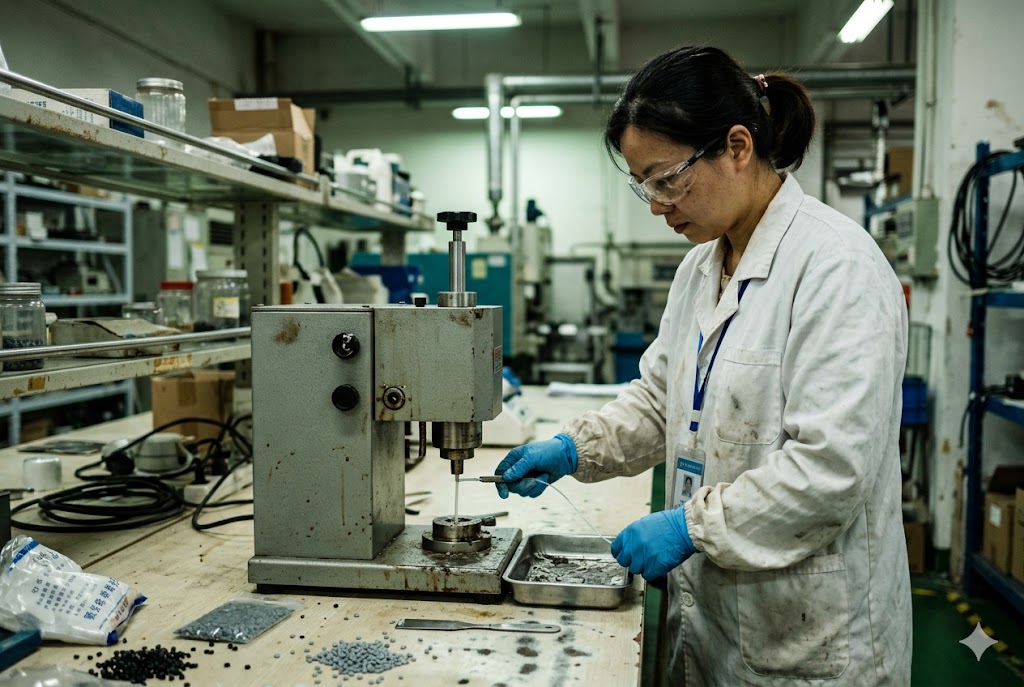
Our team manages material documentation for every production order we place with Chinese factories. The single biggest mistake buyers make is accepting a generic material certificate that lists only the resin grade — with no lot number, no source traceability, and no connection to the actual production run.
To verify virgin resin use, request a lot-traceable Certificate of Analysis from the resin manufacturer, original packaging labels from production, Melt Flow Index test results per ASTM D1238, and FTIR spectroscopy on finished part samples. These four documents together create a complete and auditable material chain.
The Core Document Stack
Four documents form the minimum verification package. Each one addresses a different substitution risk.
| Document | What It Proves | Who Issues It |
|---|---|---|
| Resin Certificate of Analysis (CoA) | Resin grade, lot number, and physical properties match virgin spec | Resin manufacturer (e.g., SABIC, LyondellBasell, Sinopec) |
| Original Packaging Labels | Resin was physically delivered from a branded supplier | Resin manufacturer — visible on bags or totes |
| Melt Flow Index (MFI) Report | Polymer chain integrity matches virgin datasheet | In-house or third-party lab per ASTM D1238 / ISO 1133 |
| FTIR Spectroscopy Report | Polymer identity confirmed; no contamination from recycled blends | Third-party lab |
Certificate of Analysis — What to Check
The CoA must come from the resin manufacturer, not the injection molder. A factory-generated document that simply states "Material: PP Virgin" is not a CoA. According to supply chain compliance guidance, a lot-traceable Certificate of Analysis 1 will carry the resin manufacturer's letterhead or stamp, a specific lot or batch number, physical test data including MFI, density, tensile strength, and elongation, and the date of manufacture.
Cross-reference the lot number on the CoA against the original packaging labels. If the numbers do not match, the CoA is not tied to the material actually used.
MFI Testing — The Fastest Red Flag Check
Melt Flow Index 2 measures how easily a polymer flows under heat and pressure. Virgin resin has a stable, predictable MFI that matches the manufacturer's published datasheet. Recycled or regrind-blended resin has gone through at least one previous heat cycle. That thermal history causes chain scission — polymer chains break and shorten. The result is a higher, less controlled MFI.
A deviation of more than ±15–20% from the virgin datasheet value is a red flag. If your PP resin datasheet lists MFI at 12 g/10 min and incoming pellets test at 16 g/10 min, you are likely looking at regrind contamination.
Request MFI testing on both incoming pellets and finished part samples. Testing both catches substitution at the material stage and at the production stage.
FTIR Spectroscopy — Detecting Blended Contamination
FTIR spectroscopy 3 identifies the chemical fingerprint of a polymer. Every resin type — PP, ABS, nylon, PC — produces a unique infrared absorption spectrum. Contaminants from a different polymer type produce spectral peaks that do not belong in a virgin reference scan.
Even small percentages of a foreign polymer — say, 5% recycled ABS blended into virgin PP — will produce detectable anomalies. This test is particularly useful when you suspect a factory is using mixed-stream recycled material rather than single-grade regrind.
Request FTIR testing on first article samples as a baseline. Archive the reference spectrum. Use it to compare against production samples from subsequent lots.
How Does Using Recycled Material Instead of Virgin Resin Affect the Quality and Strength of Injection-Molded Parts?
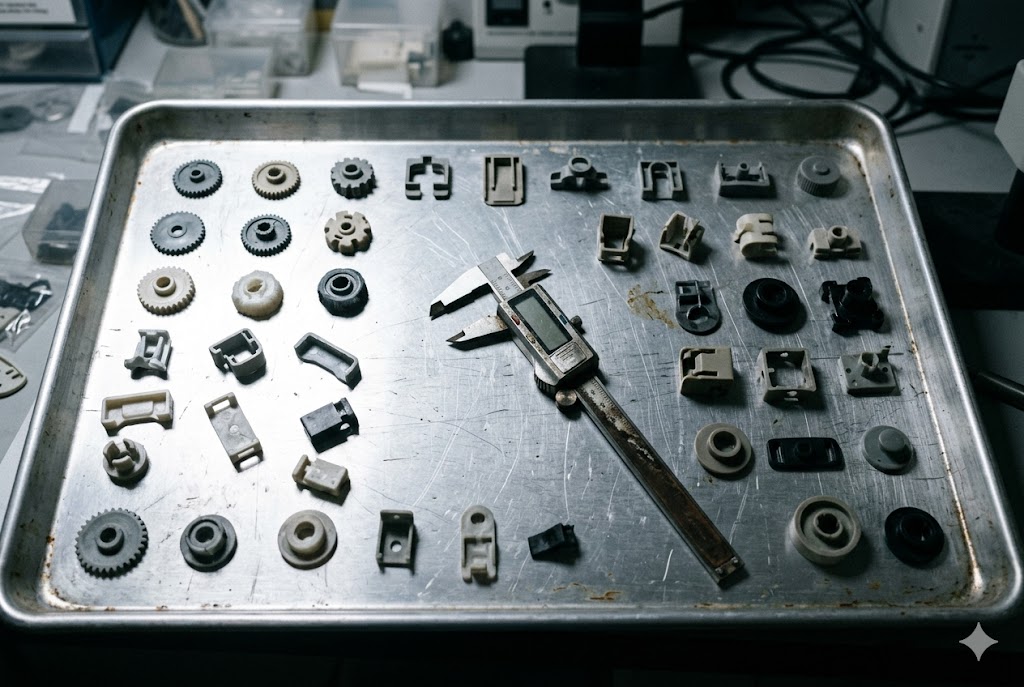
When our engineers review field failures from parts sourced through unverified suppliers, degraded resin is one of the top root causes. The damage is not always visible. A part can look identical to a correctly made one — same dimensions, same color, same surface finish — and still fail at 60% of the load a virgin-resin part would carry.
Recycled or regrind-blended resin produces measurable reductions in tensile strength, impact resistance, and fatigue life compared to virgin material. Thermal degradation from prior processing cycles shortens polymer chains, reduces crystallinity in semi-crystalline resins, and introduces oxidative contamination — all of which weaken the final part.
What Happens to Polymer Chains During Reprocessing
Every time a thermoplastic is melted and solidified, it undergoes thermal stress. That stress causes two types of damage.
Chain scission 4 breaks long polymer chains into shorter segments. Shorter chains reduce tensile strength, elongation at break, and impact resistance. The material becomes more brittle.
Oxidative degradation occurs when oxygen reacts with the polymer during melt processing. This causes discoloration, cross-linking, and the formation of carbonized particles. Cross-linking stiffens the material unpredictably. Carbonized particles act as stress concentrators — crack initiation sites under cyclic loading.
Quantified Performance Differences
The table below shows representative property changes when a 20% regrind blend replaces virgin material for common engineering polymers. Values are approximate and depend on the number of prior processing cycles.
| Property | Virgin Resin (Baseline) | 20% Regrind Blend | Estimated Change |
|---|---|---|---|
| Tensile Strength | 100% | 88–93% | −7% to −12% |
| Impact Resistance (Izod) | 100% | 75–85% | −15% to −25% |
| Elongation at Break | 100% | 70–80% | −20% to −30% |
| MFI | Datasheet value | +10% to +25% | Elevated |
| Color Consistency | Uniform | Variable, streaking | Visible defects possible |
These numbers matter most in load-bearing applications, snap-fit assemblies, and parts exposed to fatigue or impact in service. For structural housings, brackets, clips, and functional mechanical parts, a 20% reduction in impact resistance is not a marginal quality issue — it is an engineering risk.
Peer-reviewed research on thermomechanical degradation of polypropylene 5 confirms that repeated extrusion cycles cause chain scission in the PP phase, resulting in reduced viscosity, disrupted crystal structure, and declined tensile properties.
Visual and Dimensional Effects
Beyond mechanical properties, regrind contamination affects part appearance and dimensional consistency in ways that matter to your customer.
Color streaking appears when regrind from color-contaminated batches is blended back in. The streaks run in the flow direction and are visible under direct light.
Surface gloss variation results from inconsistent MFI — areas of faster or slower fill produce different surface texture on the same part.
Sink marks and voids become more common because degraded resin has different shrinkage behavior than virgin material. This makes it harder for the molder to maintain consistent process parameters across a production run.
Dimensional drift occurs across a production run as the molder adjusts pack and hold pressure to compensate for changing melt behavior. Parts from the beginning and end of a long run may fall outside tolerance even when the molder is not aware.
What Red Flags Indicate That a Chinese Injection Molding Supplier May Be Substituting Recycled Material?
We conduct pre-production factory audits as a standard service for our clients. Over the years, our team has identified a consistent set of signals — some visible during a factory visit, some detectable in the parts themselves — that indicate a supplier is using regrind or recycled material without disclosure.
Key red flags include inability to produce lot-traceable resin documentation, evidence of regrind collection bins near the molding machines, visual defects such as color streaking or surface speck contamination on sample parts, and MFI test results that deviate significantly from the virgin resin datasheet value.
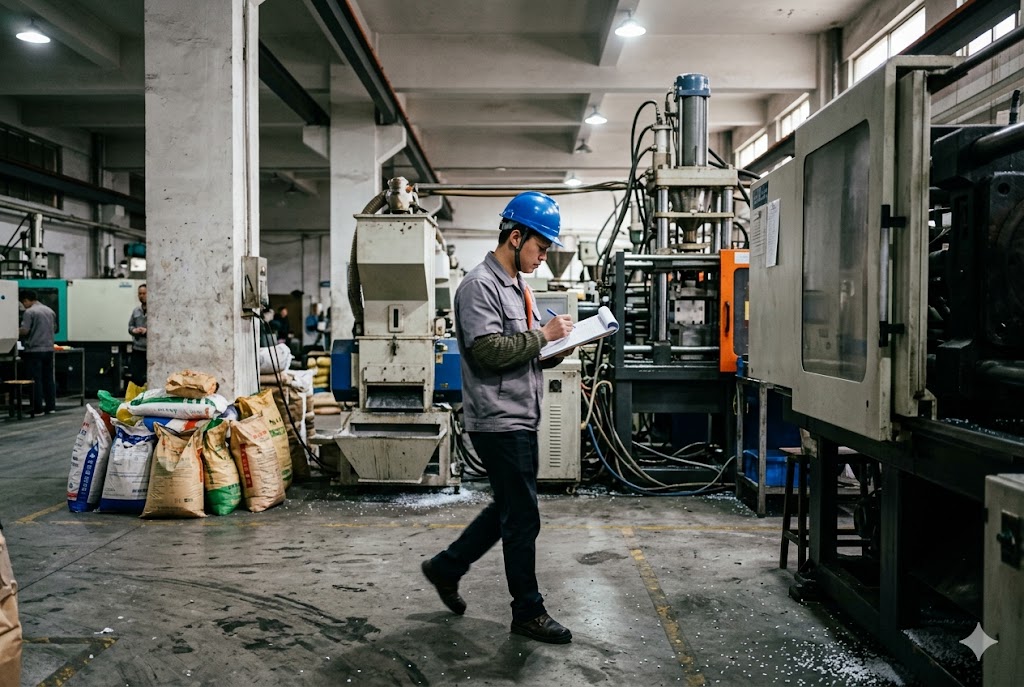
Factory Floor Red Flags
During an on-site visit or a third-party audit, look for these physical indicators:
Regrind bins and granulators positioned directly adjacent to injection molding machines are the clearest signal. A granulator is a machine that grinds runners, sprues, and rejected parts back into pellet form. Its presence near the production line means regrind is being generated and likely fed back into production.
Mixed material storage — resin bags from multiple manufacturers, multiple lot numbers, or unlabeled bulk containers stored together — indicates the factory does not maintain lot segregation. Without segregation, you cannot trace which material went into your parts.
No incoming material inspection records — if a factory cannot show you receiving logs for resin, including supplier, lot number, and delivery date, their material traceability is absent.
Inconsistent part appearance across the sample set — color variation, surface gloss differences, or flow line artifacts visible on sample parts from the same nominal run are physical evidence of variable or contaminated feedstock.
Document Red Flags
| Warning Sign | What It Suggests |
|---|---|
| CoA issued by the molder, not the resin manufacturer | No independent verification; document is self-declared |
| CoA with no lot number | Cannot be traced to a specific resin batch |
| Resin grade on CoA does not match drawing spec | Wrong material, whether intentional or not |
| Factory unable to produce original packaging labels | Resin sourcing is unverifiable |
| MFI reported value matches datasheet exactly to three decimal places | Likely copied from the datasheet, not actually tested |
Resin distributors and certified material suppliers publish quality assurance reports for individual resin lots 6 that include melt flow rate and moisture content data — a format that factory-generated certificates cannot replicate.
Part-Level Red Flags
If you already have parts in hand, examine them against these criteria:
- Color specks or dark particles embedded in the part surface — these are carbonized regrind particles
- Weld line cracking at lower-than-expected stress — weakened polymer chains fail at weld lines first
- Surface delamination or peeling — a sign of incompatible polymer contamination in the feedstock
- Inconsistent weight across parts from the same cavity — indicates variable material density from mixed feedstock
Any single red flag warrants investigation. A combination of two or more is grounds for halting production and requesting third-party material verification before proceeding.
Can I Include a Virgin-Material-Only Requirement in My Purchase Contract with a Chinese Injection Molding Factory?
Our sourcing team places all orders under written contracts. In our experience working with Chinese factories, verbal agreements on material specification are unenforceable. The only protection that holds up — in disputes, in audits, and under CIETAC arbitration 7 — is a requirement written into the purchase order, technical specification, and quality agreement before production starts.
Yes, you can and should include a virgin-material-only requirement in your purchase contract. State it explicitly in the technical specification, purchase order, and quality agreement. Tie it to documented verification deliverables — including CoA, MFI test results, and packaging confirmation — and link payment milestones to material compliance.

Where to Write the Requirement
A single mention in one document is not enough. The requirement must appear in three places:
Technical Specification (drawing or spec sheet): Add a material note that reads: "100% virgin resin only. No regrind, recycled, or reclaimed material permitted. Resin shall be [grade], sourced from [manufacturer name or approved supplier list]."
Purchase Order: Reference the technical specification by document number and add a line item: "Material compliance: 100% virgin resin per [spec reference]. Supplier to provide lot-traceable CoA and original packaging documentation prior to shipment release."
Quality Agreement: Detail the verification deliverables, inspection rights, and consequences of non-compliance. This is the document that makes the requirement enforceable.
What to Include in the Quality Agreement
| Clause | Language Recommendation |
|---|---|
| Material specification | "100% virgin resin, grade [X], from approved resin manufacturer. No regrind or recycled content permitted." |
| Documentation deliverables | "Supplier shall provide lot-traceable CoA from resin manufacturer, original packaging labels, and MFI test report for each production lot prior to shipment." |
| Inspection rights | "Buyer reserves the right to conduct unannounced third-party audits during material preparation and production." |
| Payment holdback | "10–20% of invoice value withheld until CoA and MFI compliance confirmed by buyer or appointed inspector." |
| Non-compliance remedy | "Material substitution constitutes a material breach. Buyer may reject the lot, require re-production at supplier's cost, and seek damages under CIETAC rules." |
Payment Structure as a Control Mechanism
Linking payment to material verification is the most effective enforcement tool available to a buyer. Factories respond to financial incentives. If final payment is contingent on a verified CoA and a passing ISO 1133 8 or ASTM D1238 MFI test, the factory has a direct financial reason to comply.
A common structure our team recommends:
- 30% deposit at order confirmation
- 60% released after in-production inspection confirms correct material in use
- 10% held until pre-shipment inspection confirms CoA, MFI, and visual compliance
This structure gives you leverage at every stage of production. It also creates a documented record — a clear timeline of compliance checks that can be used as evidence in a dispute.
Third-Party Audit as a Contractual Right
Include explicit language granting you — or an appointed third-party inspector — the right to attend the factory during material preparation, specifically to witness and photograph resin loading before a production run begins. Agencies such as SGS, Bureau Veritas, and Intertek 9 offer pre-production material audits as a standard service. Build this right into the contract so it cannot be refused.
The inbound logistics guidance on CoA management 10 notes that batch numbers are critical for traceability in supply chains — a principle that applies equally when receiving resin into a Chinese molding facility as it does at any other point in the materials chain.
Conclusion
Virgin resin verification requires contracts, documents, and lab tests — not trust. Write the requirement into every document, request lot-traceable CoAs, specify MFI and FTIR testing, and tie payment to compliance. These steps together give you a defensible, auditable material chain from resin manufacturer to finished part.
Footnotes
1. The lot number on a CoA is the critical link between test results and the physical material in your facility. ↩︎
2. ASTM D1238 is the standard test method for melt flow rates of thermoplastics by extrusion plastometer. ↩︎
3. ATR-FTIR spectroscopy rapidly identifies plastics based on their characteristic infrared absorption spectrum. ↩︎
4. Chain scission is thermal degradation of polymer backbone chains, reducing molecular weight and mechanical strength. ↩︎
5. Peer-reviewed study on molecular degradation pathways during conventional processing and mechanical recycling of polymers. ↩︎
6. Resin manufacturers supply lot-specific quality assurance reports covering melt flow rate and moisture content. ↩︎
7. CIETAC is China's primary arbitration body for international commercial and trade disputes. ↩︎
8. ISO 1133 specifies the standard method for determining melt mass-flow rate of thermoplastic materials. ↩︎
9. SGS, Bureau Veritas, and Intertek are the leading global TIC agencies offering pre-production and pre-shipment inspection services. ↩︎
10. Batch and lot numbers are critical for supply chain traceability and quality investigations. ↩︎