Skip to main content Skip to footer
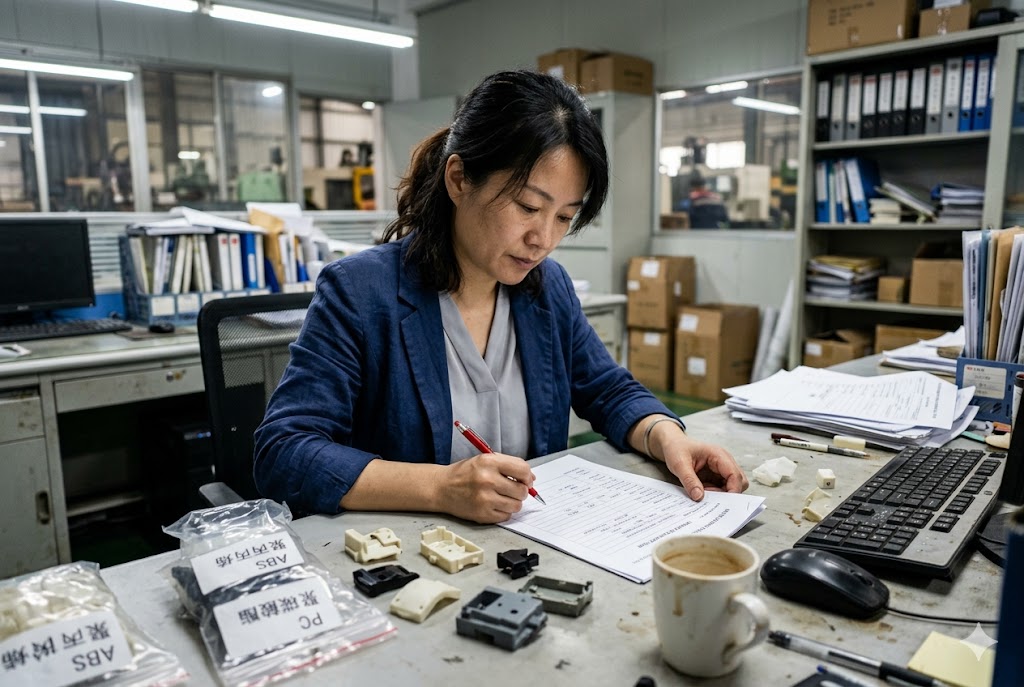
Every week, our sourcing team reviews material declarations from Chinese injection molders — and we keep seeing the same problem. Buyers specify "ABS" or "nylon," the factory quotes accordingly, and somewhere between the purchase order and the shipment, the actual resin changes. Wrong grade. Undisclosed regrind. No mill cert. The part looks fine until it fails in the field.
The most commonly used injection molding materials in Chinese factories are ABS, PP, PC, PA (nylon), and POM. Each resin serves a different function: ABS for general housings, PP for flexible and chemical-resistant parts, PC for optical clarity and impact resistance, PA for wear-critical components, and POM for precision mechanical parts requiring low friction and tight tolerances.
Understanding these five resins — and how Chinese suppliers handle them — is the foundation of any successful custom parts program. The sections below break down each one and give you the tools to specify, verify, and protect your orders.
What Is the Difference Between ABS, PP, PC, PA, and POM for Custom Injection-Molded Parts from China?
In our experience reviewing supplier quotations and factory audits, few buyers take the time to pin down exactly which resin they need before sending an RFQ. That gap is where material substitutions happen — and where quality problems begin.
ABS is a rigid, general-purpose resin best for housings and enclosures. PP offers chemical resistance and works well for living hinges. PC provides optical clarity and high impact strength up to around 130°C. PA (nylon) handles wear and friction in moving parts. POM delivers the tightest dimensional tolerances with low friction, making it the top metal-replacement resin for precision mechanical components.
ABS — The Default General-Purpose Resin
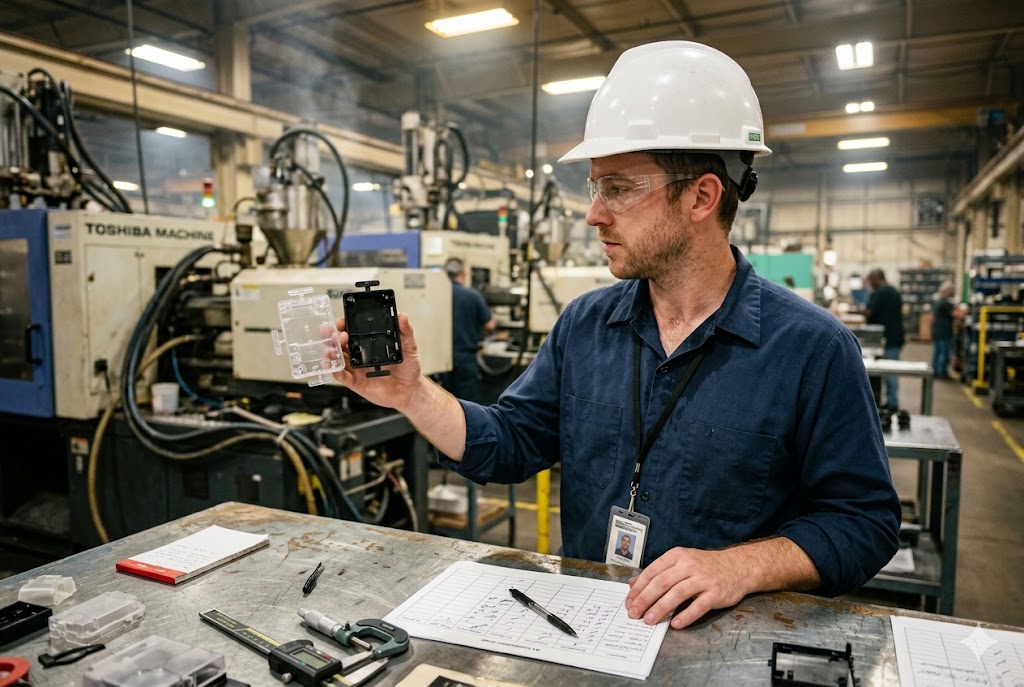
ABS (Acrylonitrile Butadiene Styrene) is the most widely stocked resin in Chinese injection molding factories. It is easy to process, accepts paint and chrome plating well, and costs less than engineering-grade resins. Most consumer electronics housings, appliance shells, and plastic enclosures are made from ABS.
The problem is that "ABS" covers a wide range of grades. A flame-retardant UL94 V0 grade 1 and a standard HB-rated grade are both called ABS, but their performance differs by a wide margin. Impact strength can vary by 50–200% between grades from different manufacturers.
PP — High Volume, High Shrinkage
PP (Polypropylene) is the highest-volume commodity resin globally. Chinese factories use it heavily for packaging components, automotive interior parts, and any part that needs fatigue resistance — such as a living hinge that opens and closes thousands of times.
PP is semi-crystalline. That means its shrinkage rate (typically 1.5–2.5%) is significantly higher than amorphous resins like ABS (0.4–0.7%). Cavity dimensions must be compensated precisely, or parts will come out undersized. Factories that run both resins frequently make tooling errors when they switch between them on the same tool. A detailed breakdown of ABS versus polypropylene shrinkage behavior 2 explains why this matters for tolerance planning.
PC — Clarity and Impact, But Process-Sensitive
PC (Polycarbonate) is the resin of choice when a part needs optical clarity, high impact resistance, or heat resistance up to approximately 130°C. Headlight lenses, safety shields, and medical device housings are common applications.
PC is moisture-sensitive. It must be dried thoroughly — typically at 120°C for 4–6 hours — before processing. Moisture trapped in polycarbonate resin 3 during molding causes splay marks, bubbles, and degraded mechanical properties. Under schedule pressure, Chinese suppliers sometimes skip or shorten the drying step. This is one of the most common root causes of cosmetic defects in PC parts.
PA — Engineering Resin for Moving Parts
PA (Polyamide / Nylon), particularly PA6 and PA66, is the primary choice for wear-critical moving parts: gears, bushings, bearings, and guide rails. PA66 has a higher continuous use temperature (~120°C) than PA6 (~100°C) and is preferred for automotive and industrial applications. A comparison of PA6 and PA66 moisture absorption behavior 4 illustrates why sealed packaging is essential before shipment.
PA absorbs moisture from ambient air and expands dimensionally as a result. A PA66 part at 50% relative humidity can absorb up to 2.5% moisture by weight, causing measurable dimensional growth. Post-mold conditioning and sealed, moisture-barrier packaging are essential before shipment — steps that low-cost Chinese tier-3 molders routinely skip.
POM — Precision Mechanical Replacement for Metal
POM (Polyoxymethylene / Acetal), available in homopolymer (Delrin-type) and copolymer grades, is the most common metal-replacement resin for precision mechanical parts. It offers high stiffness, very low friction, and excellent dimensional stability. Automotive clips, fasteners, small gear trains, and snap-fit mechanical assemblies are typical applications sourced from China. The properties that make acetal copolymer an effective substitute for light metals 5 — including gear wheels, fasteners, and lock systems — are well documented in industry material guides.
POM homopolymer has slightly higher tensile strength and hardness. POM copolymer is more stable at elevated temperatures and more resistant to hydrolysis. Chinese factories typically stock copolymer grades because they are easier to process and less prone to centerline porosity on thick sections.
Quick Comparison Table
| Resin | Key Strength | Key Weakness | Typical Application |
|---|---|---|---|
| ABS | Low cost, easy processing | Grade variation, not chemical-resistant | Housings, enclosures |
| PP | Chemical resistance, living hinges | High shrinkage, low stiffness | Caps, hinges, containers |
| PC | Clarity, impact, heat resistance | Moisture-sensitive processing | Lenses, shields, medical parts |
| PA6/PA66 | Wear resistance, fatigue strength | Moisture absorption, dimensional change | Gears, bearings, bushings |
| POM | Low friction, tight tolerances | Limited chemical resistance, no painting | Fasteners, gear trains, clips |
How Do I Choose the Right Plastic Resin for My Injection-Molded Part's Mechanical and Environmental Requirements?
Our engineers have reviewed hundreds of part drawings where the specified resin did not match the actual use environment. The buyer chose the material based on cost or familiarity, and the part failed — not from a manufacturing defect, but from a wrong material decision made upstream.
Choosing the right resin starts with four questions: What load does the part carry? What temperature will it see? What chemicals will it contact? Does it need to meet a regulatory standard? Once those are answered, the resin family becomes clear — and the specific grade within that family can be locked down by referencing published datasheet values for tensile strength, HDT, and chemical resistance.
Step 1 — Define the Mechanical Load
Start with the part's structural role. Is it a housing that carries no direct load? ABS or PP will work. Does it transmit torque or carry cyclic stress? You need PA or POM. Does it need to absorb impact without cracking? PC or ABS high-impact grade.
The most useful mechanical properties to check on a resin datasheet are:
| Property | Unit | Why It Matters |
|---|---|---|
| Tensile strength | MPa | Resistance to pulling forces |
| Flexural modulus | MPa | Stiffness under bending load |
| Izod/Charpy impact | J/m or kJ/m² | Energy absorbed before fracture |
| Heat deflection temperature (HDT) | °C | Temperature at which part deforms under load |
| Coefficient of friction | — | Relevant for sliding or rotating contact |
Step 2 — Define the Thermal Environment
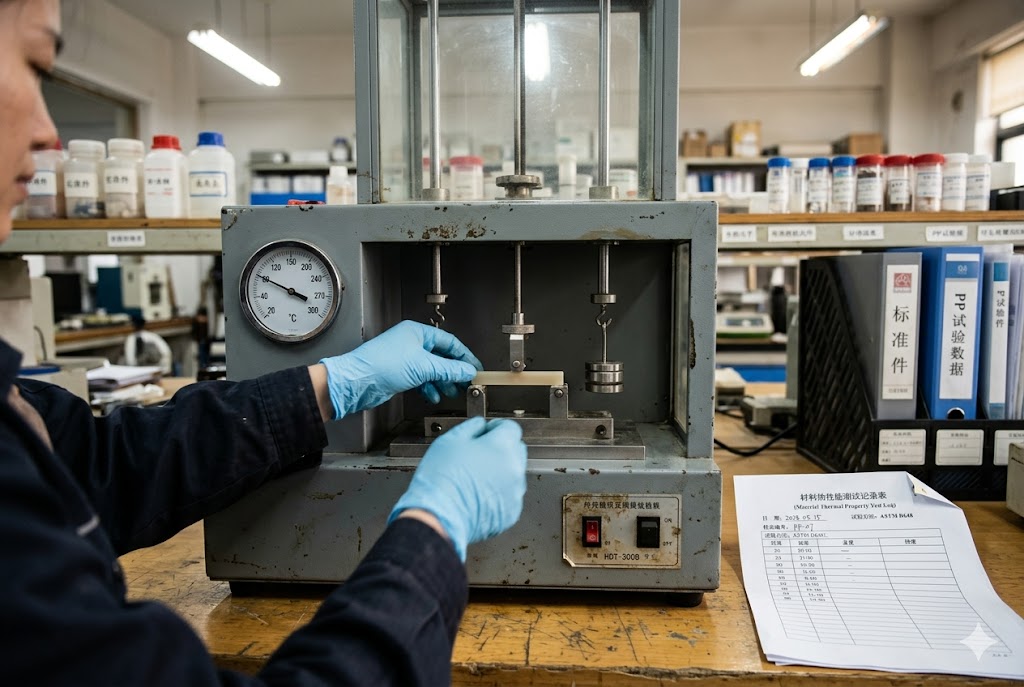
HDT is the most practical thermal benchmark. If the part sits near an engine, a PCB, or an LED array, measure the ambient temperature at the part surface and add a safety margin of at least 20°C.
- ABS: HDT typically 80–100°C (depending on grade)
- PP: HDT typically 60–100°C (unfilled grades are on the low end)
- PC: HDT typically 120–135°C
- PA66: HDT typically 200–260°C (under load, unfilled)
- POM: HDT typically 100–136°C
For parts that must survive 125°C or higher under sustained load, PC, PA66, or glass-fiber-filled grades are the practical options.
Step 3 — Define the Chemical Environment
PP is the most chemically resistant of the five common resins. It withstands most acids, alkalis, and cleaning agents that would attack ABS or PC. PC is notably vulnerable to aromatic solvents, gasoline, and many household cleaners — a detail that buyers frequently overlook.
If the part will contact fuels, oils, or industrial cleaning solutions, request a chemical resistance chart for the specific resin grade from the supplier. Do not rely on general statements.
Step 4 — Define Regulatory Requirements
For parts sold in the US or EU market, the relevant standards are:
- RoHS (Restriction of Hazardous Substances): Applies to electrical and electronic equipment. Restricts lead, mercury, cadmium, hexavalent chromium, and specific brominated flame retardants.
- REACH: Covers substances of very high concern (SVHCs) in products sold in the EU.
- UL94: Flammability classification for plastic parts in electrical enclosures. V0 is the most stringent.
- FDA / food-contact: Required for any part that contacts food or beverage. PP, certain PE grades, and specific PC grades carry FDA compliance.
Specifying the compliance requirement in your purchase order is not sufficient. You must specify the certified resin grade by brand and grade number, and require the factory to provide a Certificate of Compliance (CoC) traceable to the resin lot before production begins. Understanding what RoHS certification actually requires from injection molders 6 clarifies why a PO notation alone is never enough.
Which Injection Molding Materials Are Most Commonly Stocked by Chinese Factories for Fast-Turnaround Orders?
When clients come to us with urgent timelines — parts needed in three weeks instead of six — the first question we ask our factory network is not about price. It is about raw material availability on the shelf right now.
The resins most commonly kept in stock at Chinese injection molders are natural and black ABS, natural and black PP, PC (natural/clear), PA6 (natural and black), and POM copolymer (natural and black). Colored, glass-filled, or specialty-certified grades typically require 5–15 additional working days for resin procurement and may add cost.
What "In Stock" Actually Means at a Chinese Molder
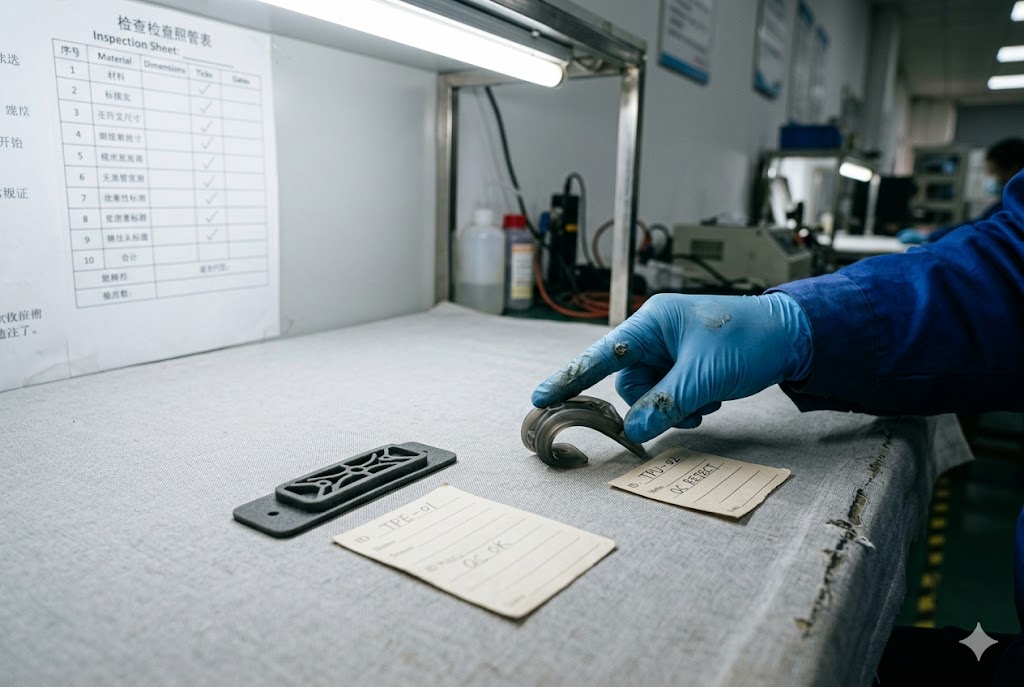
Most mid-size Chinese injection molders maintain a working inventory of 3–6 standard resins in natural (unfilled, undyed) and black colorways. Their stock is bought from local distributors — not directly from resin manufacturers — which introduces a grade traceability risk that is separate from the availability question.
When a factory says a material is "in stock," verify two things:
- Is it the correct grade? Ask for the resin brand, grade number, and lot certificate before they open the bag.
- Is it virgin material? Factories under cost pressure blend regrind into their inventory. A regrind percentage of even 10–20% can reduce impact strength by 15–30% and cause color variation across a production run.
Standard Stock vs. Special Order
| Material Category | Typically In Stock | Lead Time if Not in Stock |
|---|---|---|
| ABS (natural / black, general grade) | Yes | — |
| PP (natural / black, homopolymer or copolymer) | Yes | — |
| PC (natural / clear) | Yes at most factories | 3–7 working days |
| PA6 (natural / black) | Yes at most factories | 3–7 working days |
| POM copolymer (natural / black) | Yes at most factories | 3–7 working days |
| PA66 (natural) | Sometimes | 5–10 working days |
| PC/ABS alloy | Sometimes | 5–10 working days |
| Glass-filled grades (e.g., PA66-GF30) | Rarely | 10–15 working days |
| UL94 V0 certified grades | Rarely | 10–15 working days |
| FDA / food-contact certified grades | Rarely | 10–15 working days |
| TPU (standard hardness) | Sometimes | 5–10 working days |
TPU and TPE — The Flexible Resin Confusion
Chinese suppliers frequently use "TPU" and "TPE" interchangeably in quotations. They are not the same. TPU (Thermoplastic Polyurethane) offers superior abrasion resistance 7, higher load-bearing capacity, and better oil resistance. TPE/TPR (Thermoplastic Elastomer / Rubber) is a lower-cost rubber-like alternative — adequate for light-duty grip surfaces but not for parts carrying mechanical load or exposed to oil.
When a drawing calls for a flexible material, specify hardness (Shore A scale), abrasion resistance requirement, and whether the part contacts oil or fuel. Do not accept a generic "TPE" quotation against a TPU specification.
Color and Additive Lead Time
Natural (uncolored) resin is always faster to source than custom colors. Color matching requires the factory to procure a masterbatch, run color trials, and get your approval before production. Budget 3–5 additional working days for standard color families and up to 10 days for custom RAL or Pantone matches.
UV stabilizers, antistatic additives, and lubricated grades (internally lubricated POM for reduced friction) are available from Chinese suppliers but typically require special procurement. These should be flagged in the RFQ stage — not discovered after tooling is cut.
How Do Material Properties Affect the Price and Lead Time of Custom Injection-Molded Parts in China?
Our project managers track cost breakdowns across hundreds of part families each year. Resin selection is consistently one of the top three cost drivers — often ahead of tooling complexity and labor — yet it is the variable buyers spend the least time on during the RFQ stage.
Material properties affect both price and lead time through three mechanisms: resin raw material cost, processing difficulty (which drives cycle time and scrap rate), and certification or traceability requirements. Engineering resins like PC, PA66, and POM can cost 3–5x more per kilogram than commodity ABS or PP, and certified grades add further procurement time and documentation cost.

Resin Cost per Kilogram — A Starting Benchmark
Resin prices fluctuate with crude oil and global supply dynamics, but the relative cost relationships between material families are stable. As a rough benchmark, using commodity ABS as a baseline of 1.0×:
| Resin | Relative Cost vs. ABS | Notes |
|---|---|---|
| PP (homopolymer) | 0.6–0.8× | Cheapest commodity option |
| ABS (general grade) | 1.0× | Baseline |
| PA6 (unfilled) | 1.5–2.0× | Varies by global nylon feedstock pricing |
| POM copolymer | 1.8–2.5× | Specialty feedstock (formaldehyde-based) |
| PC (general grade) | 2.0–2.8× | Pricing sensitive to bisphenol-A supply |
| PA66 (unfilled) | 2.5–3.5× | Tighter global supply than PA6 |
| PC/ABS alloy | 2.2–3.0× | Value-add blend |
| PA66-GF30 | 3.0–4.5× | Glass fiber + engineering base |
| UL94 V0 grade (any base resin) | +20–40% premium over standard grade | Flame retardant additive cost |
Processing Difficulty and Cycle Time
Material properties directly affect injection molding cycle time and scrap rate — both of which drive unit cost.
PC requires high melt temperatures (280–320°C) and extended drying time. Mold temperatures must be controlled precisely to avoid internal stress and warpage. Cycle times are longer than ABS for equivalent wall thickness. The role of moisture-induced splay defects in polycarbonate processing 8 helps explain why improperly dried PC produces high scrap rates at underprepared factories.
PA66 has a narrow processing window. Melt temperature must stay within a tight band (~265–285°C). Moisture in the resin causes immediate degradation. Scrap rates at underprepared factories can run 10–20% on the first production run.
POM releases formaldehyde gas if overheated. This requires exhaust systems and limits the factories that can process it safely. Machine downtime for purging between materials adds cost. Acetal's dimensional stability and low-friction properties 9 make it worth the processing complexity for wear-critical assemblies.
Certification and Traceability Costs
For regulated applications — UL94, RoHS, REACH, FDA — the certified resin itself costs more than the non-certified equivalent. Beyond resin cost, certification-tied orders require:
- Resin lot certificates (CoC) issued by the resin manufacturer
- Third-party test reports (SGS, Intertek, Bureau Veritas) at the resin level
- Incoming material verification at the factory before production release
- Retention samples held for the duration of the product warranty period
These documentation and handling steps add 2–7 working days to production lead time and a fixed cost of USD 200–800 per test report, depending on the test scope and certifying body.
The Hidden Cost of Wrong Material Specification
The most expensive material decision is not choosing PC over ABS. It is specifying a generic resin name with no grade, no brand, and no certification requirement — and discovering after shipment that the factory used a non-compliant substitute. Return freight, re-inspection, re-production, and downstream customer compensation costs routinely exceed the total original order value for compliance-critical part families.
Embedding resin brand and grade in the approved material specification, requiring lot-level CoC before production release, and including a material verification hold point in the pre-shipment inspection scope costs very little upfront. The nylon material overview from Xometry 10 is one example of the kind of grade-level documentation buyers should reference when locking down polyamide specifications. It eliminates the tail risk entirely.
Conclusion
Material specification is not a detail to sort out after tooling. It is the foundation of part performance, regulatory compliance, and supply chain reliability. Specify the resin grade by brand and lot, require traceability documentation before production, and verify compliance at incoming inspection — not after shipment.
Footnotes
1. Overview of UL94 flammability classifications and flame-retardant thermoplastic grades for injection molding. ↩︎
2. Compares ABS and PP shrinkage rates and their impact on injection molding tolerances. ↩︎
3. Explains how moisture absorption in polycarbonate causes splay marks and degraded mechanical properties. ↩︎
4. Covers PA6 and PA66 moisture absorption differences and implications for dimensional stability. ↩︎
5. Details POM copolymer properties, gear and fastener applications, and metal-replacement use cases. ↩︎
6. Explains what RoHS certification requires from molders and why PO notations are insufficient. ↩︎
7. Covers TPU's superior abrasion resistance and oil compatibility versus standard TPE materials. ↩︎
8. Explains moisture-induced splay defects and their connection to inadequate resin drying practices. ↩︎
9. Details Delrin/POM dimensional stability and wear performance as a metal replacement material. ↩︎
10. Grade-level overview of nylon types, moisture behavior, and selection criteria for injection molding. ↩︎