Skip to main content Skip to footer

Every year, our team handles dozens of cases where a factory quietly swaps a resin grade and ships without saying a word. By the time the buyer notices — usually after a dimensional failure or a field complaint — production has already moved on. That problem is preventable, but only if the right process is in place before the first order is placed.
When importing custom injection-molded parts from China, material substitutions require a written Engineering Change Notice submitted before any change is made, followed by a new golden sample, re-qualification testing against your acceptance criteria, and a formal customer sign-off before mass production resumes. No shipment should leave the factory until all steps are completed.
This article walks through each step in plain terms. Read it, then use it as a checklist when you set up your next supplier agreement.
How Do I Set Up a Formal Material Change Notification Process with My Chinese Injection Molding Supplier?
When we first started managing supply chains for overseas buyers, the most common gap we saw was not bad intentions from factories — it was no agreed process at all. Without a formal notification procedure written into the contract, suppliers fill the vacuum with whatever is easiest for them.
To set up a formal material change notification process, require your supplier to submit a written Engineering Change Notice before any resin change takes effect. The ECN must include the proposed new material datasheet, a Certificate of Analysis, a proposed effective date, and a minimum notice period of 30 days. No change is valid until you issue written approval.

What an ECN Must Include
An Engineering Change Notice 1 is not an email saying "we want to switch resins." It is a structured document. At minimum, it must contain:
| ECN Field | What to Include |
|---|---|
| Part number and revision | Exact drawing reference affected |
| Current material | Full grade name, manufacturer, and datasheet |
| Proposed material | Full grade name, manufacturer, and datasheet |
| Reason for change | Supplier's stated justification |
| Proposed effective date | Must be after buyer approval |
| Supporting CoA | Lot-level Certificate of Analysis from resin supplier |
| Sample parts | Quantity and delivery timeline for review |
Every field matters. A supplier who submits only a grade name without a datasheet is not giving you enough information to approve or reject the change. Push back until the document is complete.
Setting the Notice Period
Thirty days is a reasonable minimum. For parts used in regulated products, or parts that feed downstream assembly lines, sixty days is more appropriate. The notice period exists so you have time to:
- Review the technical data
- Request sample parts
- Run your own testing if needed
- Update your approved material list
- Notify your own customers if required
Contractual Language to Use
Do not rely on verbal agreements. Include a clause in your purchase agreement that reads something like:
"Supplier shall not change the material specification of any part covered by this agreement without prior written approval from Buyer. Supplier shall submit a complete ECN no less than 30 days before the proposed effective date. Any shipment produced under an unapproved material change shall be subject to rejection and return at Supplier's cost."
This language does three things. It defines the process. It sets the timeline. And it establishes consequences. All three are necessary.
Why Suppliers Skip Notification
Understanding the reason helps you design the right control. Chinese injection molding factories change resins for a few common reasons: the original grade becomes unavailable, a domestic equivalent is cheaper, or a procurement manager makes a cost-saving decision without involving engineering. None of these reasons are malicious, but all of them bypass your control without a contractual process in place.
The fix is not to assume good faith. The fix is to make the notification process simple enough that compliance is easier than non-compliance. A one-page ECN form, a clear email address to submit to, and a committed response time from your team removes most of the friction.
What Testing or Re-Qualification Steps Are Required If a Chinese Supplier Wants to Change My Part's Resin?
Our engineers have seen firsthand how a resin with a matching datasheet value can still fail in the field. Nominal tensile strength numbers on a spec sheet are based on standardized test bars, not your actual part geometry, wall thickness, or processing conditions. Matching the paper does not mean matching the performance.
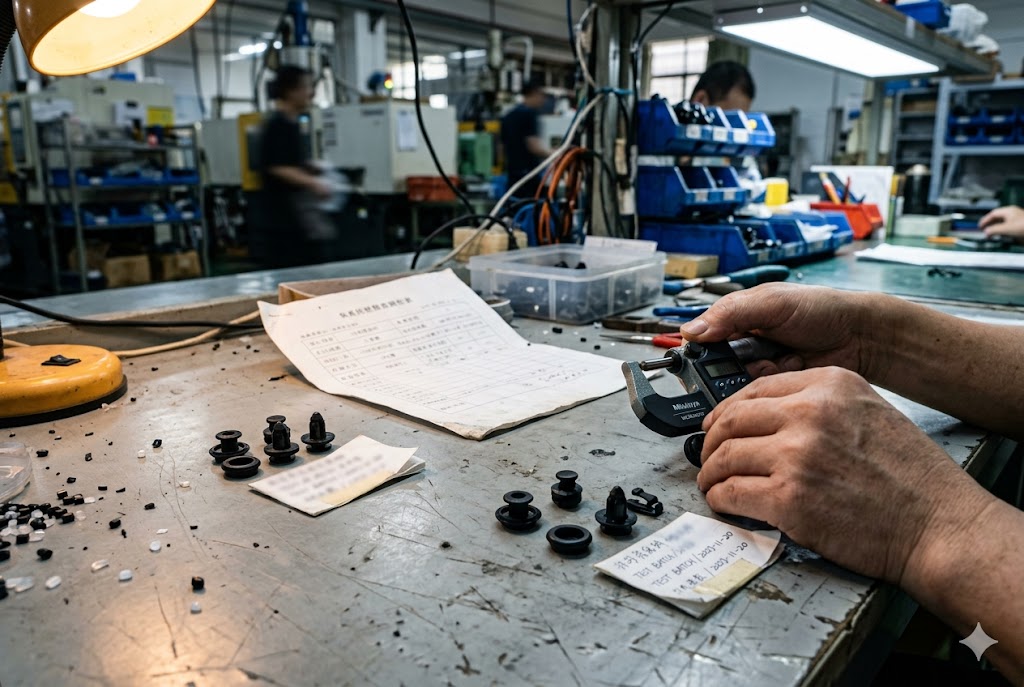
If a Chinese supplier proposes a resin change, re-qualification must include production of a new golden sample run under documented process parameters, dimensional inspection against your drawing, and functional testing using your own acceptance criteria — not the supplier's internal test data. Approval of the new golden sample is required before any production shipment.
Step-by-Step Re-Qualification Process
Re-qualification for a material substitution follows the same logic as initial tooling qualification. The only shortcut is that you already know the mold works. The material is now the unknown.
| Step | Action | Responsibility |
|---|---|---|
| 1 | Supplier submits full material datasheet and CoA | Supplier |
| 2 | Buyer reviews technical data against original spec | Buyer / Engineering |
| 3 | Supplier produces T1 sample run under documented parameters | Supplier |
| 4 | Dimensional inspection of T1 samples | Third-party QC or Buyer |
| 5 | Functional and mechanical testing against acceptance criteria | Buyer |
| 6 | T2 iteration if T1 fails any criterion | Supplier |
| 7 | Golden sample produced, signed, dated, and distributed | Supplier + Buyer |
| 8 | Written approval issued | Buyer |
| 9 | Mass production resumes | Supplier |
No step can be skipped. Jumping from step 3 directly to step 9 because the supplier says "it looks the same" is how dimensional failures reach your customers.
What to Test
Testing requirements depend on your application. At minimum, inspect for:
- All critical and major dimensions per drawing
- Surface finish and cosmetic appearance per approved standard
- Weight per part (deviations indicate density or fill differences)
- Weld line location and integrity if structural loads apply
- Shrinkage behavior if tight tolerances are involved
For parts with thermal, chemical, or electrical requirements, additional tests apply. A connector housing needs dielectric testing. A fluid-contact part needs chemical compatibility testing 2. A structural bracket needs load testing.
The Regrind Problem
Regrind is a hidden form of material substitution. When a factory reintroduces ground runners and rejected parts into the melt, the effective material is no longer the virgin resin you approved. Mechanical properties degrade. Color consistency suffers. Dimensional stability decreases.
Your contract must include an explicit no-regrind clause. And your re-qualification process must include a question: is any regrind present in these samples? Require the supplier to declare in writing that the qualification run used 100% virgin material.
Side-by-Side Comparison Testing
When a supplier claims a new grade is "equivalent," require a direct comparison. Test the original approved material alongside the proposed substitute using the same part geometry, same mold, same processing parameters. Evaluate results against your acceptance criteria — not the supplier's. Grade equivalency claims based on nominal datasheet values routinely overstate real-world performance parity, especially when the substitute comes from a lower-tier Chinese resin compounder. Each lot of substitute resin must carry a Certificate of Analysis 3 confirming tested values fall within your approved specification range.
How Do I Include a Material Change Control Clause in My Supply Agreement with a Chinese Injection Molding Factory?
Every supply agreement we help clients prepare includes a dedicated section on change control. It is not boilerplate. It is the contractual backbone that makes every other quality process enforceable. Without it, your ECN process and your golden sample procedure are strong recommendations with no legal weight behind them.
A material change control clause in your supply agreement must define the ECN submission requirement, the notice period, the re-qualification steps, golden sample approval as a condition of shipment, and a payment hold trigger. It should also specify that unauthorized substitutions are grounds for rejection and return at supplier cost.

Key Elements of a Change Control Clause
Break the clause into clear, numbered obligations. Ambiguity is your enemy in a contract with a factory overseas.
| Clause Element | What It Should Say |
|---|---|
| Scope | All material changes to approved parts under this agreement |
| Notification requirement | Written ECN submitted minimum 30 days before effective date |
| ECN content | Datasheet, CoA, sample parts, proposed date |
| Re-qualification | New golden sample required; buyer approval before production |
| Shipment hold | No shipment of parts produced under changed material until approved |
| Payment gate | Payment milestone linked to golden sample approval |
| Unauthorized change | Grounds for rejection, return at supplier cost, and potential contract termination |
| Document control | All approvals stored in version-controlled document system |
Linking Payment to Approval
This is the single most effective enforcement mechanism. When the factory knows that a shipment produced under an unapproved material change will not trigger the payment milestone, the financial incentive to skip notification disappears. Tie the shipment release and the payment milestone explicitly to golden sample approval for any change.
Golden Sample Distribution
Once the new golden sample is approved, it must be physically produced and distributed. One copy goes to the buyer's facility. One goes to the factory production floor. One goes to any third-party QC agency 4 conducting ongoing inspections. Each copy must be signed, dated, and reference the approved ECN number.
Managing this via email attachments without a physical signed sample is not adequate. A production worker checking a part on the line cannot compare it against a PDF. They need the physical part.
The golden sample 5 acts as the definitive benchmark — the single physical standard to which every subsequent production batch must be compared. Once distributed, any deviation becomes objectively verifiable.
Version-Controlled Document Control
All ECNs, approval records, redlined drawings, validation summaries, and golden sample records must be stored in a version-controlled document system 6. Managing these via email threads is a documented failure mode. When a dispute arises — and sometimes it does — you need a clear, dated, version-tracked record that shows exactly what was approved, by whom, and when.
If your team does not have a formal document control system, a shared folder with strict naming conventions and change logs is a workable minimum. The key is that every record is retrievable, dated, and linked to the part number and ECN reference.
RoHS and REACH Compliance
For parts used in products sold in the EU or in supply chains that require RoHS or REACH compliance 7, a material substitution triggers additional documentation requirements. The new resin supplier must provide an updated Declaration of Conformity and an updated substance declaration. Chinese domestic-grade resins may not carry existing EU compliance documentation even when chemically similar to the original grade. Do not assume compliance transfers automatically. Require fresh documentation for every substitution.
We have seen this play out many times. A factory quietly switches to a cheaper domestic resin. The parts look identical. They ship. Then six months later, a buyer's customer reports a field failure — brackets cracking under load, housings warping in heat, surface coatings delaminating. The investigation traces back to a resin change that was never disclosed.
The risks of unauthorized material substitution include dimensional non-conformance, mechanical failure in service, regulatory non-compliance, loss of RoHS or REACH certification, production downtime for downstream customers, and financial liability from returns, rework, and compensation claims. For high-volume parts, a single undisclosed resin change can affect thousands of units before discovery.

Why Factories Make Unauthorized Substitutions
Understanding the root cause is not about excusing it. It is about designing controls that address it directly. The most common reasons:
- The original resin becomes unavailable or lead times increase
- A procurement manager finds a cheaper domestic grade and switches without engineering review
- A sales manager approves a change to win a cost target without informing the buyer
- The factory treats minor grade changes within the same resin family as non-events
None of these reasons involve malice. All of them result in the same outcome: your approved specification has been changed without your knowledge.
Downstream Process Compatibility
For parts with secondary operations — painting, plating, ultrasonic welding, insert molding, or adhesive bonding — a resin change that looks harmless on a standalone mechanical test can fail catastrophically in the downstream process.
A paint adhesion test on a molded plaque may pass. But a different mold release agent used with the new resin can cause delamination after the painting step. A resin with slightly different surface energy may cause adhesive bond failures at assembly. A resin with a different melt flow index may create weld line weaknesses that only appear under ultrasonic vibration.
The ECN approval for a material substitution must explicitly include revalidation of all downstream processes — not just standalone mechanical properties of the molded part 8.
The Regrind Risk in Detail
Factories that use regrind without disclosure are not changing the approved resin grade, but they are changing the effective material. The accepted industry position is that repeated thermal cycling degrades mechanical properties. Impact resistance and elongation are typically the first to deteriorate. Color consistency follows. Tight-tolerance parts lose dimensional stability as regrind percentage increases.
Your quality agreement must prohibit regrind explicitly. Your inspection process must include a question about regrind at every production run, not just at qualification.
Financial Exposure
The financial exposure from an unauthorized substitution can be significant. If the substitution causes parts to fail in your customer's assembly, you may face:
- Cost of sorting and returning the affected shipment
- Cost of emergency replacement production
- Compensation claims from downstream production stoppages
- Damage to your customer relationship
The supplier who made the unauthorized change rarely bears these costs voluntarily. Without a contractual clause specifying liability, recovery is difficult. With the clause in place, you have a documented basis for a claim.
Detection Methods
Relying on visual inspection alone will not catch a resin substitution. Detection requires:
- Weight-per-part monitoring (deviations indicate density differences)
- FTIR or DSC analysis 9 on retained samples when a discrepancy is suspected
- Regular review of incoming CoAs against the approved material list
- Third-party QC inspection 10 with a scope that includes material verification questions
Building detection into your incoming quality process is the last line of defense. The first line is always the contractual process described above.
Conclusion
Material substitution is one of the most preventable quality failures in offshore injection molding supply chains. Set up the ECN process, write the clause into your contract, require physical golden samples, link payment to approval, and prohibit regrind in writing. These are straightforward steps — but they only work if they are in place before the first order is placed.
Footnotes
1. Explains what an Engineering Change Notice is and how it controls manufacturing modifications. ↩︎
2. UL Solutions covers plastics testing, including chemical compatibility and dielectric performance. ↩︎
3. Defines what a Certificate of Analysis contains and why it matters for supplier compliance. ↩︎
4. QIMA provides third-party QC inspections and supplier audits for China-based manufacturers. ↩︎
5. Explains the golden sample concept and its role as the production benchmark in international sourcing. ↩︎
6. Guide to version-controlled document control systems for manufacturing quality management. ↩︎
7. Explains the differences between RoHS and REACH and what compliance documentation is required. ↩︎
8. Details how injection molding process parameters affect part quality and material performance. ↩︎
9. Case study showing how FTIR and DSC analysis detects material substitution in molded components. ↩︎
10. Compares quality inspections and factory audits for verifying Chinese supplier compliance. ↩︎