Skip to main content Skip to footer
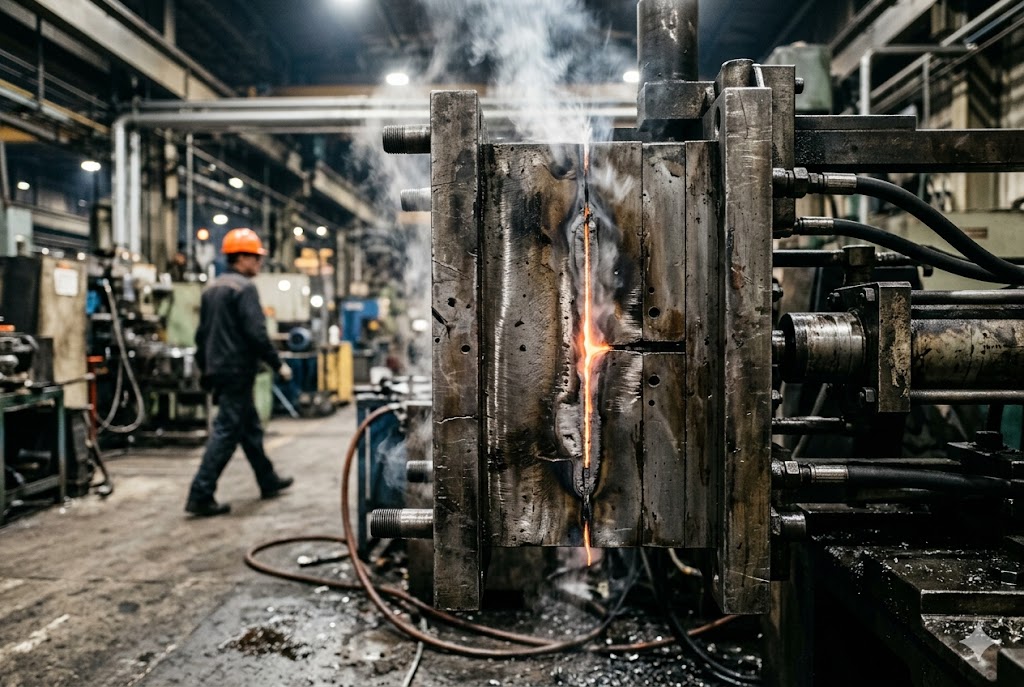
Every week, we field the same question from new clients: why is there a tooling charge before we even start production? If you've been sourcing custom die cast parts from China, you already know the frustration of seeing a five-figure line item before a single part is made.
Tooling is required in die casting because every custom part geometry needs its own purpose-built steel cavity. Molten metal is injected at pressures up to 1,500 bar into a rigid, hardened mold. Without this cavity, the machine has nothing to form the part against. There is no generic substitute.
Once you understand why the mold exists, the rest of the cost structure makes sense. Let's walk through the four questions purchasing managers ask us most often.
Why Can't My Supplier Start Mass Production Without a Die?
When our engineers receive a new inquiry, the first thing we check is whether the part can be die cast at all — and if it can, we know a mold conversation is unavoidable.
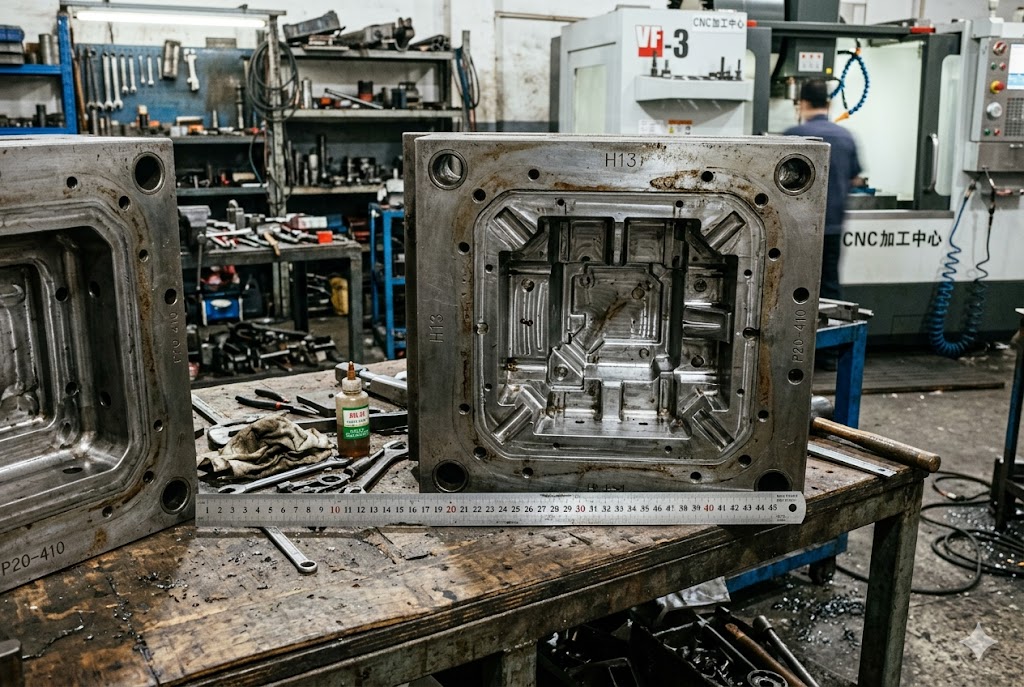
Die casting cannot begin without a die because the mold cavity is what gives the part its shape. The machine only provides pressure and heat. Every wall thickness, draft angle, and tolerance you specify in your drawing must be machined into the steel cavity before the first production shot is ever made.
Why the Machine Alone Is Not Enough
A high-pressure die casting 1 machine is essentially a high-pressure injector. It melts the alloy, forces it into the mold at high speed, and holds it under pressure until it solidifies. The machine itself has no awareness of your part geometry. All of that information lives inside the mold.
This is fundamentally different from CNC machining. In CNC, the cutting tool traces your design directly into each blank, one part at a time. In die casting, all dimensional control is transferred to the cavity surface before production begins. Every shot that comes off the machine is a copy of the steel cavity — nothing more, nothing less.
What the Die Actually Does
| Function | Detail |
|---|---|
| Shapes the part | The mold cavity 2 defines every external and internal surface |
| Controls dimensions | All tolerances are built into the steel, not adjusted per shot |
| Manages cooling | Cooling channels inside the die control solidification rate |
| Controls gating | Runner and gate geometry controls how metal fills the cavity |
| Provides ejection | Ejector pins push the finished part out after solidification |
Because all five of these functions are built into the die, a mold that is poorly designed or improperly trialed will produce bad parts consistently — at full production speed.
What Happens If a Supplier Skips Proper Tooling
Some lower-tier suppliers will rush the mold to save time or cut corners on the trial process. The result is almost always the same: parts that look acceptable in T1 samples but show dimensional drift or surface defects after the first few thousand shots. We have visited factories in Guangdong and Zhejiang where clients came to us after receiving a container of out-of-spec parts — and in every case, the root cause traced back to a die that was never properly validated before production was released.
The only way to protect yourself is to require a formal dimensional report from the first trial shots before you approve production. If your supplier cannot produce this, treat it as a red flag.
How Does Tooling Make Die Casting More Efficient for Larger Volumes?
We run the same internal analysis every time a client asks us to compare die casting against CNC machining 3 for a new project: at what volume does die casting win on total cost?
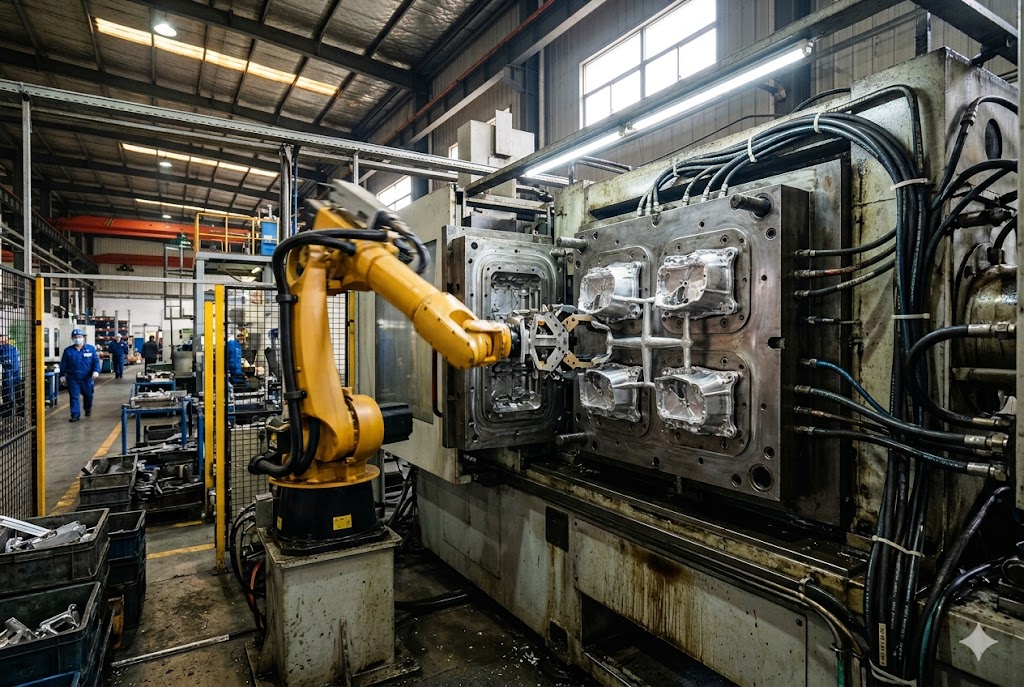
Tooling cost is a one-time fixed investment. It spreads across every unit produced. An $80,000 mold over 10,000 units adds $8.00 per part. The same mold over 200,000 units adds only $0.40 per part. This is why die casting consistently delivers lower unit costs than CNC at volumes above roughly 1,000 pieces.
The Cost Structure Behind Every Quotation
Chinese suppliers separate tooling from piece price in their quotes for a reason. The economics are structurally different. Tooling is a capital asset — it is machined once and used for years. Piece price covers material, machine time, labor, and finishing for each cycle. Mixing them together makes it impossible to evaluate a program correctly.
| Volume | Tooling Cost | Tooling per Unit | Piece Price | Total per Unit |
|---|---|---|---|---|
| 1,000 units | $20,000 | $20.00 | $4.50 | $24.50 |
| 10,000 units | $20,000 | $2.00 | $4.50 | $6.50 |
| 50,000 units | $20,000 | $0.40 | $4.50 | $4.90 |
| 100,000 units | $20,000 | $0.20 | $4.50 | $4.70 |
The numbers above use a simple single-cavity mold. At higher volumes, multi-cavity tooling 4 changes the picture further.
Single-Cavity vs. Multi-Cavity Tooling
A multi-cavity mold produces two or more identical parts per machine shot. This increases the upfront tooling cost — sometimes by 60–80% over a single-cavity die — but it cuts cycle time per part and reduces machine hours significantly. At volumes above 50,000 units per year, the math almost always favors multi-cavity tooling.
The decision should be driven by your confirmed lifetime volume forecast. Do not ask for the lowest possible tooling quote and then complain about piece price at scale. The two are directly linked.
Tool Life and Long-Term Program Economics
A well-maintained H13 steel mold 5 can produce between 100,000 and 500,000 shots before it needs major refurbishment. The range is wide because it depends on part complexity, alloy type, wall thickness, and how disciplined the supplier is about preventive maintenance.
| Tool Steel Grade | Typical Shot Life | Best Use Case |
|---|---|---|
| P20 (soft tooling) | Up to 50,000 shots | Pre-production, bridge volumes, design validation |
| H13 (hardened) | 100,000–500,000 shots | Long-term production programs |
| SKD61 (hardened) | 100,000–500,000 shots | High-cycle, precision production |
If your supplier cannot tell you what steel grade they used and what shot-life they guarantee, ask. It matters to your total cost of ownership over a multi-year program.
Should I Still Choose Die Casting If My Volume Is Not High Enough to Absorb Tooling Cost?
This is the most honest conversation we have with new clients. Die casting is not always the right answer — and we would rather tell you that upfront than take your tooling deposit and deliver a bad program.
Die casting makes economic sense when lifetime volume is high enough to amortize the tooling investment into an acceptable per-unit cost. For most aluminum parts with standard complexity, that threshold starts at around 1,000 pieces. Below that, CNC machining or other processes will usually deliver a lower total program cost.
When Die Casting Still Makes Sense at Lower Volumes
There are exceptions. If your part has internal geometry, thin uniform walls, or complex undercuts that CNC machining cannot easily produce, die casting may be necessary regardless of volume. Understanding the correct draft angle 6 for your design is one of the first steps in determining feasibility. In these cases, soft tooling made from P20 steel is a reasonable bridge solution.
Soft tooling costs between $3,000 and $15,000 for most part sizes. It is not built to last — expect up to 50,000 shots before the cavity shows wear. But it allows you to validate your design, qualify the process, and start shipping parts while you decide whether volume justifies the investment in a hardened production die.
Treat soft tooling as a qualification asset, not a production asset. Budget for the hardened die once your design is confirmed and your customer has committed to volume.
Process Comparison for Medium-Complexity Parts
| Factor | Die Casting | CNC Machining | Soft Tooling + Die Casting |
|---|---|---|---|
| Upfront investment | High ($20K–$100K+) | Low to none | Low to medium ($3K–$15K) |
| Per-unit cost at 500 pcs | High (tooling not absorbed) | Medium | Medium |
| Per-unit cost at 10,000 pcs | Low | High | Low |
| Design flexibility | Low after tool cut | High | Medium |
| Surface finish | Good | Very good | Good |
| Typical lead time | 6–10 weeks (incl. tooling) | 2–4 weeks | 4–7 weeks |
The Tariff Factor
Our US clients have raised this more frequently over the past two years. With Section 301 tariffs 7 applying to many Chinese-origin manufactured parts, the total landed cost calculation has shifted. In some cases, tooling investment in Vietnam — where our branch office operates — delivers a better duty-adjusted total cost even at moderate volumes. We run this comparison for every new program on request.
The key point is this: volume threshold is not the only variable. Tariff rate, logistics cost, lead time requirement, and design complexity all affect whether die casting — and where — is the right choice for your program.
What Should I Understand About Tooling Before I Approve My First Project?
Before a client signs off on tooling with us, we walk them through four non-negotiable points. Most sourcing problems we have seen in this industry started because one of these was skipped.
Before approving tooling on your first die casting project, you need to confirm four things: who owns the mold, what steel grade it is built from, what the trial and approval process looks like, and how maintenance will be managed over the life of the program. Getting these wrong at the start is very hard to fix later.

1. Tooling Ownership
Always negotiate to own the tooling outright. Put this in the contract explicitly. Many Chinese suppliers treat the mold as their asset by default — it sits on their floor, they paid their team to build it, and they may not see why you should have the right to take it elsewhere.
This matters when disputes arise. If a pricing disagreement or quality issue causes you to consider moving production, a supplier who owns your mold has significant leverage over you. We insist on buyer ownership language in every tooling contract we manage on behalf of clients.
2. Steel Grade and Shot Life Commitment
Ask for the steel specification in writing before tooling is cut. H13 steel 8 and SKD61 are the standard choices for production dies. If a supplier proposes a steel grade you do not recognize, ask them to justify it against these benchmarks.
Request a written shot-life commitment as part of the commercial terms. A reputable supplier will guarantee a minimum number of shots — typically 100,000 for a standard H13 die on aluminum alloy. If they refuse to commit, that is informative.
3. The Trial and Approval Process
The T1/T2/T3 trial sequence is where Chinese suppliers most often underinvest. T1 is the first shot off the new mold. Parts are measured, gating and venting are assessed, cooling is evaluated, and shrinkage compensation is checked against your die casting design guidelines 9. Problems found at T1 are corrected before T2. This iterative qualification phase is not optional — it is how you know the mold is ready for production.
Require a full dimensional report at each trial stage. Do not approve production release based on visual inspection alone. We have seen clients receive T1 samples that looked good on the outside but had internal porosity 10 or hidden dimensional drift that only showed up at first article inspection.
4. Preventive Maintenance Schedule
A mold that is not maintained will fail before it reaches its rated shot life. Ask your supplier what their preventive maintenance protocol is — how often they clean the cavity, inspect the cooling channels, check ejector pins, and polish contact surfaces. A supplier with no answer to this question is running your die into the ground.
We track shot counts and maintenance records for all tooling we manage. When a die approaches 80% of its rated life, we initiate a refurbishment assessment before failure, not after.
Conclusion
Tooling is not a hidden cost — it is the foundation of every die casting program. Understand what you are paying for, own the asset, validate it properly, and the economics of die casting will work in your favor at scale.
Footnotes
1. Overview of high-pressure die casting process, applications, and material considerations. ↩︎
2. Guide to mold cavity types, cores, and inserts used in die casting production. ↩︎
3. Comparison of die casting vs. CNC machining across cost, geometry, and break-even volume. ↩︎
4. How multi-cavity die casting boosts efficiency and lowers per-unit cost at high volumes. ↩︎
5. Properties, applications, and heat resistance of H13 tool steel in die casting dies. ↩︎
6. Beginner's guide to draft angles in die casting design and part ejection. ↩︎
7. Current US-China tariff rates under Section 301 and their impact on sourcing costs. ↩︎
8. H13 tool steel characteristics, toughness, and extended mold lifetime for die casting. ↩︎
9. Key design tips for die casting including draft angles, fillets, and wall thickness guidelines. ↩︎
10. Causes, detection methods, and solutions for porosity defects in die cast parts. ↩︎