Skip to main content Skip to footer
Every week, our team reviews supplier documentation for clients sourcing wire EDM parts from China. One question we hear constantly: how do you actually know the steel going into your parts is what the supplier claims it is? The gap between a supplier's word and a verified MTR can cost you a rejected shipment — or worse, a field failure.
To confirm your Chinese wire EDM supplier uses ASTM or SAE compliant materials, require a Mill Test Report (MTR) explicitly citing the ASTM or SAE designation for every material lot, cross-reference it against the GB/T equivalent, then verify authenticity through third-party spectrochemical testing (PMI) and EN 10204 Type 3.1 or 3.2 certification before production begins.
Material traceability is not paperwork — it is your first line of defense against grade substitution. Here is exactly how to build that defense, step by step.
Should I Send My Supplier an Approved Material Specification Sheet Before Production?
When our project managers onboard a new wire EDM supplier for a client, the very first document we send is not a PO — it is the material specification sheet. Most quality failures we have seen trace back to assumptions made at the start of the job, not mistakes made on the shop floor.
Yes, you must send your supplier an approved material specification sheet before production starts. It should state the full ASTM or SAE designation, edition year, and any additional requirements such as hardness, surface condition, or heat treatment. Without this, your supplier has no binding reference to work from.

Why a Verbal or Informal Reference Is Not Enough
A supplier quoting you "D2 tool steel" without a documented spec attached to the PO is operating on assumption. Different mills, even within China, interpret grade requirements differently. A material spec sheet removes ambiguity before a single cut is made.
Your approved material specification sheet should include at minimum:
| Field | What to Include |
|---|---|
| ASTM/SAE Designation | Full designation and edition year (e.g., ASTM A681-08 1) |
| Material Grade | Specific grade (e.g., D2, H13, 4140) |
| Chemical Composition Limits | Per the standard — min/max for key elements |
| Mechanical Property Requirements | Hardness, tensile strength, yield strength as applicable |
| Condition | Annealed, pre-hardened, normalized — state it explicitly |
| Certification Required | EN 10204 Type 3.1 or 3.2, CoC required |
| Substitution Policy | No substitution without written ECN approval |
What Happens Without a Spec Sheet
Without a spec sheet attached to the PO, you have no enforceable basis to reject a non-conforming material lot. A supplier can argue — often successfully — that they supplied a "common equivalent." Your spec sheet is the document that makes material rejection unambiguous and contractually defensible.
How to Distribute and Confirm Receipt
Send the spec sheet to both the sales contact and the quality manager. Request a written acknowledgment that both have read it. For higher-risk jobs, ask the quality manager to sign and return a copy. This confirmation matters if you need to escalate a dispute later.
Updating the Spec Sheet Over Time
ASTM and SAE standards are revised periodically. Each time you update your spec sheet, re-issue it to your active suppliers with a clear revision number and date. Make it a standing item in your supplier qualification procedure. The SAE steel grade numbering system 2 provides a reliable four-digit reference framework for specifying alloy and carbon steel grades in your documentation.
Can Chinese Suppliers Source ASTM-Grade Steel Domestically, or Must It Be Imported?
This is a question we get from clients regularly, especially those sourcing hardened tool steels for precision EDM work. The honest answer from our experience visiting steel distributors and mills across China: it depends entirely on the grade and the application tolerance.
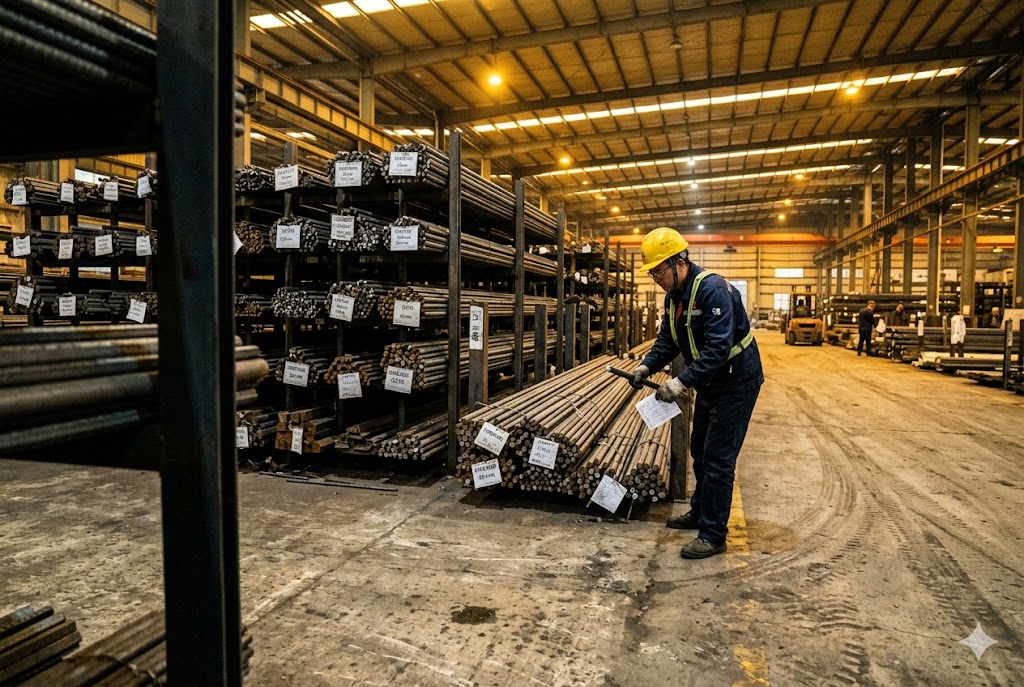
Chinese suppliers can source some ASTM-equivalent grades domestically, but for specialty alloys such as H13, D2, 420SS, or titanium, domestic Chinese mill stock shows higher lot-to-lot composition variance than Western or Japanese equivalents. For tight-tolerance or safety-critical wire EDM parts, imported bar or plate stock is generally more reliable.
What Chinese Mills Actually Produce
China's domestic steel industry is large and capable. For common carbon and low-alloy grades, domestic mills can produce material that meets ASTM or SAE chemical composition requirements. But "meets composition" on paper does not always mean consistent microstructure, inclusion content, or heat-to-heat repeatability — all of which matter for wire EDM work where surface integrity and recast layer formation 3 are critical.
| Steel Category | Domestic Sourcing Reliability | Notes |
|---|---|---|
| Carbon steel (ASTM A36, 1018, 1045) | High | Widely produced domestically; MTC review sufficient |
| Low-alloy steel (SAE 4140, 4340) | Medium-High | Domestic quality acceptable; verify MTR heat numbers |
| Tool steel (D2, H13, A2) | Medium | Significant lot-to-lot variance; prefer imported or PMI-verified |
| Stainless (420SS, 316) | Medium | Composition checks needed; Mo content requires verification |
| Titanium alloys (Ti-6Al-4V) | Low | Recommend imported; domestic mill traceability inconsistent |
| High-speed steel (M2, M42) | Medium | Heat treatment consistency is the main variable |
The Distributor Layer Problem
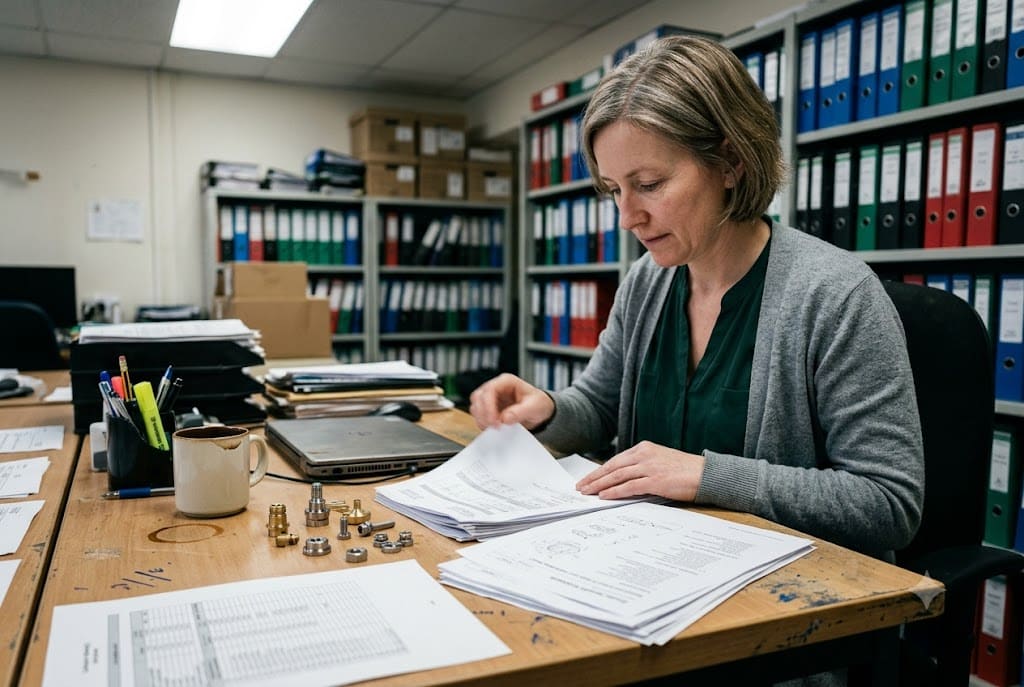
Most Chinese wire EDM shops do not buy directly from a mill. They buy from steel distributors. Each distributor may re-issue its own certificate with its own letterhead, breaking the direct chain of traceability from the original mill heat. When you receive an MTR from a supplier, always check:
- Is the issuing party the original mill or a downstream distributor?
- Does the heat number on the certificate match the heat number marked on the raw material?
- Is the certificate date consistent with the purchase date of the material lot?
If the MTR comes from a distributor, request the original mill certificate alongside it. A distributor reissuance alone is not sufficient for EN 10204 Type 3.1 compliance 4.
When to Require Imported Material
For parts where hardness consistency, fatigue life, or dimensional stability over repeated cycles is critical, specify in your PO that the material must originate from a named mill such as Uddeholm, Böhler, or Carpenter Technology 5. This is a commercially defensible requirement and many experienced Chinese EDM shops can accommodate it — it simply costs more and must be planned into the schedule.
How Do I Cross-Reference Chinese GB Material Grades With ASTM Equivalents?
Our engineers use GB-to-ASTM cross-reference tables regularly when reviewing supplier submissions. But we always tell clients the same thing: treat these tables as a starting point, not a finish line.
To cross-reference Chinese GB/T grades with ASTM equivalents, use published international steel grade equivalence tools 6 to identify candidate matches, then verify compliance by reviewing the actual MTC chemical composition data against the specific ASTM standard's requirements — because equivalence tables reflect approximate correlations, not full interchangeability.

Common GB/T to ASTM/SAE Equivalents for Wire EDM Materials
The table below shows commonly referenced equivalences. These are approximations. Always verify via MTC before accepting. A comprehensive GB/T-to-ASTM cross-reference guide 7 can clarify where composition differences between systems require closer scrutiny before acceptance.
| Chinese GB/T Grade | Approximate ASTM/SAE Equivalent | Key Difference to Watch |
|---|---|---|
| Cr12MoV | ASTM A681 D2 | Vanadium content may vary slightly |
| 4Cr5MoSiV1 | ASTM A681 H13 | Thermal fatigue properties differ by heat treatment |
| 40Cr | SAE 5140 / SAE 4140 | Cr content at lower end of ASTM range |
| 42CrMo | SAE 4140 | Generally close match; verify Mo content on MTC |
| 9Mn2V | ASTM A681 O1 | Acceptable for most tooling; check Mn at upper limit |
| 1Cr13 | AISI 410 | Low-end stainless; check C and Cr minimums |
| 0Cr17Ni4Cu4Nb | 17-4PH (ASTM A564 Gr. 630) | Nb content critical; require mill cert from known source |
Why "Equivalent" Does Not Mean "Interchangeable"
Two grades can share similar nominal chemical composition but differ significantly in:
- Inclusion content — affects machinability and fatigue resistance
- Heat treatment response — same composition can yield different hardness profiles
- Microstructure consistency — mill process controls affect grain structure
- Surface condition — decarburization depth varies between mills
For wire EDM work specifically, surface integrity matters. A recast layer formed on a material with inconsistent composition or microstructure behaves differently under cyclic stress than one formed on a certified, mill-controlled heat.
The Right Workflow for Grade Cross-Referencing
- Identify the GB/T grade the supplier plans to use.
- Look up the approximate ASTM equivalent in a published reference table.
- Pull the ASTM standard for the specific grade and check the chemical composition limits.
- Request the supplier's MTC and compare the reported chemistry values against ASTM limits — not just against the GB/T standard.
- If values fall outside ASTM limits even by a small margin, reject the lot or escalate to engineering for a formal substitution review.
Does My Purchase Order Need to Explicitly State ASTM Material Requirements to Be Enforceable?
We have reviewed dozens of POs sent by clients before they came to us. The most common gap: the material section says "as per drawing" or simply lists a grade name with no standard citation. In a dispute, that language gives you almost nothing to work with.
Yes, your purchase order must explicitly state the ASTM or SAE standard by full designation and edition year to be enforceable. It should also specify that any material substitution, including a GB/T equivalent, requires a formal engineering change notification with your written approval before production begins. Without this language, a supplier can legally claim compliance with a "close" alternative.
What Your PO Material Section Must Include
A PO that will hold up in a supplier dispute or quality audit should include:
Standard identification: State the full ASTM or SAE designation and edition year. Example: ASTM A681-08, Grade D2, annealed condition. Do not rely on grade names alone.
Certification requirement: State the required EN 10204 document type. For most precision EDM work, EN 10204 Type 3.1 is the minimum. For safety-critical parts, require EN 10204 Type 3.2 8 (third-party witnessed). Also require a Certificate of Conformance (CoC) that explicitly references your customer specification.
Substitution clause: Include language such as: No material substitution, including equivalent GB/T grades, is permitted without a written Engineering Change Notification (ECN) approved by [your name/company] prior to the start of production.
MTR submission requirement: Require that the MTR be submitted before or with the first article, not after delivery. This gives you time to review and reject before the parts ship.
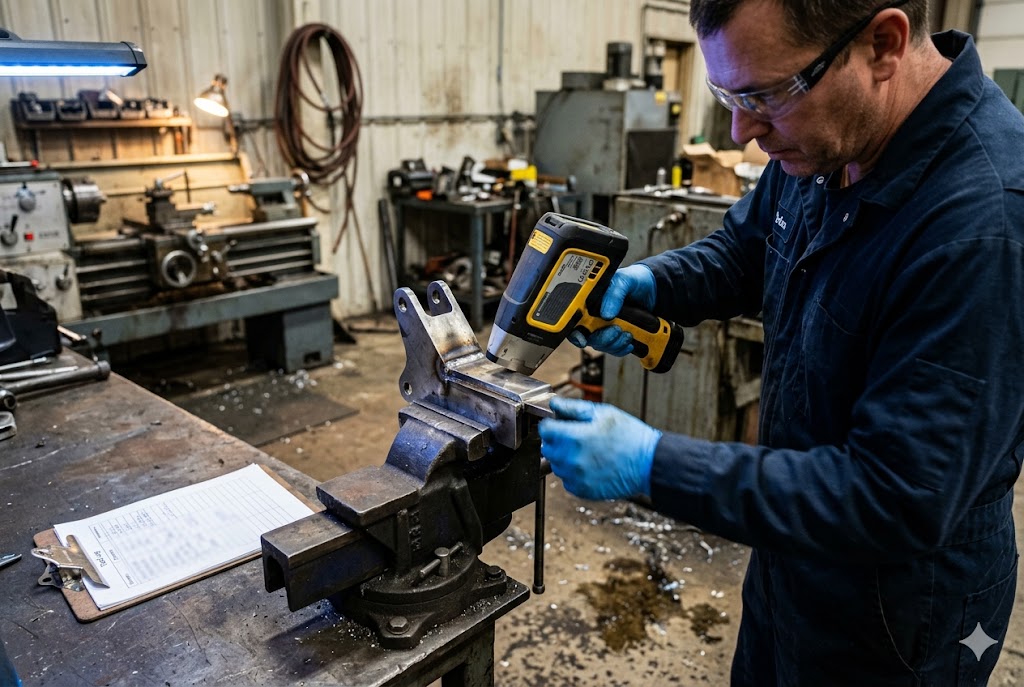
PMI right: Reserve the right to conduct positive material identification (PMI) testing 9 on any received lot, at any time, without advance notice.
The ECN Requirement as a Substitution Gate
The engineering change notification clause is the most important protection in your PO. Without it, a supplier facing a steel shortage will substitute the nearest available grade and ship the parts. By requiring a formal ECN with your written approval, you force a pause before any substitution occurs. Your engineering team gets to evaluate whether the proposed alternative is truly acceptable for your application — not just compositionally similar.
MTR Authenticity: What to Check Before Accepting
Even with a compliant PO, MTR data can be falsified. Cases exist where reported values were simply copied from a previous job's certificate and passed internal inspection on paper. To verify authenticity:
- Cross-check reported heat numbers against markings on the raw material or bar ends.
- Review the MTC formatting for inconsistencies (font changes, unusual spacing, missing fields).
- Contact the issuing lab or mill directly to confirm the report number exists in their records.
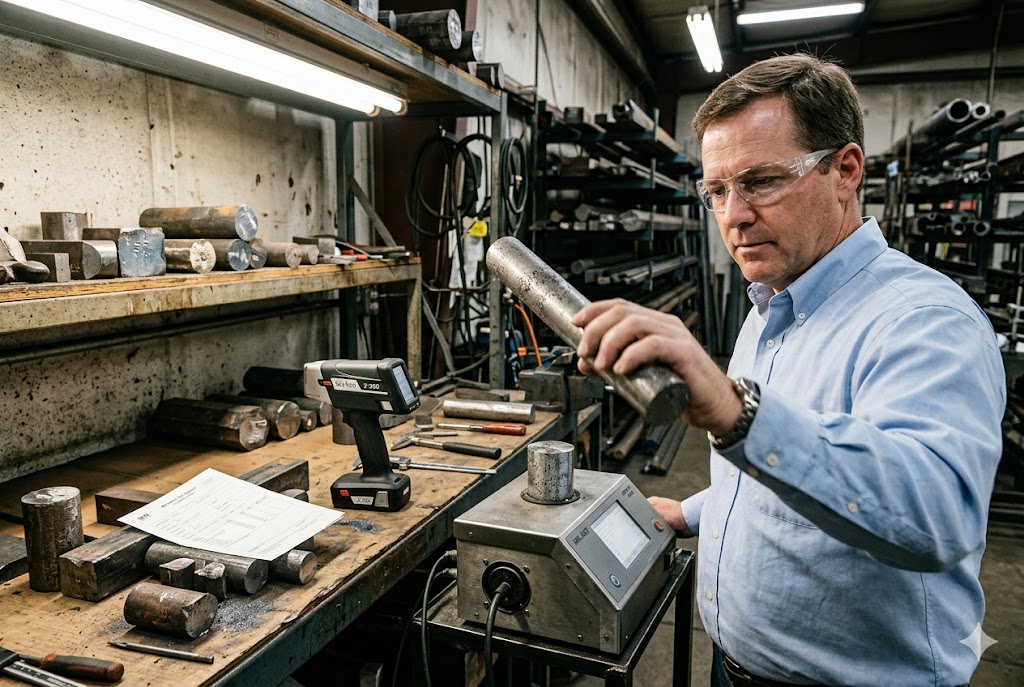
- For high-risk orders, require a third-party witnessed certificate (EN 10204 Type 3.2) and arrange independent PMI testing via XRF or OES spectrometer 10.
PMI is the most reliable field method for catching grade substitution early. It takes minutes per sample and can detect cases where carbon steel has been labeled as stainless, or a lower alloy has been substituted for a specified higher-performance grade.
Wire Electrode Traceability: A Separate Chain
One point almost all buyers miss: wire EDM requires two separate material traceability chains — the workpiece material and the wire electrode. Wire electrode grade (brass, zinc-coated, molybdenum) affects the recast layer thickness, surface integrity, and dimensional stability of the finished part. Electrode substitution is a known hidden variable. Confirm your supplier tracks MTRs for both, and that the electrode grade used matches what was validated during process qualification.
Conclusion
Confirming that your Chinese wire EDM supplier uses ASTM or SAE compliant materials comes down to three things: clear documentation before production starts, rigorous MTR review against the actual standard, and independent verification through PMI testing when the risk warrants it. Build these steps into your standard process — and they will save you from costly surprises.
Footnotes
1. Official specification covering chemical and mechanical requirements for wrought alloy tool steels under ASTM A681. ↩︎
2. Overview of the SAE four-digit steel grade numbering system used to designate carbon and alloy steel compositions. ↩︎
3. Research on recast layer formation in wire EDM and how material consistency affects surface integrity. ↩︎
4. Detailed guide explaining EN 10204 Type 3.1 vs. 3.2 mill test certificate requirements and traceability rules. ↩︎
5. Carpenter Technology's H13 tool steel datasheet — a benchmark premium specialty alloy from a named Western mill. ↩︎
6. Interactive cross-reference tool for matching steel grades across ASTM, EN, DIN, JIS, GB, and other standards. ↩︎
7. Comprehensive guide to GB/T-to-ASTM/EN/JIS steel grade equivalents with composition caveats for procurement. ↩︎
8. Explanation of EN 10204 Type 3.2 third-party witnessed certification and when it is required for critical parts. ↩︎
9. Wikipedia overview of positive material identification (PMI) methods, including XRF and OES for alloy verification. ↩︎
10. LGC Standards guide on PMI techniques, industry standards, and how XRF and OES verify alloy composition. ↩︎