Skip to main content Skip to footer
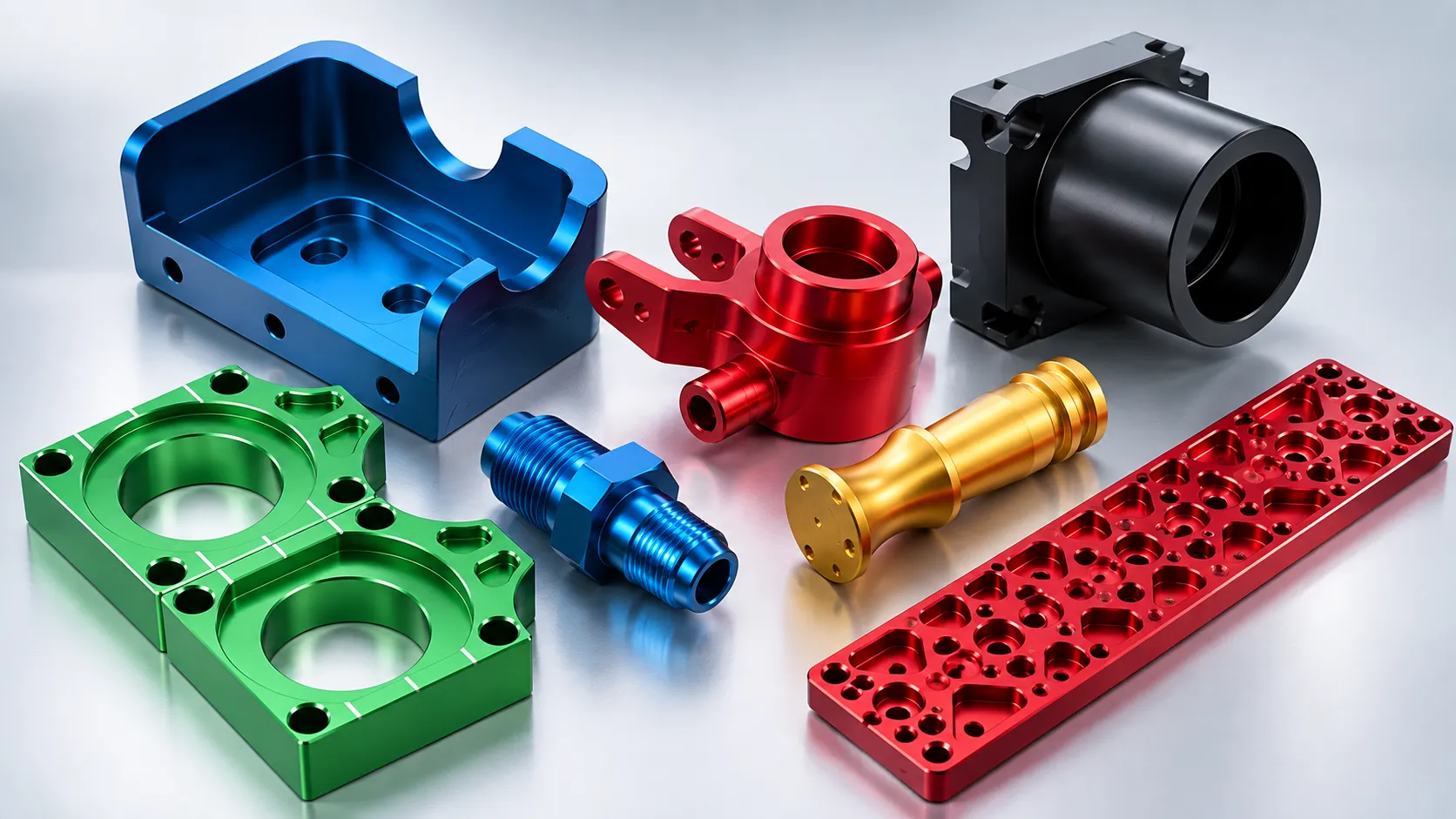
Hard anodizing is not simply a thicker version of regular anodizing.
Regular Type II anodizing is typically chosen for appearance, color, and corrosion protection, while Type III hard anodizing is used when higher hardness and wear resistance are required.
For precision CNC parts, however, there is another important difference: anodizing can affect final dimensions.
This guide compares Type II vs. Type III anodizing by thickness, hardness, wear resistance, color, cost, applications, and tolerance impact—so you can choose the right finish for your aluminum parts.
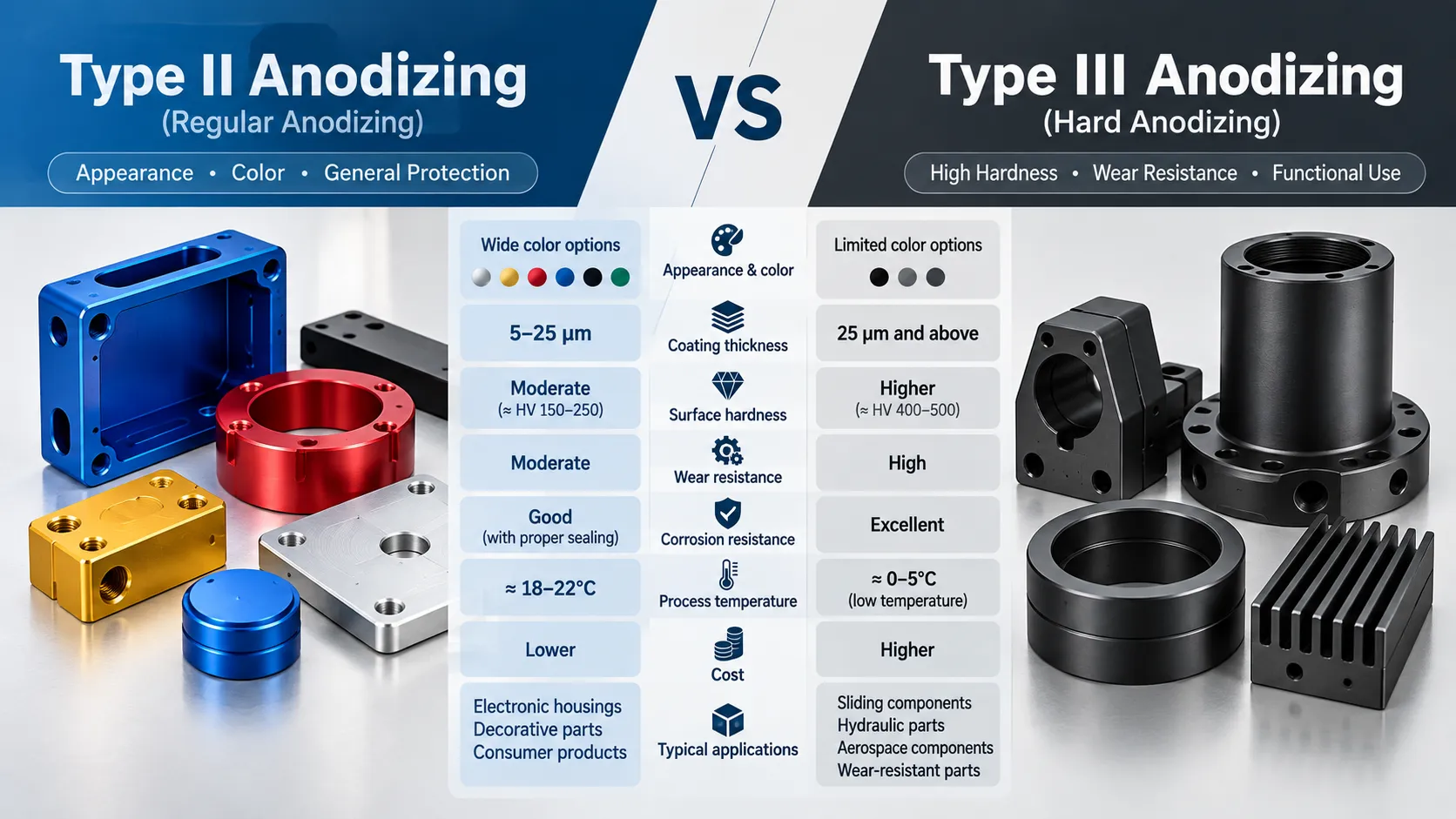
Hard Anodizing vs Regular Anodizing: Quick Comparison
If you only need a quick answer, start here:
| Feature | Regular Anodizing (Type II) | Hard Anodizing (Type III) |
|---|---|---|
| Main purpose | Appearance & corrosion protection | Hardness & wear resistance |
| Typical thickness | 5–25 μm | 25 μm and above |
| Surface hardness | Moderate | Higher |
| Wear resistance | Moderate | High |
| Color options | Wide | More limited |
| Decorative finish | Better | Less suitable |
| Process temperature | Higher | Lower |
| Cost | Lower | Higher |
| Typical use | Housings, panels, decorative parts | Sliding & wear-resistant parts |
| Tolerance impact | Usually smaller | More important to consider |
The exact coating thickness and resulting properties depend on the aluminum alloy, process specification, and application.
Simple rule: Choose Type II when appearance and color matter most. Choose Type III when wear resistance and surface hardness matter most.
For tight-tolerance CNC parts, however, coating thickness must also be considered during machining.
What Is Regular Anodizing (Type II)?
Regular anodizing, commonly known as Type II sulfuric acid anodizing, is one of the most widely used surface treatments for CNC-machined aluminum parts.
During anodizing, the aluminum part undergoes an electrochemical process that forms an aluminum oxide layer on its surface. Unlike paint, this oxide layer is formed from the aluminum itself rather than simply being deposited on top.
Type II anodizing is commonly selected to provide:
- Corrosion resistance
- Improved surface protection
- Decorative appearance
- A wide range of colors
Typical Type II coating thickness ranges from approximately 5–25 μm, depending on the required specification.
Because the porous oxide layer can absorb dyes before sealing, Type II anodizing is particularly suitable for parts where appearance matters.
Typical applications include:
- Electronic housings
- Aluminum panels
- Camera components
- Consumer products
- Decorative CNC parts
If your primary requirements are appearance, color, and general corrosion protection, Type II is usually the more practical option.
What Is Hard Anodizing (Type III)?
Hard anodizing—also called hard coat anodizing or Type III anodizing—uses the same basic electrochemical principle but is designed for functional performance rather than primarily for appearance.
The process typically operates at lower temperatures and uses different electrical conditions to create a thicker, harder oxide layer.
Hard anodizing coatings typically begin at approximately 25 μm, with thicker coatings possible depending on the application and specification.
Compared with Type II anodizing, Type III generally provides:
- Higher surface hardness
- Better wear resistance
- Good corrosion resistance
- Electrical insulation
- Improved durability in demanding mechanical applications
Typical applications include:
- Hydraulic components
- Sliding parts
- Pistons
- Machine components
- Aerospace components
- Parts exposed to repeated friction or wear
The trade-off is that hard anodizing offers fewer decorative color options and generally costs more to process.
6 Key Differences Between Type II and Type III Anodizing
1. Coating Thickness
One of the most obvious differences is coating thickness.
Regular Type II anodizing typically uses a thinner oxide layer, while Type III hard anodizing produces a thicker coating.
Typical reference ranges are:
- Type II: approximately 5–25 μm
- Type III: typically 25 μm and above
But thicker is not automatically better.
The correct thickness should be selected according to the functional requirements of the part rather than simply specifying the thickest possible coating.
For precision parts, excessive coating thickness can also create dimensional problems if it was not considered during machining.
2. Hardness and Wear Resistance
Hard anodizing is designed for applications where the aluminum surface must withstand repeated friction, sliding, or mechanical wear.
This makes Type III a better candidate for components such as sliding blocks, cylinders, pistons, and other mechanical parts exposed to contact.
Type II provides surface protection as well, but its main advantage is not extreme wear resistance.
Decorative or general-purpose part → Type II
Wear-critical mechanical part → Type III
3. Color and Appearance
Type II is generally the better choice when appearance is important.
Its porous oxide structure accepts dyes well before sealing, allowing a wide range of colors.
Hard anodizing is different. Because the coating is thicker and denser, the natural appearance tends to be darker, and the available color range is more limited. Gray, dark gray, and black finishes are common.
So if your customer wants a specific decorative color, don't automatically specify hard anodizing simply because it sounds more durable.
The functional requirement and cosmetic requirement need to be considered separately.
4. Process Conditions
Regular and hard anodizing also use different processing conditions.
Conventional sulfuric acid anodizing typically operates at approximately 18–22°C, while hard anodizing requires much lower bath temperatures, with typical conditions around 0–5°C or lower depending on the process.
Maintaining these lower temperatures requires additional cooling and tighter process control.
This is one reason Type III is generally more expensive than Type II.
5. Cost
Hard anodizing usually costs more because the process requires tighter temperature control, higher energy consumption, and longer processing time.
However, there is no universal price ratio.
Actual finishing cost depends on factors such as:
- Part size
- Quantity
- Aluminum alloy
- Coating thickness
- Masking requirements
- Color
- Surface requirements
- Inspection requirements
For this reason, choosing Type III for every aluminum component can add unnecessary cost without providing meaningful functional benefit.
The better question is not:
Which anodizing process is better?
It is:
Which anodizing process does this part actually need?
6. Typical Applications
Type II is usually preferred for components where cosmetic appearance and general protection are important.
Type III is more suitable for functional components exposed to friction, wear, or demanding service conditions.
This distinction sounds simple, but for precision CNC parts there is one more issue that engineers should not overlook:
Tolerance.
How Does Anodizing Affect CNC Machining Tolerances?
This is one of the most important considerations from a CNC machining perspective.
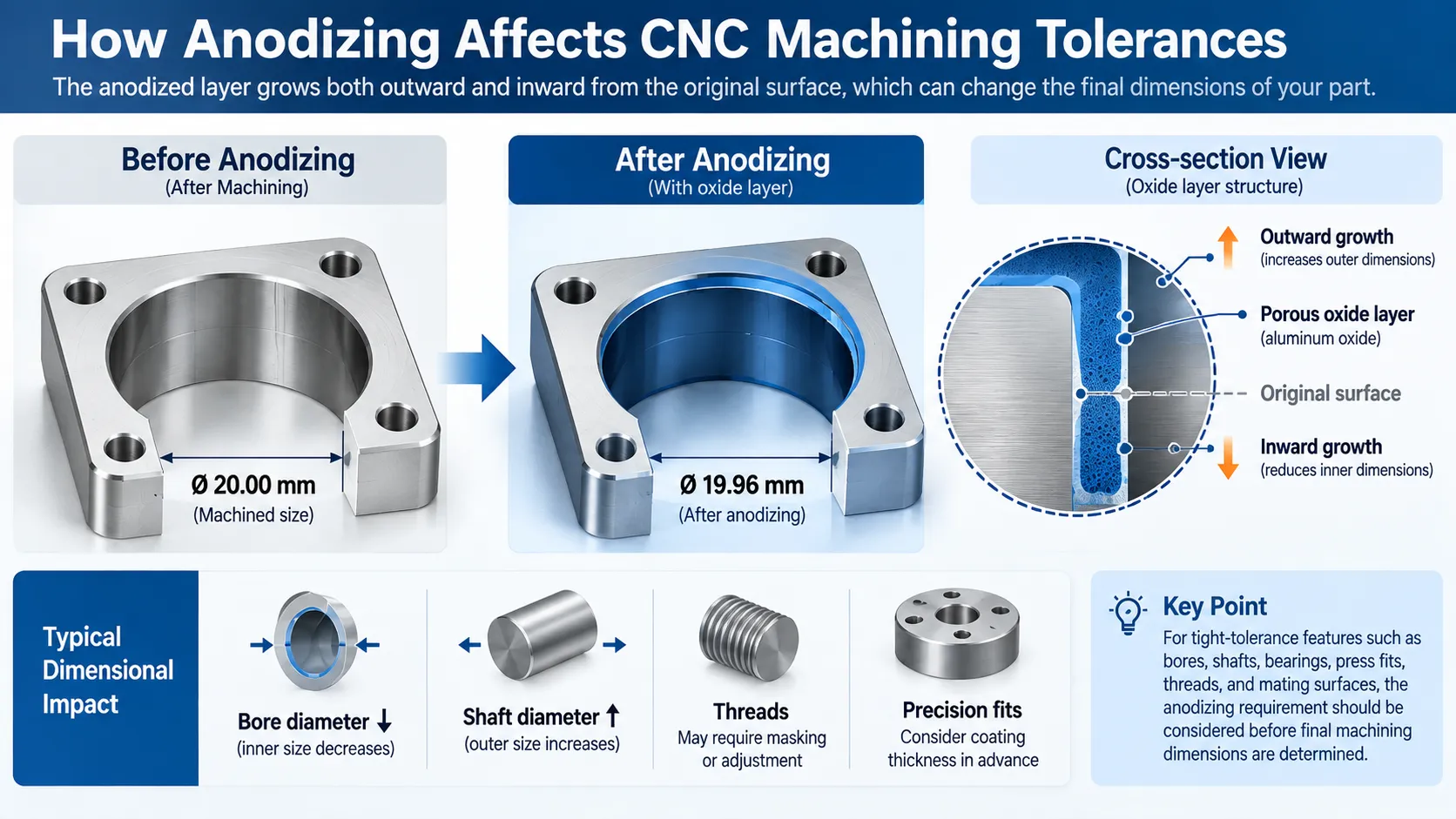
Anodizing does not behave like paint.
The oxide layer develops relative to the original aluminum surface: part of the coating forms into the substrate, while part grows outward.
That means the finished dimensions can differ from the dimensions measured immediately after machining.
This matters particularly for:
- Precision bores
- Shaft diameters
- Bearing seats
- Press fits
- Threaded features
- Mating surfaces
- Locating features
Example: A Precision Bore
Imagine a bore that has already been CNC machined close to its minimum allowable diameter.
If that bore is then hard anodized, oxide growth occurs on its internal surface. The resulting usable diameter can therefore become smaller.
For a decorative housing, the dimensional change may not matter.
For a bearing seat or precision mating feature, it can be the difference between a part that assembles correctly and one that does not.
This is why the surface finish should be considered before final machining dimensions are determined.
What Should Be Defined Before Anodizing a Precision CNC Part?
For tight-tolerance components, simply writing "Black Anodize" or "Hard Anodize" on a drawing may not provide enough information.
Before production, clarify the following.
1. Anodizing Type
Specify whether the requirement is Type II or Type III.
2. Coating Thickness
Define the required coating thickness or applicable specification rather than leaving the requirement open to interpretation.
3. Critical Final Dimensions
Identify features whose dimensions are critical after surface treatment, especially:
- Bearing bores
- Shafts
- Press-fit interfaces
- Threads
- Sealing surfaces
4. Dimensions Before or After Anodizing
For critical features, make it clear whether the drawing requirement applies to the machined part or the finished anodized part.
5. Masking Requirements
Some functional surfaces may need to remain unanodized.
Masking may be required for certain:
- Electrical contact areas
- Threads
- Grounding surfaces
- Precision mating surfaces
These requirements should ideally be identified during design or DFM review rather than after machining is complete.
Does Aluminum Alloy Affect Anodizing?
Yes.
The aluminum alloy can affect both the appearance and performance of the anodized surface.
Alloying elements such as silicon and copper influence how the material reacts during anodizing.
As a result, two parts with the same anodizing specification but different aluminum alloys may not have exactly the same appearance.
This becomes particularly important when cosmetic consistency is required across multiple components.
For this reason, engineers should consider material selection and surface finishing together, rather than treating anodizing as an independent final step.
Type II or Type III: Which Should You Choose?
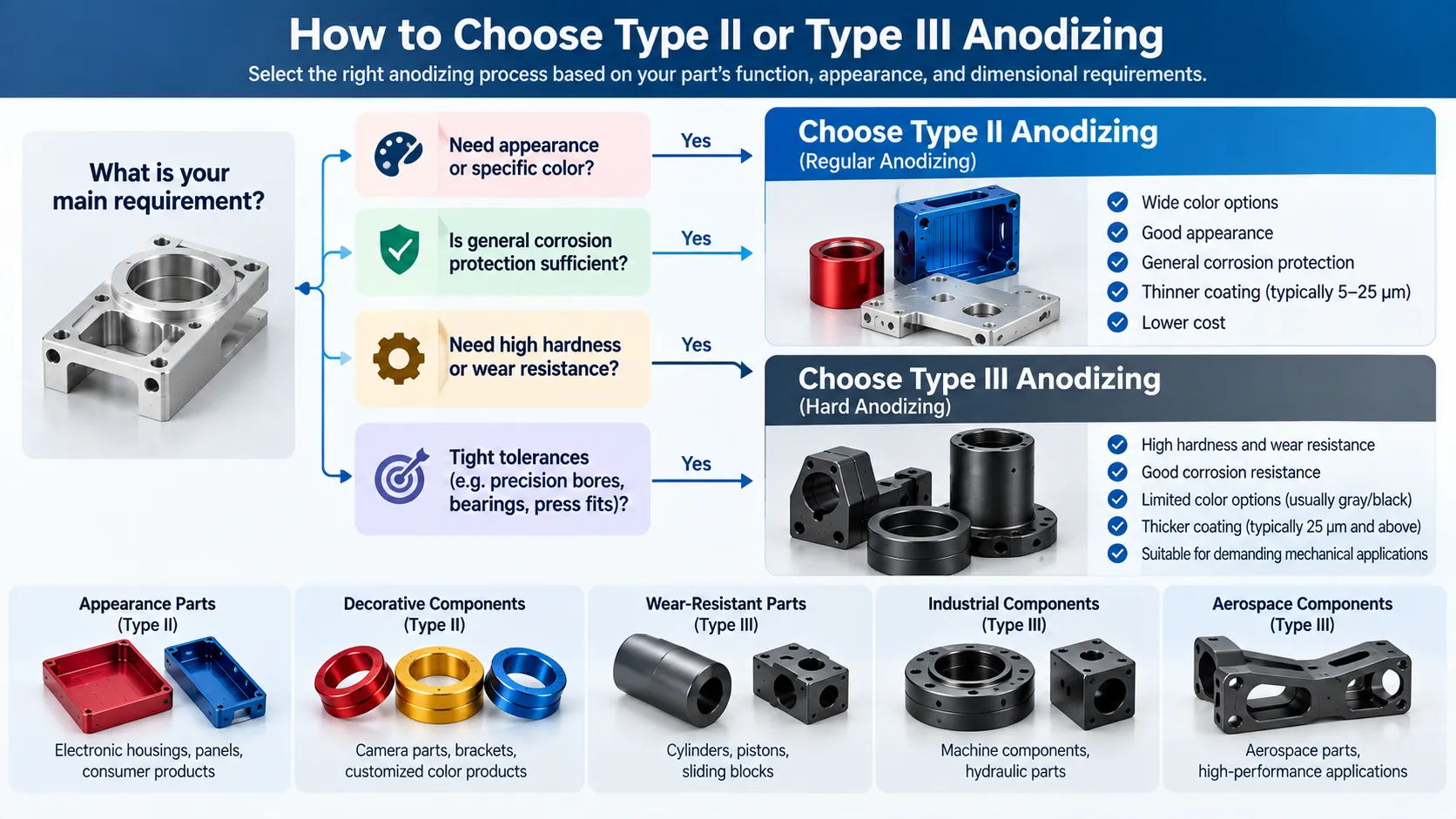
Use the following decision guide as a starting point.
Choose Type II anodizing when:
- Appearance is important
- Multiple color options are required
- General corrosion protection is sufficient
- Extreme wear resistance is not required
- A thinner coating is preferred
- Cost needs to remain lower
Choose Type III hard anodizing when:
- The part is exposed to repeated wear
- Higher surface hardness is required
- Sliding contact occurs
- The component operates in demanding mechanical conditions
- Functional performance matters more than decorative appearance
Pay special attention when:
- Tolerances are tight
- The part contains precision bores
- Bearings or bushings will be installed
- Press fits are involved
- Threads require dimensional control
- Some surfaces need masking
In these cases, the anodizing requirement should be reviewed before machining begins.
Common Mistakes When Specifying Anodizing
Mistake #1: Assuming Hard Anodizing Is Simply Thicker Type II
The processes have different objectives, operating conditions, surface characteristics, and typical applications.
Choose according to function—not thickness alone.
Mistake #2: Specifying "Black Anodize" Without More Detail
Color alone does not define coating type, thickness, tolerance requirements, or functional performance.
Mistake #3: Ignoring Final Dimensions
This is particularly risky for precision bores, bearing fits, shafts, and mating features.
Mistake #4: Choosing Hard Anodizing for Every Industrial Part
Higher performance is useful only when the application needs it.
Unnecessary Type III anodizing can increase cost and complicate tolerance control without providing meaningful benefit.
Mistake #5: Considering Surface Finish Only After Machining
For precision CNC parts, material, machining tolerance, surface treatment, and final inspection should be considered as one manufacturing system.
FAQ: Hard Anodizing vs Regular Anodizing
Is hard anodizing better than regular anodizing?
Not necessarily.
Hard anodizing is generally better for wear resistance and surface hardness, while regular Type II anodizing is usually better for decorative appearance, color options, and general corrosion protection.
The better process depends on the function of the part.
Is hard anodizing the same as Type III anodizing?
Type III commonly refers to hard coat anodizing, while Type II generally refers to conventional sulfuric acid anodizing.
How thick is Type II anodizing?
A typical Type II anodizing thickness is approximately 5–25 μm, depending on the required process and application.
How thick is hard anodizing?
Hard anodizing commonly starts around 25 μm, with thicker coatings possible depending on the specification and application.
Does anodizing change part dimensions?
Yes.
Because the oxide layer develops relative to the original aluminum surface, anodizing can affect final dimensions.
This is particularly important for tight-tolerance bores, shafts, press fits, threads, and mating surfaces.
Can hard anodized aluminum be colored?
Color options are generally more limited than with Type II anodizing.
Hard anodized surfaces also tend to have a naturally darker appearance.
Final Takeaway
The difference between hard anodizing and regular anodizing comes down to what the part needs to do.
Choose Type II anodizing when appearance, color, and general corrosion protection are the main priorities.
Choose Type III hard anodizing when higher hardness and wear resistance are required.
But for precision CNC components, there is one rule worth remembering:
Don't treat anodizing as an afterthought.
If a part contains tight-tolerance bores, bearing fits, press fits, threads, or mating surfaces, coating thickness and final dimensions should be considered before machining is finalized.
Need Help Reviewing an Anodized CNC Part?
If your aluminum part includes tight tolerances or critical mating features, send your drawing and surface-finish requirements for a manufacturability review.