Skip to main content Skip to footer
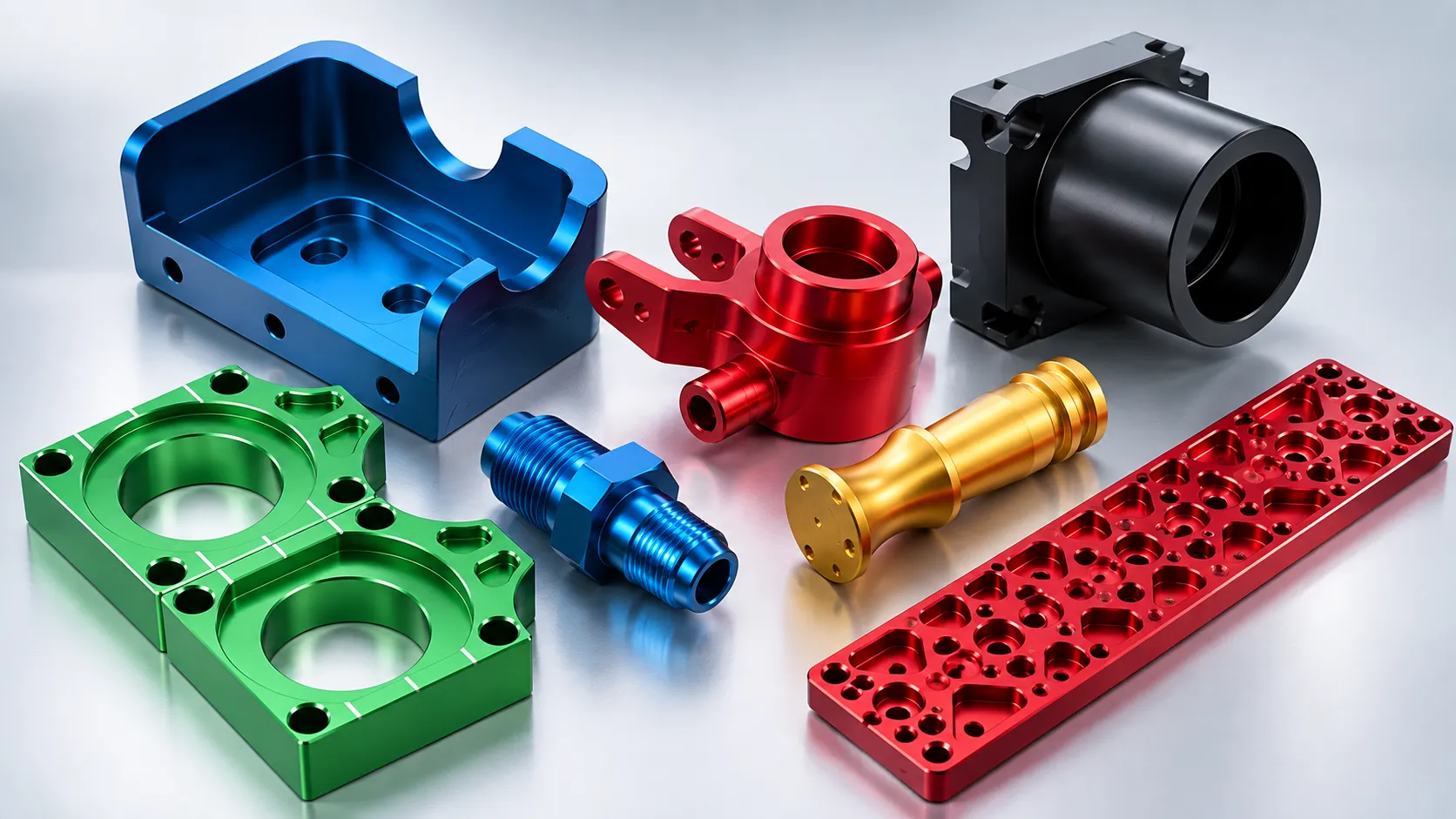
We've seen it happen on the third shipment. The first two orders looked fine. Then the parts came in slightly off — dimensional drift, unusual tool marks, a surface that didn't take the coating right. We traced it back to the raw material. The supplier had swapped grades without saying a word.
Material substitution by Chinese suppliers is preventable. You need to specify exact material grades by standard and chemistry on every drawing and purchase order, require Mill Test Reports with heat-level traceability for every batch, conduct a Pre-Production Inspection before machining begins, and contractually link final payment to verified material approval — not to shipment date.
This article walks through each control point. If you follow all four, you close most of the gaps that suppliers exploit.
What Incoming Material Inspection Steps Catch Grade Substitution Before Machining Begins?
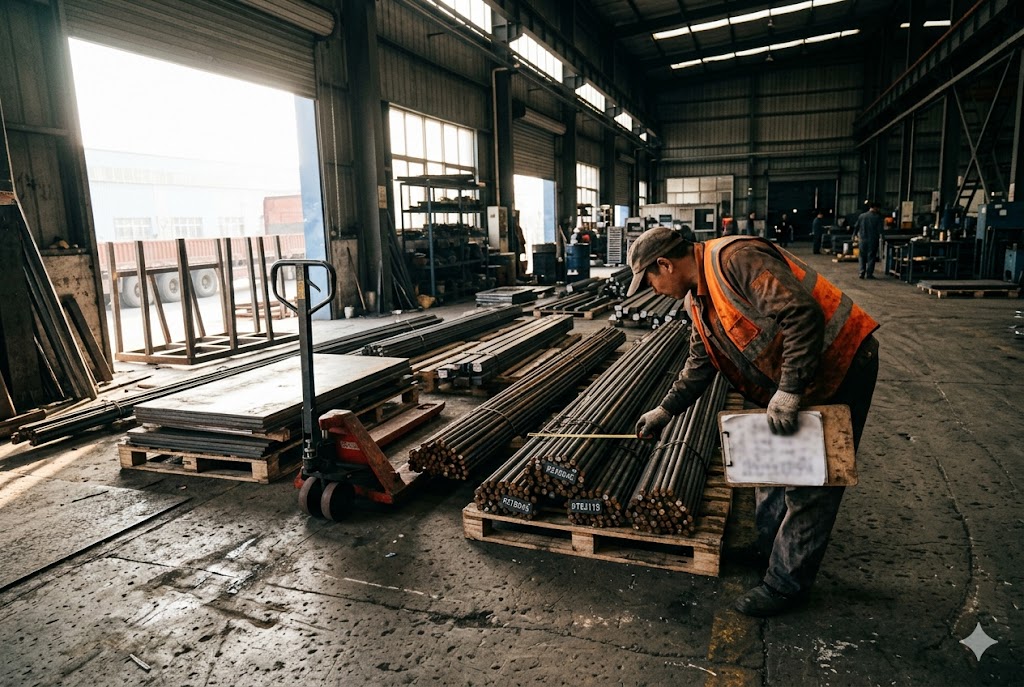
Most quality problems are locked in before a single cut is made. By the time we're reviewing finished parts, the damage is already done. The right moment to stop substitution is when raw material arrives at the factory dock — before it touches any machine.
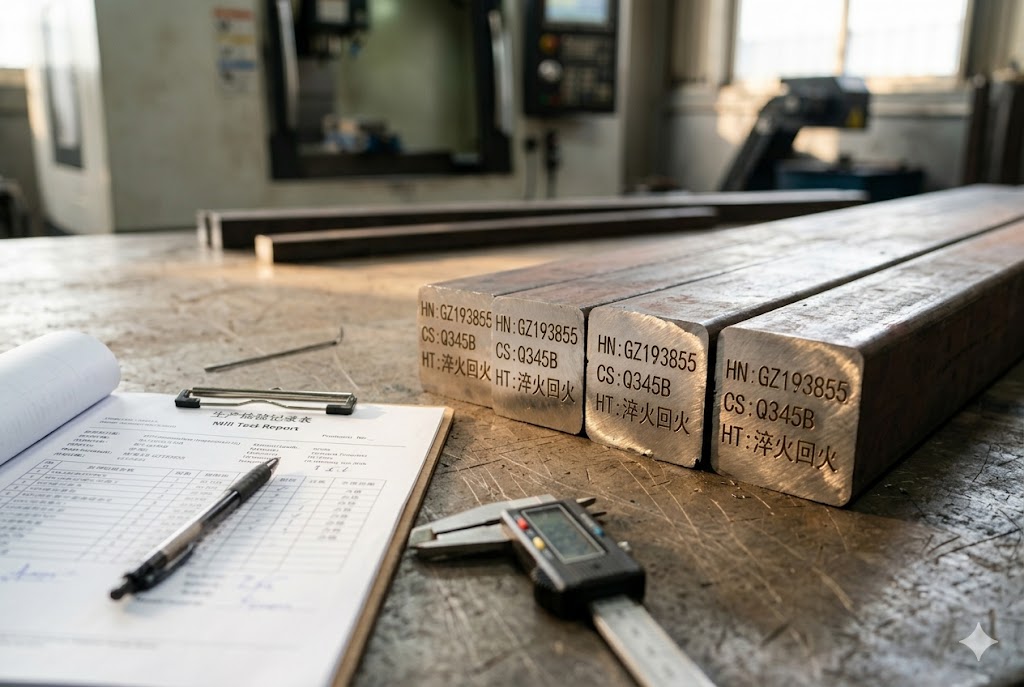
Incoming material inspection catches grade substitution by verifying Mill Test Reports against your drawing specifications, cross-checking heat numbers on physical stock, and using XRF spot-testing on a sample of bars or sheets before the production order is released. This inspection must happen after material arrives but before any machining begins.
Why the Pre-Production Inspection (PPI) Is Your Best Control Point
A Pre-Production Inspection 1, or PPI, is timed to happen after raw materials arrive at the factory but before production starts. This is the cheapest intervention point in the entire supply chain. You catch the wrong material before thousands of units are machined from it.
Here is what a proper incoming material inspection should cover:
Key Steps in Incoming Material Inspection
| Step | What to Check | Who Does It |
|---|---|---|
| Document review | MTR heat number, mill name, chemical composition, mechanical properties | Your QC team or third-party inspector |
| Physical label match | Heat number stamped on bar, coil, or sheet matches the MTR | Inspector on-site |
| Dimensional check | Bar diameter, sheet thickness, profile dimensions | Inspector with calipers |
| XRF spot test | Elemental composition compared to spec | Third-party lab or portable XRF device |
| Visual condition | No corrosion, no prior machining marks, correct surface condition | Inspector on-site |
What Is a Mill Test Report (MTR)?
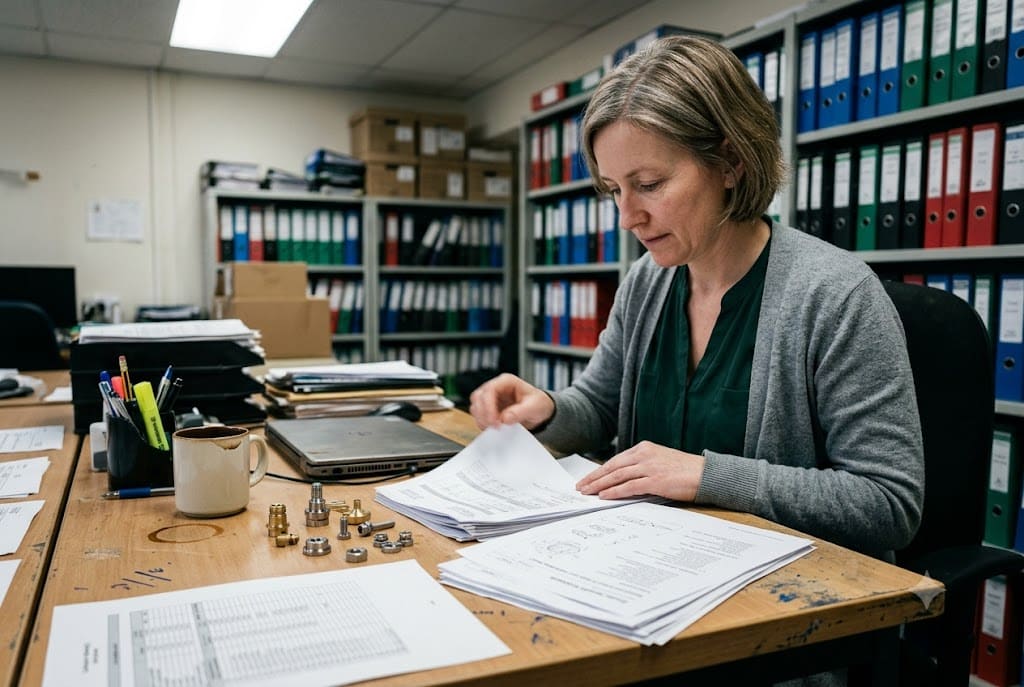
An MTR is a quality document issued by the steel or alloy mill. It records the actual chemical composition and mechanical properties of a specific batch, identified by a heat number. The heat number links that document to a specific melt 2 — and is physically stamped on the material itself, making it very hard to fabricate convincingly.
A generic Certificate of Conformance (CoC) is not the same thing. A CoC only states that "this material meets standard X." It does not trace back to a specific melt. Suppliers can print CoCs internally. Require the MTR, not the CoC.
The XRF Test: A Practical Tool
XRF stands for X-ray fluorescence. A portable XRF gun can read the elemental composition 3 of a metal surface in seconds. It won't replace a full lab test, but it will catch obvious substitutions — like carbon steel passed off as stainless, or a lower-alloy grade substituted for a higher one.
Many third-party inspection companies in China now carry portable XRF devices. You can request XRF testing as part of a standard incoming inspection report. The cost is low relative to the risk.
Timing Is Everything
Don't schedule inspections only at shipment. By then, every part is already machined, assembled, and packed. The incoming inspection must happen on a specific date — after material delivery, before the production release sign-off. Build this gate into your purchase order terms.
Can I Require My Supplier to Photograph and Label Raw Material Certs for Each Batch?
Yes — and you should. This requirement costs the supplier almost nothing to comply with if they're using the right materials. If they push back hard, that resistance itself is a signal worth noting.
Yes, you can and should require your supplier to photograph raw material certs and physical labels for every production batch. This means a photo of the MTR document, a photo of the material label or heat number stamped on the stock, and a photo showing both together — submitted to you before production release is authorized.

What to Ask For, Exactly
Don't leave room for interpretation. Tell your supplier exactly what photos you need and when to send them. Vague instructions produce vague compliance.
Here is a simple documentation checklist you can copy into your purchase order or supplier quality agreement:
| Document / Photo Required | Timing | Format |
|---|---|---|
| MTR from the original mill | Before production starts | PDF or clear photo |
| Photo of physical heat number on raw stock | Before production starts | JPEG, labeled with PO number |
| Photo of MTR and physical stock side by side | Before production starts | JPEG showing both clearly |
| Signed Material Verification Form | Before production starts |
Why Side-by-Side Photos Matter
A photo of the MTR alone is not enough. A photo of the bar or coil alone is not enough. You need both in the same frame. This makes it much harder to pair a legitimate MTR with non-conforming material. It's not foolproof, but it raises the cost of substitution significantly.
Build This Into Your PO Terms, Not Just a Request
Many buyers ask for this informally. Suppliers comply once, then stop. The way to make it stick is to write it into your purchase order terms. State clearly: "Production release will not be granted until the required material documentation photos are submitted and approved." Tie your approval to a physical email or WeChat message from your team. Make the gate real.
Storing Traceability Records
Once you receive the photos and documents, store them by batch and PO number. When a quality dispute arises — and it will, at some point — you will need to trace a defective part back to its incoming material batch. Without a documented record, that link is broken, and your dispute leverage drops sharply.
Our team uses a simple shared folder structure: one folder per PO, with subfolders for incoming material docs, in-process inspection reports, and pre-shipment inspection reports. The folder is shared with the client so they can access it directly. This removes the back-and-forth.
What If the Supplier Refuses?
Most legitimate suppliers will comply without much friction. If a supplier tells you this is "too complicated" or "not how they do things," treat that as a yellow flag. It's not conclusive, but a supplier who handles your kind of work regularly already has these documents on hand. Sharing a photo takes thirty seconds.
Photographs and MTRs get you a long way. But if you have a serious dispute, or if you're dealing with safety-critical parts, you need a lab. Third-party labs in China can test material identity conclusively — and their results carry weight in arbitration.
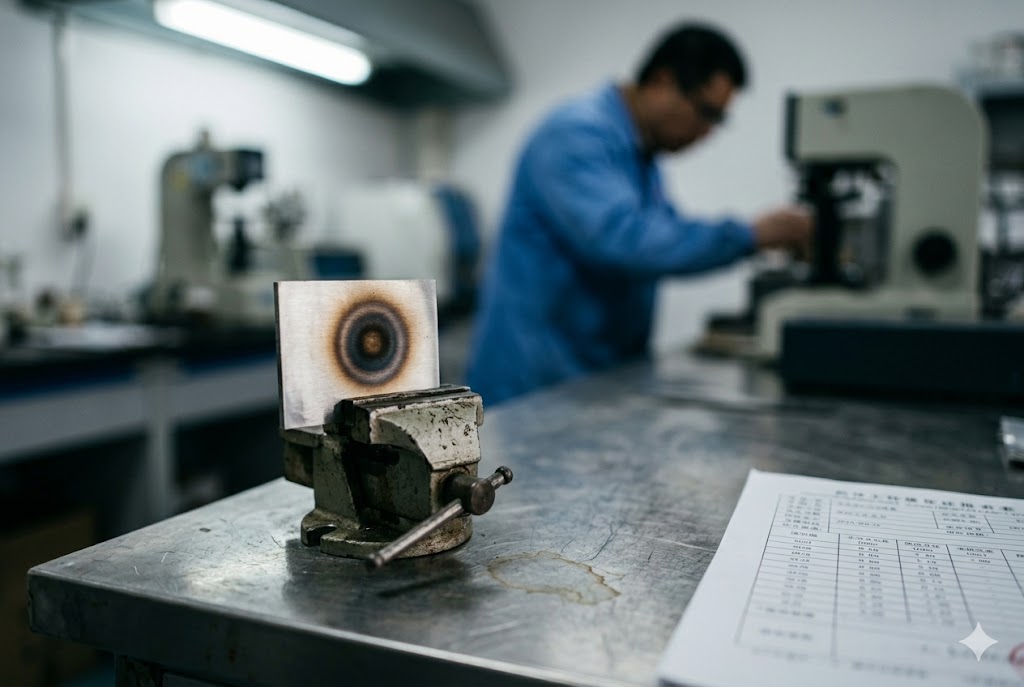
Third-party material testing labs detect substitution by performing spectrographic analysis, tensile and hardness testing, and microstructure examination on actual production material samples. These tests confirm whether the material's real chemistry and mechanical properties match the specification — regardless of what the MTR claims.
Common Tests Used to Detect Substitution
Different tests catch different types of substitution. Here is a summary:
| Test Type | What It Detects | Turnaround |
|---|---|---|
| OES (Optical Emission Spectrometry) | Full elemental composition, identifies alloy grade | 1–3 days |
| XRF (X-ray Fluorescence) | Elemental composition, good for on-site screening | Minutes (portable) or 1 day (lab) |
| Tensile test | Yield strength, tensile strength, elongation | 2–5 days |
| Rockwell / Brinell hardness | Hardness grade, heat treatment condition | 1–2 days |
| Metallographic examination | Grain structure, phase composition, coating depth | 3–7 days |
OES vs. XRF: Which One Do You Need?
XRF is a good screening tool. It's fast and portable. Many inspectors carry handheld units. But XRF has limitations — it reads surface layers and can struggle with light elements like carbon, which is critical for differentiating steel grades.
OES, or optical emission spectrometry 4, burns a small spot on the material and reads the emitted light spectrum. It gives a much fuller elemental profile, including carbon content. For steel and aluminum alloy verification, OES is the standard method in most Chinese labs accredited to ISO/IEC 17025.
How to Use a Third-Party Lab Strategically
You don't need to send every batch to a lab. The cost and time don't justify it for routine orders. Use labs at three trigger points:
First, on your first order with a new supplier. Establish a baseline. Test the actual incoming material against the spec. Store the result.
Second, on the third or fourth order — the point where substitution most commonly begins, once you've relaxed oversight after clean early shipments.
Third, any time you see a co-occurring set of defects: dimensional instability, unusual surface finish, and abnormal machining tool wear in the same run. This pattern is a strong signal of an undisclosed material change, not a process drift. Trigger re-verification immediately rather than issuing a standard CAPA.
Finding Accredited Labs in China
Look for labs accredited to ISO/IEC 17025 with CNAS recognition 5 (China National Accreditation Service). SGS, Bureau Veritas, and Intertek all operate material testing labs in major Chinese manufacturing hubs including Shenzhen, Ningbo, and Tianjin. Local Chinese labs with CNAS accreditation are also valid and often faster for dispute-related testing.
Should Material Traceability Requirements Be Written Into My Supply Contract?
Yes. Every control we've discussed so far — the PPI, the photo documentation, the MTR requirement — is only enforceable if it's in your contract. Without a contract clause, it's a preference. With one, it's a breach.
Yes, material traceability requirements must be written into your supply contract. At minimum, include an Approved Material List (AML) clause, a payment milestone tied to material verification, a prohibition on sub-tier material substitution without written ECN approval, and reference to both international standards (ASTM, EN, ISO) and their Chinese GB equivalents on all drawings.

What to Include in Your Contract
Here is a practical summary of clauses that address material substitution risk:
| Contract Clause | What It Does |
|---|---|
| Approved Material List (AML) | Names exact grades, standards, and approved mills; prohibits substitution without written ECN sign-off |
| Dual standard reference | Requires compliance with both international standard (e.g., ASTM A36) and Chinese GB equivalent (e.g., Q235B), closing the gap suppliers exploit between standard families |
| MTR submission gate | Production cannot begin until MTRs are submitted and approved in writing |
| Payment milestone tie | Balance payment released only after verified MTRs and passed incoming inspection — not on shipment or delivery date |
| Sub-tier substitution prohibition | Tier-2 and tier-3 material changes require written approval; undisclosed swaps constitute a contractual breach |
| Golden sample retention | Both parties retain a sealed, tamper-evident sample of approved incoming material for the duration of the warranty period |
Why Dual Standard Reference Matters
Specifying only one standard creates a gap. A supplier might argue that GB Q345B is equivalent to EN S355 — and in many contexts, they are similar. But they are not identical in low-temperature toughness requirements, and that difference can matter for structural or dynamic load applications.
When you reference both the international standard and the GB equivalent 6, you close that interpretive gap. The supplier cannot claim compliant substitution between standard families, because both are named, and the drawing specifies which takes precedence in case of conflict.
The Golden Sample Protocol for Raw Material
Most buyers keep a golden sample of a finished part. Fewer keep a golden sample of incoming raw material. But a finished-part golden sample cannot retroactively prove what material it was made from. The base material was changed before machining started.
A raw material golden sample — a physically sealed bar end, sheet offcut, or resin pellet bag — gives you a direct comparator if a dispute arises. Label it with the PO number, the MTR heat number 7, and the date. Seal it with tamper-evident tape. Store it for the warranty period. Both you and the supplier should retain one.
Contractual Breach vs. Quality Dispute
This distinction matters enormously if you end up in arbitration. A material substitution without an AML clause is likely treated as a quality dispute — the supplier argues they used a "comparable" material in good faith. An AML clause converts the same act into a breach of a specific contractual obligation. In CIETAC arbitration 8, that changes your leverage significantly.
Our service agreements with clients include a standard AML clause and a payment milestone structure that ties the balance payment to material verification approval. We've had clients avoid significant losses because the contract structure gave them real enforcement leverage — not just a quality complaint.
To understand how drafting arbitration agreements with Chinese suppliers 9 affects your dispute options, work with legal counsel experienced in Sino-foreign commercial contracts.
Conclusion
Material substitution doesn't happen randomly. It happens where there are gaps — in your drawings, your PO terms, your inspection timing, and your contract. Close those gaps systematically, and you remove most of the opportunity. A comprehensive quality control inspection process in China 10 — from pre-production through to shipment — is the structural answer to an otherwise invisible risk. Start with your next purchase order.
Footnotes
1. Complete guide to pre-production inspection services in China and what they verify. ↩︎
2. How to read a mill test report and verify heat number traceability on flanges and steel products. ↩︎
3. How handheld XRF analyzers enable rapid on-site alloy identification and incoming inspection. ↩︎
4. OES analysis services for full elemental composition testing and alloy grade verification in metals. ↩︎
5. Explanation of ISO 17025 and how CNAS accredits testing laboratories in China. ↩︎
6. Step-by-step guide to reading an MTR, covering heat numbers, standards, and chemical composition sections. ↩︎
7. What an MTR certifies, how heat numbers work, and how to verify them against physical stock. ↩︎
8. Guide to CIETAC arbitration for foreign companies and how Chinese arbitrators weigh contractual obligations. ↩︎
9. Key considerations for drafting valid arbitration clauses in contracts with Chinese suppliers. ↩︎
10. Overview of China quality control inspection types, from pre-production through final shipment. ↩︎