Skip to main content Skip to footer
Every time we manage production for a customer order, we face the same quiet risk: what happens to the material left over after the run? Leftover raw material sitting in an unmarked bin is not just a housekeeping problem — it is a contamination waiting to happen.
Yes, leftover raw materials can be separately stored and reserved to prevent cross-order contamination. The key controls are physical segregation zones, lot-level reservation in an inventory system, clear container-level labeling, and a formal material disposition record at order closeout. Without all four, contractual language alone will not protect you.
Here is what that looks like in practice — and how to make it stick with a Chinese or Vietnamese supplier.
How Should I Specify Material Segregation Requirements in My Purchase Agreement?
When we put together a supply agreement for a custom parts order, the segregation clause is one section most buyers skip or leave vague. That omission almost always causes problems later.
A purchase agreement should specify that leftover raw material must be stored in a labeled, dedicated zone assigned to your order number, cannot be consumed on other jobs without written authorization, and must be reported in a material disposition record at order closeout. Include the right to audit compliance during production and at shipment.

What the Clause Needs to Cover
A weak segregation clause says: "Supplier shall store materials properly." That gives you nothing enforceable.
A strong clause defines four things:
| Element | What to Specify |
|---|---|
| Physical location | Dedicated labeled bin, shelf, cage, or area per order or lot |
| Labeling minimum | Order number, lot number, material grade, heat number, reservation status |
| Prohibition | Leftover material from this order cannot be consumed on other orders without buyer's written approval |
| Closeout deliverable | Supplier provides a material disposition report at order completion |
Why Contractual Language Alone Is Not Enough
The contract sets the obligation. It does not create the behavior on the factory floor. A supplier who has never used lot-level reservation in their ERP will not start doing it because a clause says so. You need to verify compliance during a factory visit and in production documentation.
That said, the contract does two important things. First, it gives you legal standing if material is misused. Second, it signals to the supplier that you are a buyer who pays attention to process detail — and experienced suppliers respond to that signal by treating your orders with more discipline.
Escalation Language Worth Adding
Include a remedy clause: if reserved material is found to have been consumed on another order without authorization, the supplier bears the cost of replacement material, re-inspection, and any resulting delivery delay. This is not punitive — it is just a clear statement of who owns the consequence. Buyers who add this clause report fewer "we ran out of your reserved lot" surprises.
FIFO and FEFO as Supporting Controls
Your agreement can also reference FIFO (first in, first out) or FEFO (first expired, first out) 1 picking requirements. These are standard in food and pharmaceutical supply chains and increasingly relevant in precision mechanical manufacturing where material shelf life or certification expiry matters. FIFO by itself creates picking discipline that reduces the temptation for operators to pull from whatever bin is closest — including your reserved remnant.
Can a Chinese Supplier Tag and Quarantine Unused Material With My Order Number?
This is a fair question to ask before you place an order — not after. Our team visits factories regularly in China and Vietnam, and the answer varies enormously depending on the supplier's tier, size, and quality management maturity.
Yes, a capable Chinese supplier can tag and quarantine unused raw material with your order number. In practice, this requires a dedicated physical storage area, a standardized label format that includes order number and lot number, and an inventory system that flags the lot as reserved. Tier-1 and ISO-certified suppliers generally have this capability. Tier-2 and tier-3 shops often do not.

What "Tagging" Looks Like in a Real Factory
In a well-run contract manufacturing environment, tagging a reserved remnant looks like this:
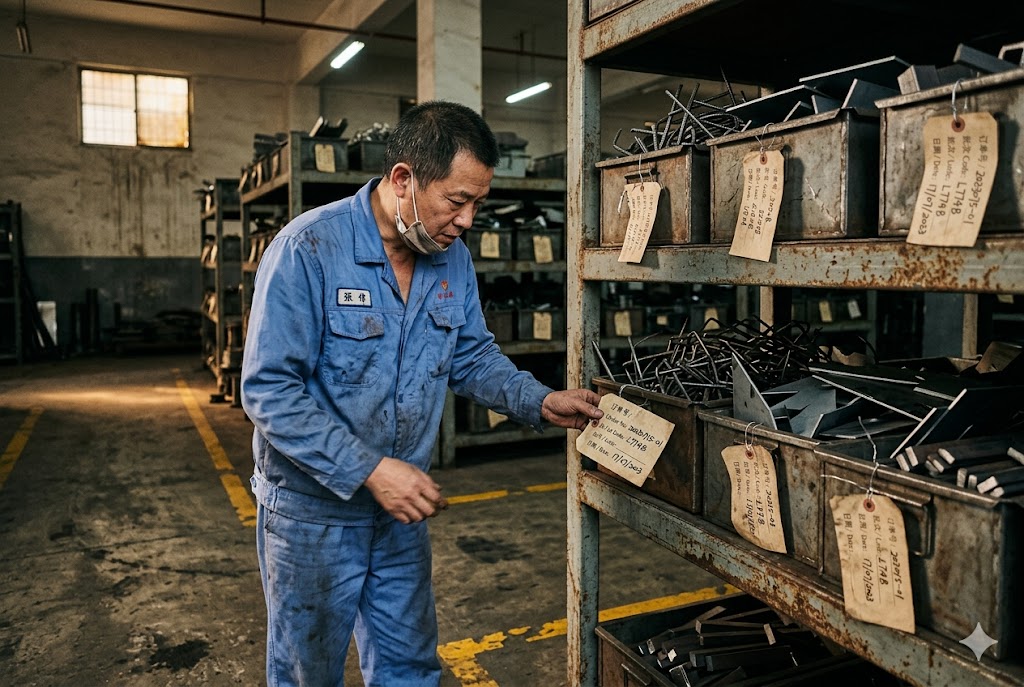
- The leftover material is moved to a designated shelf or cage labeled with the customer's name and order number.
- A physical tag is attached to the container or pallet. The tag shows: material grade, heat number, lot number, order number, quantity remaining, and status (e.g., "Reserved — Do Not Use Without Authorization").
- The same information is entered into the ERP or WMS as a soft reservation 2, linking the lot to the work order.
- The lot cannot be released for another job without a supervisor override and a documented reason.
| Labeling Field | Purpose |
|---|---|
| Order number | Links physical stock to the specific customer job |
| Lot / heat number | Enables traceability back to the mill certificate |
| Material grade | Prevents substitution with a visually similar but non-conforming grade |
| Quantity remaining | Supports accurate inventory records and prevents partial over-consumption |
| Reservation status | Signals to warehouse staff and operators that this lot is not available for general use |
The Reality at Tier-2 and Tier-3 Factories
In our experience working with fabrication shops across Guangdong, Jiangsu, and Zhejiang, floor space is the first constraint. Many mid-size factories do not have dedicated customer material zones. Remnants from multiple orders end up on the same shelf, sometimes in the same bin. When an operator needs material for the next job, they pull what is available — not what is assigned.
This is the most common source of material-grade substitution and cross-order contamination 3 in contract manufacturing. It does not happen because suppliers are dishonest. It happens because no physical or systemic barrier exists to prevent it.
How to Verify Before You Order
Ask the supplier three questions:
- Do you have a dedicated storage zone for customer-reserved raw material?
- Can you show me an example label from a previous order?
- Can you show me how a reserved lot is tracked in your inventory system?
A supplier who answers all three with documentation is in a different category from one who answers with a verbal "yes, of course." The physical evidence — a photo of the storage area, a sample label, a screenshot of the ERP reservation screen — is what you need.
What Traceability Documentation Should Accompany Reserved Raw Material Batches?
We ask every supplier we work with to provide a traceability package with each material lot. Not every supplier delivers one without being pushed. Knowing what to ask for — and why each document matters — puts you in a stronger position.
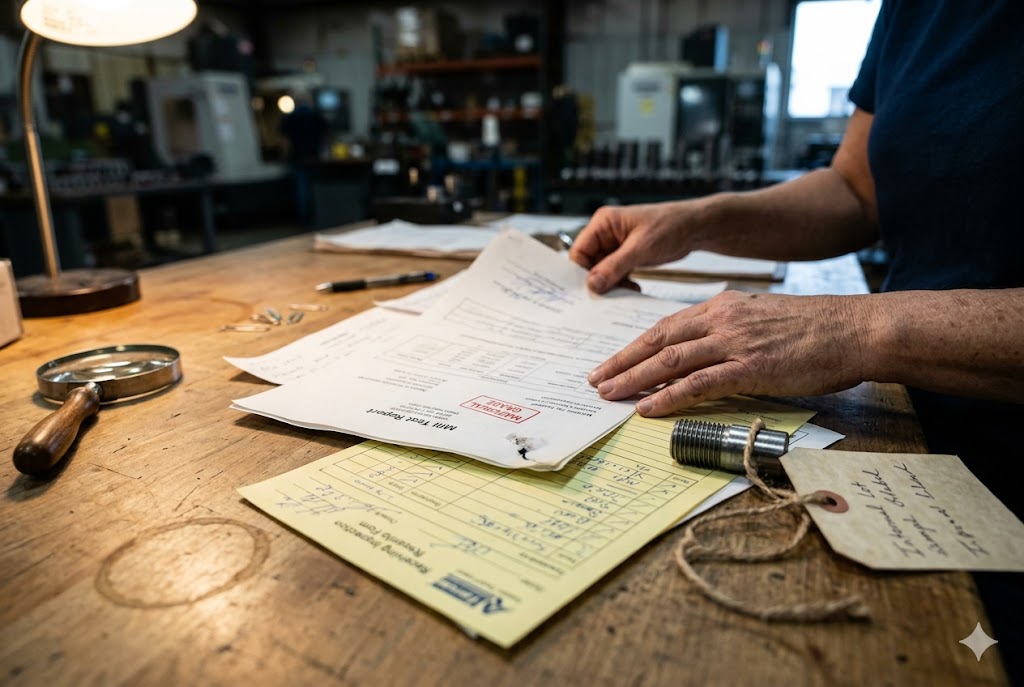
Reserved raw material batches should be accompanied by a mill test report or certificate of conformance 4, a receiving inspection record, an internal lot label with heat number and order number, a lot reservation record from the inventory system, and a material disposition report at order closeout. Any batch that cannot be linked back to a mill-level certificate loses its qualification status.
The Core Document Set
| Document | What It Confirms |
|---|---|
| Mill Test Report (MTR) / Certificate of Conformance (CoC) | Chemical composition, mechanical properties, heat number — issued by the material producer |
| Receiving Inspection Record | Supplier's incoming quality check: dimensions, surface condition, quantity, any nonconformance noted |
| Internal Lot Label | Links physical stock to the MTR/CoC via heat number; shows order number, grade, quantity, status |
| Lot Reservation Record | ERP or WMS entry showing that this specific quantity is reserved against your work order |
| Material Disposition Report | Issued at order closeout: documents quantity used, quantity remaining, storage location, and next action (hold, return, scrap) |
Why the MTR Link Is Non-Negotiable
A segregated leftover that cannot be linked back to its original MTR or CoC 5 loses its qualification status. It does not matter that it was physically isolated. If you cannot confirm the heat number, you cannot confirm the grade. An unlabeled remnant treated as "probably the same material" is the starting point for most material substitution incidents.
This is especially relevant for orders involving alloy steels, stainless grades, aluminum alloys, or any material where grade substitution has structural or regulatory consequences.
Partial Lot Traceability
When a lot is partially consumed, the remaining quantity must be re-labeled as a discrete sub-lot. The new label should show the original lot number, the quantity now remaining, and the date of the partial withdrawal. It should not be merged back into generic open stock. This step is missed more often than any other in the traceability chain — and it is the step that most directly enables unintended cross-order consumption.
Ask your supplier to show you a historical example of a partially consumed lot and its updated label. If they cannot produce one, their partial lot control is likely informal at best.
Quarantine Status Flags
In an ERP or WMS, each lot should carry a status flag: Released, Reserved, On Hold, or Pending Inspection. A reserved lot flagged in the system cannot be transferred to another work order without a supervisor authorization step. This is the systemic layer of control that sits above physical labeling. Physical labels can fall off, be ignored, or be misread. A system flag creates a mandatory checkpoint 6 before any movement of the lot is recorded.
Is It Realistic to Audit a Supplier's Material Storage Practices During a Factory Visit?
Yes — and in our view, it is one of the highest-value hours you can spend during a factory visit. Most buyers focus their audit time on production equipment and finished parts inspection. Material storage gets a quick walkthrough at best. That is a missed opportunity.
Yes, auditing material storage practices during a factory visit is realistic and should be a standard part of any pre-production or in-production audit. In one to two hours, you can assess physical segregation zones, label quality, ERP reservation records, and partial lot controls. What you find will tell you more about contamination risk than any questionnaire.

What to Look at During the Warehouse Walk
Do not ask for a presentation. Walk the warehouse and look for these things:
Physical Layout
Are there clearly marked customer-specific storage zones? Are they physically separated — by shelves, cages, or tape lines — from general stock? Is the floor space organized enough that a new operator could identify which material belongs to which order without asking anyone?
Label Quality
Pick up a container at random. Read the label. Does it show order number, lot number, material grade, and quantity? Is the label legible and firmly attached? An informal sticker in pencil with no order number is a red flag.
Partial Lot Controls
Ask the warehouse supervisor to show you a partially consumed lot from a current or recent order. Can they locate it quickly? Does the label show the updated quantity? Is it recorded separately in the system from the original full lot?
System Spot-Check
Ask to see the inventory record for a specific lot 7 you identified on the shelf. Does the system show the same lot number, quantity, and reservation status as the physical label? If the system and the shelf disagree, that is a traceability failure.
Common Findings at Tier-2 Shops
| Finding | Risk It Creates |
|---|---|
| Remnants from multiple orders stored in same unlabeled bin | Material grade confusion, unintended cross-consumption |
| Labels with only grade and quantity — no order or lot number | No link to MTR, no order-level accountability |
| Partial lots returned to general stock without re-labeling | Loss of traceability, potential use on wrong order |
| No ERP reservation — segregation is purely physical and informal | Physical controls can fail without systemic backup |
| Reserved material accessible to general warehouse staff without authorization step | High risk of accidental or informal consumption |
Making the Audit Finding Actionable
Document what you see with photos. If you find gaps, raise them in your corrective action request before production starts — not after. A supplier who cannot demonstrate adequate segregation controls before you place your order is unlikely to improve mid-production without a specific, written requirement and a follow-up check.
The ISO 9001 identification and traceability requirements 8 under Clause 8.5.2 provide a useful benchmark: they require suitable identification of outputs, status tracking throughout production, and documented records enabling traceability. Using these as an audit reference gives you a recognized standard to point to rather than purely buyer-specific requirements.
Similarly, IATF 16949 traceability requirements 9 go further than ISO 9001 by explicitly requiring lot-level tracking including sub-tier supplier material. Even for non-automotive orders, citing these expectations during a pre-production audit communicates a credible quality standard.
If a full on-site visit is not possible before the first order, ask the supplier to send photos of the material storage area once receiving inspection is complete. It is a lower bar than an on-site audit but still better than no visibility at all.
Conclusion
Preventing cross-order contamination starts with clear contract language, enforced through physical controls, supported by lot-level documentation, and verified on the factory floor. Paper requirements without site verification are not enough — especially in tier-2 and tier-3 fabrication environments where floor space and informal practices create real commingling risk. Understanding dedicated storage areas and inventory control measures 10 as both physical and systemic requirements — not just contractual language — is what separates buyers who get clean, traceable lots from those who discover the problem only after a quality failure.
Footnotes
1. How FIFO and FEFO picking methods enforce inventory rotation discipline and prevent unauthorized material consumption. ↩︎
2. How ERP lot-tracking systems link reserved inventory to specific work orders for full batch traceability. ↩︎
3. Overview of cross-order contamination risks in multi-product contract manufacturing and the role of physical segregation. ↩︎
4. Comprehensive guide to mill test reports and their role as the foundation of quality assurance in metal supply chains. ↩︎
5. How to verify material test certificates from suppliers and reduce fraudulent or inaccurate documentation risk. ↩︎
6. ISO 9001 identification and traceability rules requiring unique lot identification and status tracking throughout production. ↩︎
7. Ten-point factory quality audit checklist for importers, covering material storage, sampling, and system verification. ↩︎
8. Detailed breakdown of ISO 9001 Clause 8.5.2 covering product identification, status tracking, and documented traceability records. ↩︎
9. How IATF 16949 enhances traceability requirements beyond ISO 9001 with lot-level tracking across the automotive supply chain. ↩︎
10. How dedicated storage areas, labeling procedures, and inventory controls prevent cross-contamination in manufacturing facilities. ↩︎