Skip to main content Skip to footer

We have shipped wire EDM parts to North American clients for years. One thing we see repeatedly: buyers assume their supplier understands RoHS. They rarely do — not at the shop floor level. That gap creates real risk at customs and in the field.
To communicate RoHS requirements to a Chinese wire EDM supplier, embed the specific directive version — EU 2011/65/EU or IEC 62474 — directly on your engineering drawings and purchase order. Verbal or email-only instructions are not enforced at the production level and will not hold up in an audit or dispute.
This article walks through four areas: what to put in your PO and drawings, what documentation to demand, how to verify compliance on arrival, and how to handle the China RoHS 2 distinction. Each section gives you language you can use today.
Should I Include RoHS Material Restrictions in My Purchase Order and Technical Specification?
Our team reviews supplier POs every week. The single most common gap we find is that RoHS requirements appear only in an email thread — not on the drawing, not in the PO. That gap is invisible to the machinist cutting your parts.
Yes, you must include RoHS material restrictions in both your purchase order and your technical specification. Reference the directive by number — EU 2011/65/EU or IEC 62474 — and list each restricted substance with its threshold limit. This is the only way to make compliance a contractual obligation at the shop floor level.

Why Verbal Instructions Fail
A sales rep at a Chinese EDM shop may speak good English. The machinist running the wire EDM does not review emails. The person ordering raw material stock does not read the email chain either. Your compliance instruction must live on the document that travels with the job — the drawing and the PO.
If it is not on the drawing, it does not exist in the factory.
What to Write on the Drawing
Add a note block in the title block area or near the material callout. Here is a simple, enforceable format:
This part must comply with EU RoHS Directive 2011/65/EU 1. All homogeneous materials must meet restricted substance concentration limits as listed below. Supplier must provide a part-level RoHS Declaration of Conformity before shipment.
Then list the substances and limits directly on the drawing or in an attached specification sheet referenced by the drawing number.
Substance Threshold Table
| Restricted Substance | Chemical Symbol | Maximum Concentration |
|---|---|---|
| Lead | Pb | ≤ 1000 ppm |
| Cadmium | Cd | ≤ 100 ppm |
| Mercury | Hg | ≤ 1000 ppm |
| Hexavalent Chromium | Cr-VI | ≤ 1000 ppm |
| Polybrominated Biphenyls | PBB | ≤ 1000 ppm |
| Polybrominated Diphenyl Ethers | PBDE | ≤ 1000 ppm |
Note: cadmium has a tighter limit than the others. Many buyers miss this.
What to Include in the Purchase Order
Your PO should contain a dedicated compliance clause, not just a drawing reference. The clause should:
- Name the directive version by number
- State that the requirement flows down to all sub-tier suppliers and material distributors
- Require advance written approval for any material or process change, including raw material lot substitution
- Tie final payment or holdback disbursement to receipt of the part-level Declaration of Conformity
That last point matters most. Chinese EDM shops operate under tight margins. If compliance documentation is tied to payment, it becomes a prerequisite. If it is not, it becomes an afterthought.
High-Risk Material Vectors in Wire EDM
Wire EDM has three specific RoHS risk points that most buyers ignore:
| Risk Vector | Restricted Substance Risk | What to Specify on Drawing |
|---|---|---|
| Base workpiece material | Pb in free-machining grades (303 SS, 12L14) | Require RoHS-compliant material grade with MTR |
| EDM wire alloy | Cd or Be in certain brass wire coatings | Require wire lot certification |
| Post-process surface treatment | Cr-VI in yellow chromate / Pb in some electroless nickel | Specify RoHS-compliant finish by name |
Most RoHS instructions sent to Chinese EDM suppliers cover the base material only. They say nothing about the wire consumables or the plating shop. That is where compliance failures actually happen.
Flow-Down to Sub-Tier Suppliers
Wire EDM shops routinely outsource surface finishing — anodizing, passivation, plating — to third-party shops. Your PO must state that RoHS requirements apply to all external providers used on your job, not just the prime supplier. The IEC 62474 material declaration standard 2 provides a recognized framework for communicating substance data across the supply chain. Without explicit flow-down language, the plating shop is outside your compliance scope entirely.
What RoHS Compliance Documentation Should I Require from My Supplier and Their Coating Shops?
In our experience managing quality inspections before shipment, documentation is where most suppliers cut corners. A generic annual compliance letter is common. It is also nearly worthless.
Require a part-level RoHS Declaration of Conformity signed by a named, authorized representative of the supplier — not a company-level letter. It must identify each restricted substance by name, its concentration at the homogeneous material level, and confirm whether it falls below the applicable threshold limit.

Part-Level vs. Company-Level Declaration
A company-level RoHS letter says: "Our company is RoHS compliant." It is signed by a sales manager. It covers everything and nothing.
A part-level Declaration of Conformity says: "Part number XYZ-001, produced from 316L stainless steel lot #A2240, surface treated with RoHS-compliant passivation per ASTM A967, contains no restricted substances above threshold limits. Signed: [name, title, date]."
The second document is what you need. It is the only one that survives a product liability audit.
Third-Party Test Reports
A Declaration of Conformity is a self-declaration. It is a legal statement, but it is not a test. Require third-party test reports in addition to the DoC for:
- Any new workpiece material grade you have not sourced before
- Any surface treatment involving chromium, nickel, or cadmium chemistry
- Initial production runs from a new supplier
Specify accredited labs by name. The three most widely accepted in Chinese manufacturing contexts are SGS, Bureau Veritas 3, and Intertek. Specify the applicable IEC 62321 test method series 4 for each substance group in your supplier documentation.
Documentation Package Per Shipment Lot
| Document | Required for Every Lot? | Notes |
|---|---|---|
| Part-level RoHS DoC | Yes | Signed by named individual, not just company stamp |
| Raw material MTR (Mill Test Report) | Yes | Tied to specific heat/lot number |
| EDM wire lot certification | Yes | Confirm no Cd or Be content |
| Surface treatment process confirmation | Yes | From the finishing shop, not just the EDM shop |
| Third-party test report | Initial run + any material change | SGS, Bureau Veritas, or Intertek |
| Dielectric fluid Safety Data Sheet | On request | Relevant for Cr-VI and other chemical exposure |
Record Retention Requirement
Include a clause requiring the supplier to retain all raw material COAs, wire lot certifications, and process records for a minimum period matching your regulatory exposure. Chinese EDM shops routinely discard consumable records — wire lot certs, fluid SDSs — after job completion unless contractually prohibited.
If you face a RoHS enforcement action two years after delivery, you will need those records. Your supplier will not have them unless your contract requires retention.
Coating Shop Documentation
Your prime EDM supplier may not own their plating or coating process. Require that the DoC covers all external providers. The coating shop should provide its own process confirmation — the type of finish, the chemistry used, and a statement of RoHS conformity — and this should be included in your shipment documentation package.
Can a Chinese Supplier Provide a Valid RoHS Declaration of Conformity for Machined Parts?
We work with dozens of machining and wire EDM factories across China and Vietnam. Many can provide a valid RoHS DoC — but the quality of that document varies enormously depending on how clearly you specify what you need.
Yes, a Chinese supplier can provide a valid RoHS Declaration of Conformity for machined parts, provided you specify the required format, content, and signatory authority in your purchase order. Without this specification, most suppliers will issue a generic company stamp letter that does not meet EU or US importer compliance standards.

What Makes a DoC Valid
A valid RoHS DoC for machined parts must contain:
- The specific part number and drawing revision it covers
- The material specification and heat/lot number of the workpiece
- The surface treatment applied, including the process chemistry type
- A statement that each restricted substance is below its threshold limit at the homogeneous material level
- The name, title, and signature of the authorizing individual at the supplier
- The date of issue and the shipment lot it applies to
A document that contains all of these items, even on the supplier's own letterhead, is enforceable and audit-ready.
China RoHS 2 vs. EU RoHS: A Critical Distinction
This distinction catches many importers off guard. EU RoHS applies concentration limits at the product level. China RoHS 2 5 (SJ/T 11363 and later GB/T standards) requires that each homogeneous material within the product independently meet the restricted substance limits. This is a stricter standard.
If your parts will be sold into the Chinese market — or if a downstream customer has Chinese regulatory exposure — you must call out China RoHS 2 compliance separately in your supplier documentation. A EU RoHS DoC does not satisfy China RoHS 2 requirements 6. Specify this explicitly in your PO and drawing notes. Do not assume your supplier knows the difference. Many do not.
How to Evaluate a Supplier's RoHS Capability
Before placing an order, ask three questions:
- Can you provide a part-level DoC referencing a specific part number and material lot?
- Do you retain raw material MTRs and wire lot certifications after shipment?
- Does your DoC cover sub-tier finishing suppliers?
If the answer to any of these is unclear or negative, the supplier's RoHS documentation capability is not production-ready. You can still work with them — but you will need to build the documentation structure yourself and require it contractually before the first order ships.
Right-to-Audit Clause
Include a right-to-audit clause in your supply agreement. It should specifically cover RoHS material traceability records — not just dimensional inspection records. This means:
- Raw material COAs and heat numbers
- Wire lot certifications
- Surface treatment process records and chemical datasheets
- Sub-tier supplier documentation
Audits are rarely exercised, but the clause changes supplier behavior. Suppliers who know you can audit their material records are far more diligent about maintaining them.
How Do I Test Incoming Wire EDM Parts for RoHS-Restricted Substances Independently?
Our pre-shipment inspection team flags compliance documentation issues before cargo moves. But independent testing at the receiving end is a second line of defense — especially for high-value or high-regulatory-risk parts.
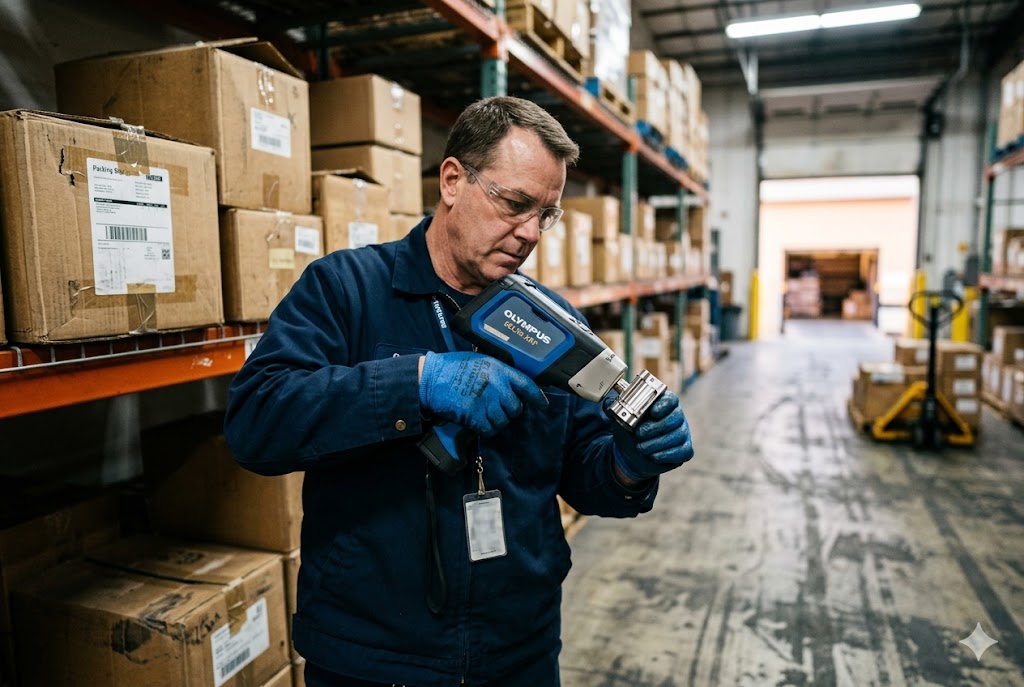
To independently test incoming wire EDM parts for RoHS-restricted substances, use X-ray fluorescence (XRF) screening 7 for rapid surface-level detection, and commission IEC 62321-series wet chemistry or chromatography testing from an accredited laboratory for confirmation of any suspect findings.
XRF as a Screening Tool
X-ray fluorescence is non-destructive and fast. A handheld XRF gun can screen a part in under 60 seconds. It detects lead, cadmium, mercury, chromium, and bromine compounds at the surface level.
XRF is a screening tool, not a definitive test. It cannot distinguish hexavalent chromium (Cr-VI, restricted) from trivalent chromium (Cr-III, not restricted). For any chromium-bearing surface treatment — passivation, chromate conversion coating — you must follow up with a colorimetric wet chemistry test per IEC 62321-7-2 8 to confirm the valence state.
Applicable IEC 62321 Test Methods
| Restricted Substance | Recommended Test Method |
|---|---|
| Lead (Pb) | IEC 62321-5 (XRF), IEC 62321-4 (ICP-OES confirmation) |
| Cadmium (Cd) | IEC 62321-5 (XRF), IEC 62321-4 (ICP-OES confirmation) |
| Mercury (Hg) | IEC 62321-6 (CV-AAS or ICP-MS) |
| Hexavalent Chromium (Cr-VI) | IEC 62321-7-2 (colorimetric wet chemistry — required, not XRF) |
| PBB / PBDE | IEC 62321-6 (GC-MS) |
When to Commission Third-Party Testing
You do not need third-party testing on every lot. Apply it selectively:
- First production run from a new supplier
- Any lot where the supplier's material changed — new steel grade, new wire source, new plating shop
- Any lot where the DoC is missing, incomplete, or unsigned
- Random periodic audit of an established supplier, at least annually
Send samples to SGS 9, Bureau Veritas, or Intertek 10. Specify the IEC 62321 series you want run for each substance group. Turn-around is typically 5–10 business days for a full RoHS panel.
Tying Testing to Payment
The most effective enforcement mechanism is financial. Structure your payment terms so that:
- Final payment or holdback release requires receipt and internal verification of the part-level DoC
- Any lot flagged by incoming XRF screening triggers a hold on final payment pending third-party confirmation
- Confirmed non-conformance triggers a written corrective action request and cost recovery clause
This converts compliance from a paperwork formality into a production prerequisite. It is the single most effective change you can make to your supplier management process for RoHS.
Conclusion
RoHS compliance with a Chinese wire EDM supplier starts and ends with documentation. Put the requirements on the drawing and PO. Demand a part-level DoC. Tie payment to compliance. Test when the risk warrants it.
Footnotes
1. European Commission overview of the RoHS Directive and its hazardous substance restrictions. ↩︎
2. Explains how IEC 62474 enables standardized material declaration across electronics supply chains. ↩︎
3. Bureau Veritas accredited RoHS and REACH testing services for manufactured parts. ↩︎
4. Overview of the full IEC 62321 test method series by substance and analytical technique. ↩︎
5. Practical guide to China RoHS 2 compliance requirements, labeling, and substance thresholds. ↩︎
6. TÜV SÜD FAQ comparing China RoHS 2 standards to EU requirements in detail. ↩︎
7. Industry expert explanation of why handheld XRF is the preferred RoHS screening tool. ↩︎
8. Detailed breakdown of IEC 62321 parts including the Cr-VI colorimetric wet chemistry method. ↩︎
9. SGS guidance on RoHS testing scope and third-party substance verification services. ↩︎
10. Intertek RoHS testing services for restricted substance verification and compliance reports. ↩︎