Skip to main content Skip to footer
We have rejected entire shipments of Swiss-turned parts that looked perfect on the outside — only to find they failed cleanliness extraction tests. Buyers rarely know what to specify, and suppliers rarely volunteer the information.
Cleanliness requirements for Swiss CNC parts in hydraulic or medical applications must be defined using particle count limits (ISO 16232:2018 or ISO 13485 Section 7.5), documented cleaning processes, and sealed barrier packaging — combined with per-lot extraction test reports before shipment release.
The sections below break this down by standard, cleaning method, test report, and packaging — so you can write a spec that actually holds up.
What Cleanliness Standard (ISO 4406, NAS 1638) Applies to Precision Hydraulic Swiss-Turned Components?
Many buyers assume ISO 4406 covers component cleanliness. It does not — and mixing these standards up leads to incomplete purchase orders that suppliers cannot fulfill correctly.
For precision hydraulic Swiss-turned components, the correct standard is ISO 16232:2018 (or VDA 19.1), which uses the Component Cleanliness Code (CCC) to define maximum allowable particle counts by size class, normalized per part, per 1,000 cm² of surface area, or per 100 cm³ of volume.
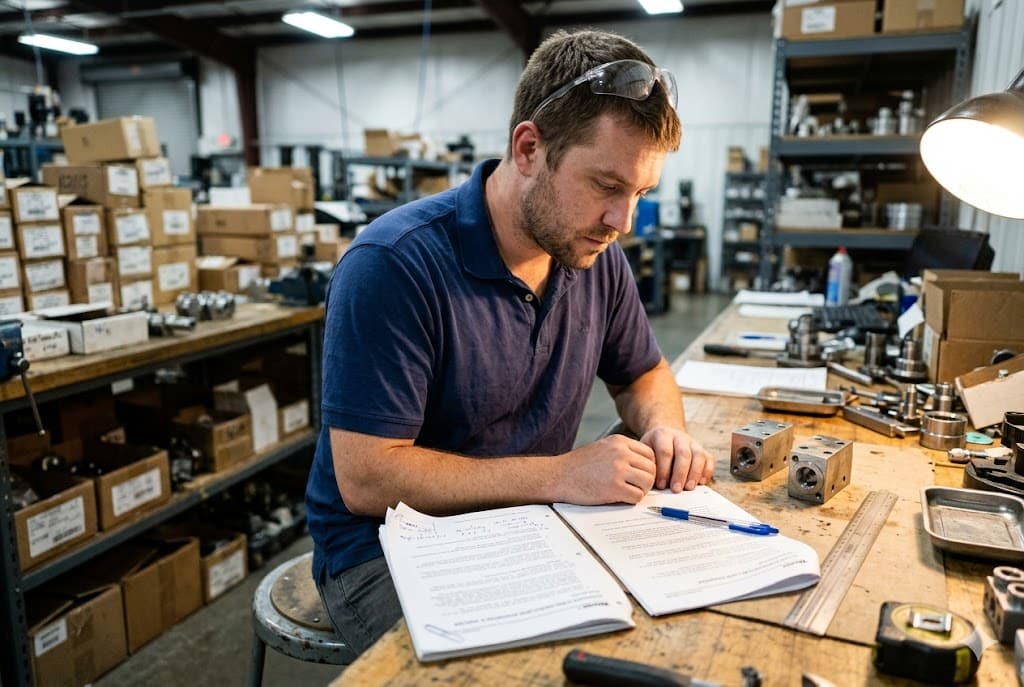
ISO 4406 vs. ISO 16232: Understanding the Difference
ISO 4406 1 is a fluid cleanliness code. It measures particulate contamination in hydraulic fluid — not in the component itself. NAS 1638 2 is similar: it classifies fluid cleanliness in aerospace hydraulic systems. Neither standard was designed to define or test the cleanliness of a machined part before assembly.
ISO 16232:2018 3 (aligned with VDA 19.1) 4 was written specifically for component cleanliness. It defines:
- Which particle sizes to measure (typically 25 µm, 50 µm, 100 µm, 200 µm, and 600 µm thresholds)
- How to extract particles from the part (pressure rinse, ultrasonic bath, or air blowoff)
- How to normalize results (per part, per surface area, or per volume)
- How to report findings using the CCC format
This matters because a hydraulic valve body and a hydraulic fitting have very different surface areas. Reporting raw particle counts without normalization makes cross-part and cross-supplier comparison meaningless.
The 2007 vs. 2018 Revision Problem
There is a complication many buyers do not anticipate. Some OEM specifications — especially older tier-1 automotive and industrial hydraulics specs — still reference ISO 16232:2007. The 2007 and 2018 coding schemes are not directly compatible. If your customer's drawing calls out a CCC level based on the 2007 edition, and your Chinese supplier tests to the 2018 edition, the results are not directly comparable.
Always confirm which revision of ISO 16232 applies to your end-use specification. State the revision explicitly on the quality plan or purchase order.
Cleanliness Limit Table for Common Hydraulic Applications
| Application | Typical CCC Target | Key Particle Threshold | Normalization Basis |
|---|---|---|---|
| Industrial hydraulic valve | CCC 100/15 or tighter | 100 µm | Per part |
| Mobile hydraulics (construction) | CCC 200/15 | 200 µm | Per 1,000 cm² |
| High-pressure fuel injection | CCC 50/5 | 50 µm | Per part |
| Precision servo valve | CCC 25/5 or tighter | 25 µm | Per part |
If your end customer has not specified a CCC limit, ask them. "Clean" without a number is not a requirement — it is a disagreement waiting to happen at incoming inspection.
How Do Chinese Factories Wash and Package Parts to Meet Medical Device Cleanliness Requirements?
Most factories that machine medical parts use the same wash line as their industrial parts — unless you specify otherwise. That gap between assumption and reality is where contamination failures originate.
Under ISO 13485 5 Section 7.5, medical part cleanliness must be defined as a written specification whenever cutting fluids or coolants are used during machining. Cleaning processes must be formally verified or validated. Chinese factories must document the cleaning chemistry, method, and cycle parameters — supplier assertion alone is a nonconformance.
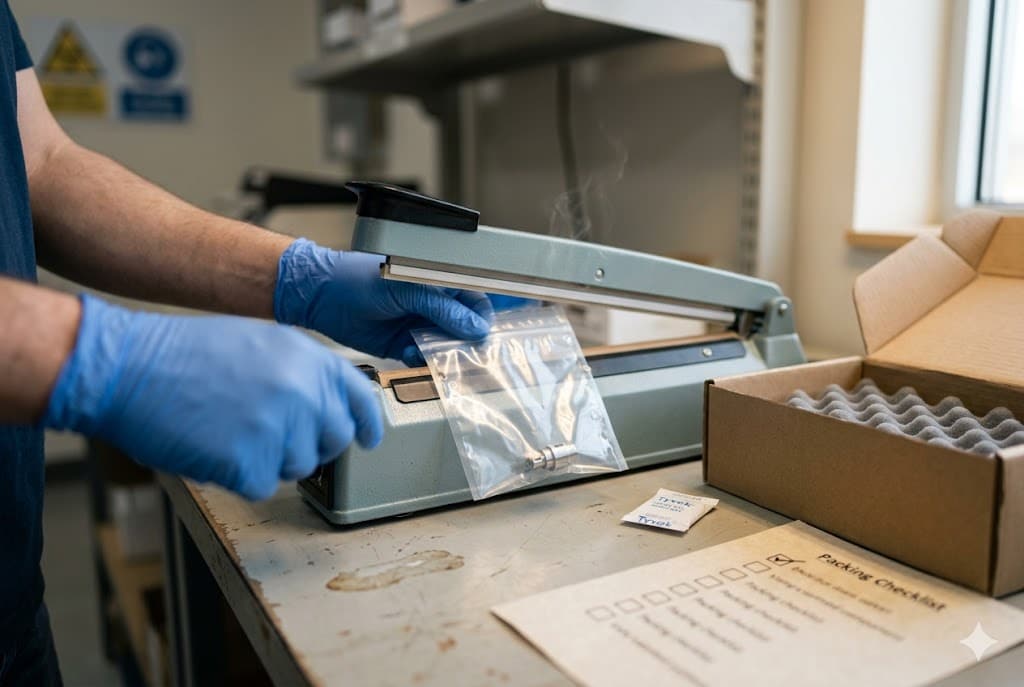
What ISO 13485 Section 7.5 Actually Requires
ISO 13485 does not leave cleanliness to supplier judgment. Section 7.5 states that when process agents must be removed, cleanliness must be specified and the removal process must be verified. This creates three mandatory elements for any compliant supplier:
- A written cleanliness specification (particle size limits, chemical residue limits, or both)
- A defined and documented cleaning process (method, chemistry, temperature, time, agitation)
- Verification or validation records showing the process achieves the specification
"Clean enough" is not a valid response from a supplier under ISO 13485. If your supplier cannot produce a cleaning process record and a validation summary on request, that is a documented nonconformance — not a minor gap.
Ultrasonic Cleaning for Swiss-Turned Medical Parts
Swiss-turned medical parts often include cross-holes, blind bores, and internal fluid passages — features that trap cutting fluid and chips. Conventional spray washing cannot reliably reach these internal geometries.
Our QC team specifies ultrasonic cleaning 6 for any part with an internal passage smaller than 3 mm in diameter. Ultrasonic agitation propagates cleaning energy into cavities that spray jets cannot access. The key parameters to specify are:
- Ultrasonic frequency (typically 25–40 kHz for metal parts)
- Bath chemistry (must be disclosed and approved)
- Immersion time and temperature
- Number of rinse stages
- Drying method (compressed air or oven drying — avoid cloth wiping, which recontaminates)
Biocompatibility of Cleaning Chemistry
This is the most commonly overlooked risk in medical part washing. ISO 10993-5 7 governs cytotoxicity limits for materials in contact with human tissue or fluids. If a cleaning agent leaves a residue on the part surface after drying, that residue must be evaluated against ISO 10993-5 limits.
Cutting fluid residue that survives the final wash cycle is a biocompatibility risk — not a cosmetic one. Require your supplier to disclose every chemical used in machining and cleaning, and verify that residues from those chemicals are compatible with ISO 10993-5 before approving the process.
Medical Part Cleaning Process Requirements
| Process Step | Minimum Requirement | Documentation Required |
|---|---|---|
| Pre-wash (bulk chip removal) | Solvent or aqueous bath | Process record |
| Ultrasonic cleaning | 25–40 kHz, disclosed chemistry | Validated cycle parameters |
| Rinse stages | Minimum 2× DI water rinse | Water quality record |
| Drying | Oven or clean compressed air — no wiping | Operator instruction |
| Post-clean inspection | Visual + particle extraction sample | Inspection record |
| Packaging | Sealed barrier bag in cleanroom area | Packaging specification |
Can a Factory Provide a Cleanliness Test Report for Parts Destined for Hydraulic or Sterile Applications?
Yes — but only if you specify the extraction method in your purchase order. Without a fixed test method, the report you receive will reflect whichever technique generates the most favorable result for the supplier.
A factory can provide cleanliness test reports for hydraulic or sterile parts per ISO 16232:2018 extraction methods (pressure rinse, ultrasonic extraction, or air blowoff). The extraction method must be contractually specified — the same part will yield dramatically different particle counts depending on which technique is used.

Why the Extraction Method Matters More Than the Limit
ISO 16232 permits three primary extraction techniques. Each generates a different particle count from the same physical part:
- Pressure rinsing: High-pressure fluid jet directed at the part surface. Effective for external surfaces, less effective for internal passages.
- Ultrasonic extraction: Part immersed in bath, ultrasonic energy dislodges particles from all surfaces including internal features. Most aggressive method — yields highest particle counts.
- Air blowoff: Compressed air over external surfaces only. Least aggressive — typically yields the lowest particle counts.
If your quality plan states only "test per ISO 16232" without specifying the extraction method, a supplier will select the method that generates the lowest count — which may not reflect the contamination level your application actually needs to control. Our engineering team always specifies the extraction method explicitly on the quality plan. For valve bodies and instrument components with internal passages, we require ultrasonic extraction as the contractually fixed method.
What a Valid Cleanliness Test Report Contains
A compliant ISO 16232 cleanliness test report should include all of the following elements:
| Report Element | What to Check |
|---|---|
| Part number and revision | Matches your drawing |
| Lot or batch reference | Traceable to production records |
| Extraction method used | Matches your specified method |
| Extraction fluid and volume | Disclosed and consistent across lots |
| Filter membrane pore size | Typically 0.8 µm or per spec |
| Particle count by size class | Results for each threshold (25, 50, 100, 200, 600 µm) |
| Normalization basis | Per part, per 1,000 cm², or per 100 cm³ |
| Pass/Fail vs. CCC limit | Explicit statement against your specified limit |
| Lab reference or technician | Name or lab ID for traceability |
If any of these elements are missing, the report is incomplete. Do not accept a one-line statement that "parts meet cleanliness requirements" as a test report.
Tying the Test Report to Payment
The most effective enforcement mechanism is a cleanliness hold point within your payment milestone structure. Require extraction particle analysis on a defined sample from each production lot, with documented results submitted and approved before the shipment release payment tranche is triggered. This converts cleanliness from a one-time PPAP event into an ongoing per-lot production control with a financial consequence for non-compliance — the only consequence that reliably changes supplier behavior at scale.
What Packaging and Sealing Method Prevents Contamination of Clean Parts During Shipping from China?
Parts that pass cleanliness testing at the factory can fail incoming inspection at your facility — if packaging is treated as an afterthought. Recontamination between final wash and shipment is the most common failure mode that passes all in-process inspection.
To prevent recontamination during shipping from China, specify individual heat-sealed barrier poly bags applied immediately after cleaning, before parts are handled or exposed to ambient air. For ferrous alloys, include a desiccant. For medical applications, use cleanroom-compatible packaging material and seal in a classified environment.
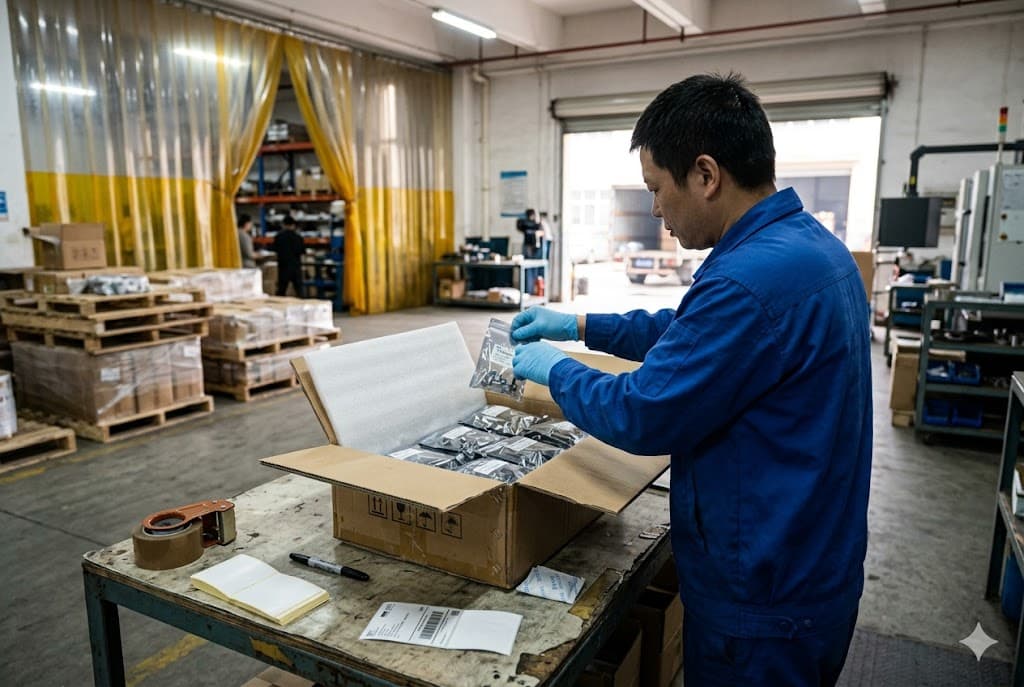
Packaging Is a Cleanliness Control Step
Most factories treat packaging as a logistics function — something done in a general warehouse after parts come off the wash line. That gap is the problem. Packaging must be treated as the final cleanliness control step, performed immediately after drying and before any further handling.
The required sequence is:
- Ultrasonic wash → rinse → dry
- Immediate transfer to packaging area (no intermediate storage in open bins)
- Individual part placed directly into barrier bag
- Bag heat-sealed
- Outer carton packed and labeled
If parts are washed in the morning and packaged in the afternoon, the morning's cleaning effort is partially wasted. Airborne particles, operator handling, and ambient humidity all recontaminate parts during open-air dwell time. Our team writes this sequence into the packaging specification on every medical and hydraulic order — not as a suggestion, but as an auditable process step.
Barrier Packaging Requirements by Application
| Application | Bag Material | Seal Type | Desiccant Required | Environment |
|---|---|---|---|---|
| Hydraulic (non-sterile) | Clear LDPE poly bag | Heat-sealed | For ferrous alloys | Standard clean area |
| Medical device (non-sterile) | Cleanroom-compatible LDPE or Tyvek | Heat-sealed | Application-dependent | ISO Class 7 or 8 area |
| Sterile medical (final packaging) | Validated sterile barrier per ISO 11607 8 | Validated seal | No (sterile environment) | ISO Class 5 or better |
| High-humidity shipping route | Moisture barrier bag (MBB) with foil layer | Heat-sealed | Required | Standard |
For standard hydraulic parts, the minimum specification is: individual heat-sealed clear poly bag, applied immediately after drying, with a desiccant sachet for any ferrous alloy part. This prevents both particulate recontamination and rust formation during ocean freight — which typically takes 20–35 days from China to US East Coast ports.
Surface Finish and Cleanability
Surface finish on fluid-contact surfaces directly affects how well parts can be cleaned and how long they stay clean. Ra values 9 below 0.8 µm reduce contamination adhesion and are achievable on Swiss-turned stainless steel using CBN or diamond tooling.
When specifying surface finish, always include the measurement cutoff length per ISO 1302 or ASME Y14.36M. A bare Ra callout without a cutoff length is ambiguous — suppliers will default to the easiest interpretation, which may allow a rougher surface that traps more contamination.
Chemical and Ionic Cleanliness: The Hidden Risk
Particle counting catches visible contamination. It does not catch ionic or organic residue from cutting fluids, rust inhibitors, and cleaning chemistry. For medical and sensitive hydraulic applications, both types of contamination matter:
- Ionic contamination: Detected by ion chromatography 10 or ROSE (Resistivity of Solvent Extract) testing. Chlorinated or sulfurized extreme-pressure cutting oil additives can leave halogen-bearing residues that are invisible to particle count testing but will fail RoHS or biocompatibility screening.
- Organic residue: Detected by XRF or gravimetric extraction. Cutting fluid film that survives washing adds organic mass that can outgas, corrode sealing surfaces, or create biological risk in medical applications.
Require your supplier to disclose all cutting fluids used at the Swiss machine as a purchase order condition. Chlorinated EP additives are a red flag for medical parts and should be replaced with ester-based or synthetic alternatives before machining begins.
Conclusion
Cleanliness for Swiss CNC parts in hydraulic or medical applications is a system — not a single test. Define the standard, fix the extraction method, validate the cleaning process, and seal parts immediately after washing. Then tie test report approval to your payment release. That sequence closes every gap.
Footnotes
1. Full guide to ISO 4406 hydraulic fluid cleanliness codes and how to interpret particle count data. ↩︎
2. History and explanation of NAS 1638, the aerospace hydraulic fluid contamination classification standard. ↩︎
3. Official ISO page for ISO 16232:2018, the component cleanliness standard for road vehicles and hydraulic parts. ↩︎
4. Comparison of VDA 19.1 and ISO 16232 for technical cleanliness inspection in automotive manufacturing. ↩︎
5. Comprehensive guide to ISO 13485 QMS requirements for medical device manufacturers, including cleanliness obligations. ↩︎
6. Frequency selection guide for ultrasonic cleaning of precision metal and delicate components. ↩︎
7. Practical overview of ISO 10993-5 cytotoxicity testing and biocompatibility requirements for medical devices. ↩︎
8. Explanation of ISO 11607 sterile barrier packaging requirements for terminally sterilized medical devices. ↩︎
9. CNC machining surface roughness guide covering Ra measurement, standards, and application-based finish selection. ↩︎
10. Overview of ion chromatography analysis for detecting ionic contamination on precision components and assemblies. ↩︎